


















Tucked away in the desert landscapes of Nagaur district in Rajasthan lies Manjhwas, a village where deeply entrenched spiritual reverence walks hand in hand with rigorous community reform. In a departure from typical religious sanctuaries dedicated to conventional deities, the focal point of community worship here is Phulan Bai, who lived centuries ago and is revered under a 300-year-old Khejri tree. Villagers honor her as an exalted folk deity and hold profound trust in her legacy. Parallel to this spiritual devotion runs an equally remarkable civil commitment: since the independence of the country, not a single licensed or unlicensed liquor shop has ever been permitted to operate across the village and its nearby settlements.
Architectural Splendor and the 91-Foot Central Dome
The shrine erected in memory of Phulan Bai in Manjhwas serves as an architectural highlight as much as a spiritual anchor. The sanctum features a towering central dome that reaches approximately 91 feet into the sky from the ground level. Craftsmen designed the monument with intricate decorative details that capture the attention of pilgrims and travelers alike.
Encircling the structure are ornate stone balconies known as jharokhas, housing 56 finely carved white marble statues representing diverse sacred figures. Matching this layout, artisans constructed 56 miniature domes directly overhead each corresponding idol. To facilitate smooth movement during major gatherings, the layout incorporates five independent pathways for entering and exiting the complex. The structural harmony and meticulous scale make the monument an enduring landmark of regional stonecraft.
The Living 300-Year-Old Khejri Tree and Sacred Relics
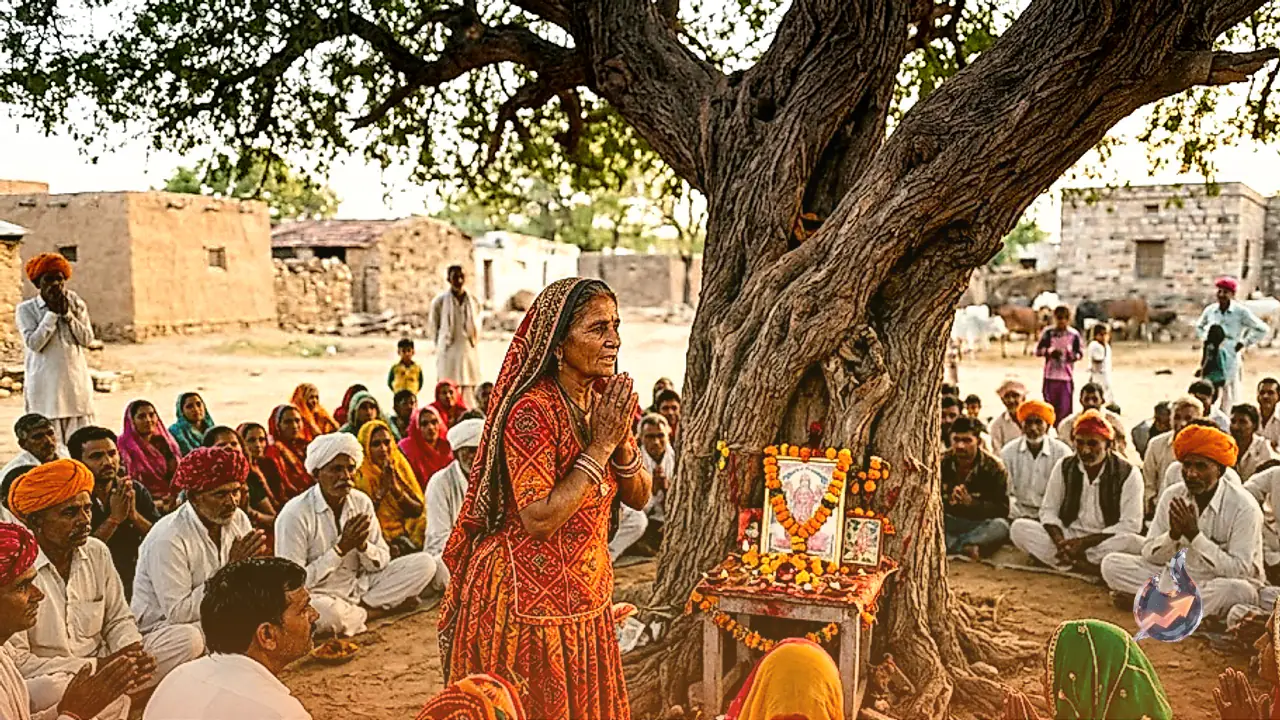
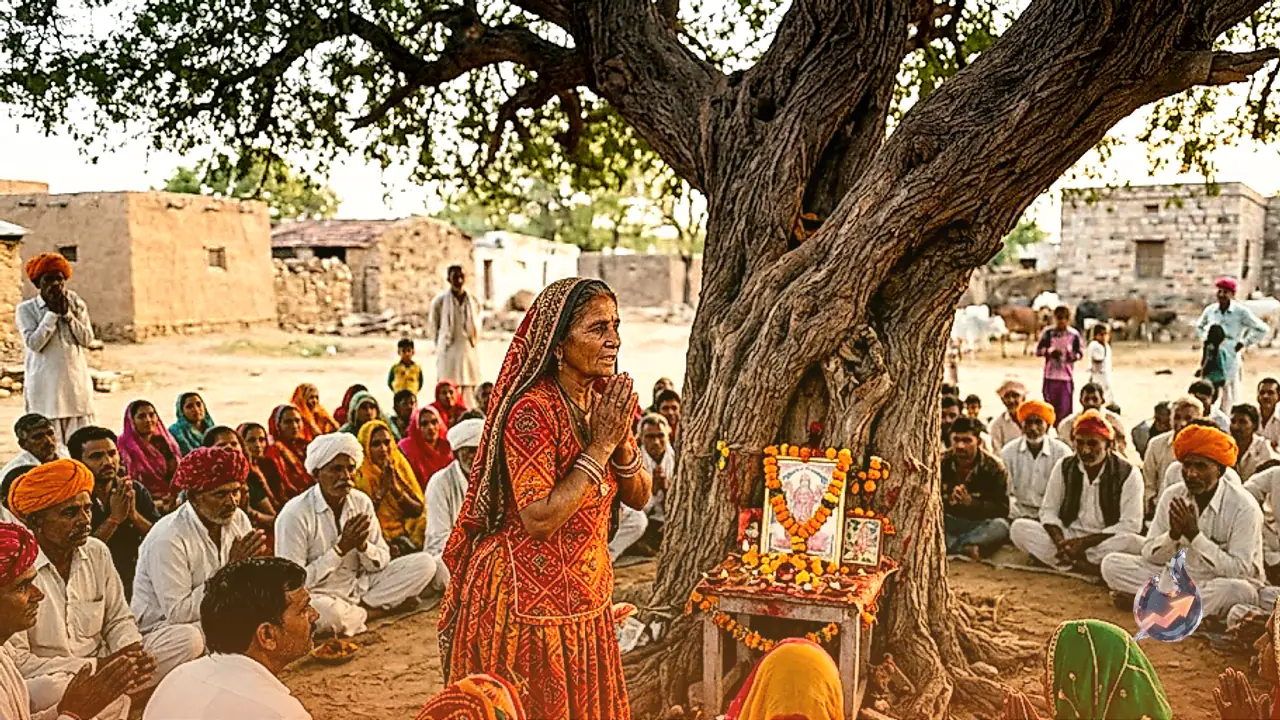
The primary historical anchor linking the modern village to its patron deity remains the ancient Khejri tree, whose roots run back roughly 300 years. Local heritage accounts preserve the story of Phulan Bai spending her daily hours beneath this canopy, shaping dried cow-dung cakes and carrying out household chores with deep mindfulness. Over the centuries, devotees built a stone platform beneath the branches, which continues to serve as an active site of veneration.
Pilgrims visiting the precinct consistently perform ritual circumambulations around this ancient tree and its platform. Alongside the main temple halls, a designated sanctuary specifically commemorating Phulan Bai sits near the Khejri tree. Even amid the grandeur of modern stone construction, this living botanical landmark remains the purest touchpoint for the villagers' historical memory and emotional devotion.
A Life of Celibacy, Ramanandi Devotion, and the Historic Sitar
According to village tradition, Phulan Bai embraced a lifelong vow of celibacy and dedicated her days entirely to devotion towards Lord Rama. She expressed her spirituality through music, strumming melodic notes on a stringed sitar and singing devotional hymns throughout her life. In a rare act of preservation, her personal sitar has been sheltered carefully down the generations and remains safely kept within the sacred complex as tangible evidence of her musical worship.
Reflecting an intimate social bond, the temple premises also encompass a dedicated station honouring Phulan Bai's brother. The residents of the village still look upon her not merely as an abstract divine figure, but as an affectionate ancestor and protector of their households. Devotees visit these quiet commemorative alcoves to draw inspiration from her disciplined asceticism and spiritual fortitude.
Manjhu Clan Heritage and the Annual Convention
The settlement of Manjhwas derives its historic identity from the Manjhu clan, which constitutes a core component of the village population of roughly 300 families. Members of this community regard Phulan Bai as both an ancestral guardian and an immortal folk deity. Her annual death anniversary serves as the catalyst for an extensive religious convention held within the village boundaries.
This gathering draws clan members and pilgrims not just from neighboring areas of Rajasthan, but from diverse states across India. The convention transcends conventional theological discourses, doubling as an open platform where attendees reaffirm practical community pledges regarding environmental conservation, protection of local wildlife, and strict avoidance of intoxicating substances.
The Clean Living Movement and Padma Shri Himmataram Bhambhu
The transformation of the annual gathering into an environmental and anti-intoxicant summit owes much of its impetus to Padma Shri recipient Himmataram Bhambhu. He initiated this organized convention, establishing an enduring framework that links faith to public wellness and ecological defense. This consciousness has rippled into adjoining habitations such as Jhadisara, Kanwalisar, Jhatera, Janjolai, and Jeewan Bera, reinforcing collective rejection of substance abuse.
Village residents take immense pride in their assertion that an alcohol outlet has never found ground in Manjhwas in post-independence history. Kailash Godara, the president of the Phulan Bai Temple Committee, highlighted that nobody is ever seen smoking or indulging in any form of intoxication within the temple vicinity. The local leadership and families maintain zero tolerance against alcohol sales, preserving Manjhwas as a singular emblem of folk piety, social sobriety, and responsible ecology.