























For agricultural communities across Rajasthan, stray cattle and wild animals have long posed a relentless threat to livelihood and food security. Months of hard labor and heavy financial investments in tilling, sowing, and fertilizing can be wiped out overnight when herds of feral livestock invade unfenced farmland. Farmers have historically spent freezing winter nights and sweltering summer evenings awake in open fields, armed with sticks to guard their produce. In Piprauwa village within Dholpur district, progressive grower Ramveer Singh faced this exact hardship for years. Repeated crop devastation by blue bulls and wandering cattle frequently prevented him from even recovering his basic input costs. Today, a durable fencing initiative backed by public funds has completely shielded his land and rewritten his economic prospects.
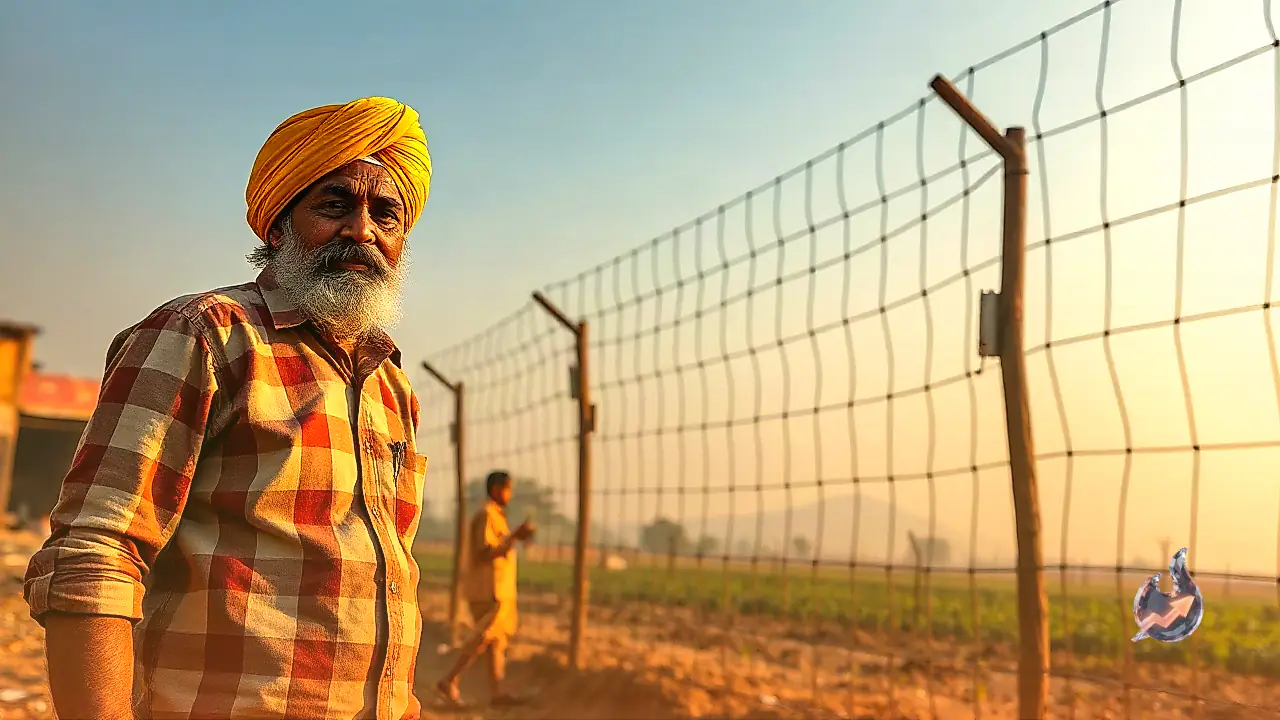
Piprauwa Farmland Secured with 400-Meter Boundary Barrier
Exhausted by constant yield losses and the endless cycle of night patrols, Ramveer Singh decided to seek a permanent remedy for the animal intrusion. He approached the local agriculture department and submitted a formal application under the state government's specialized fencing subsidy framework. Upon receiving official administrative sanction, he installed a rugged 400-meter barrier combining barbed wire and metal mesh around the entire periphery of his agricultural plot. The impenetrable enclosure completely blocked external entry points for marauding herds. With wild animals unable to breach the perimeter, his crops have flourished without disruption throughout the growing season.
Agriculture Department Disburses 40,000 Rupee Financial Grant
Erecting sturdy wire fencing across hundreds of running meters demands substantial capital expenditure that an ordinary cultivator struggles to muster independently. Under the prescribed financial guidelines, Ramveer Singh received an outright subsidy grant of 40,000 rupees from the agriculture department, which covered a significant share of the total installation bill. Reflecting on the impact, Ramveer Singh explained that preventing crop destruction has led to a remarkable surge in his farm output. Produce that was previously trampled or devoured now reaches the agricultural produce market intact, yielding a substantial expansion in his household earnings. His family now enjoys greater financial stability, and his operational success is encouraging fellow cultivators across neighboring villages to enroll in the department's rural welfare initiatives.
Core Objective of the State Field Protection Initiative
The state administration designed the fencing subsidy initiative to build long-term resilience among cultivators battling wildlife interference. By helping landowners encircle their cultivable plots with durable chain link or barbed wiring, the program aims to achieve total crop preservation against non-domesticated livestock. Protecting every acre from animal damage directly sustains farm incomes and boosts aggregate agricultural productivity across Rajasthan without imposing the complete capital burden on individual rural families.
Subsidy Breakdown Across Different Farmer Categories
The financial assistance framework is tiered according to landholding status and application mode, offering higher support percentages to resource-constrained and collaborative growers
- General Cultivators: Farmers in the general bracket receive a grant covering 50 percent of the total incurred cost or a maximum ceiling of 40,000 rupees, whichever figure is lower.
- Small and Marginal Holders: To extend additional economic cushioning to smaller operations, small and marginal landholders receive up to 60 percent of the total expenditure, capped at a maximum of 48,000 rupees.
- Community and Group Enrolment: Cultivators who band together and submit collective group applications are granted the highest subsidy rate of 70 percent, reaching up to 56,000 rupees in state assistance.
- Perimeter Length Cap: The government disbursement is strictly limited to a maximum fencing perimeter of 400 running meters per approved claim.
Mandatory Eligibility Criteria and Required Paperwork
To qualify for the subsidy, an individual applicant must possess a minimum agricultural land parcel of 0.5 hectares, roughly equivalent to 2 bighas. When multiple farmers unite to apply under the group category, their land parcels must be contiguous and physically situated in the same location. Importantly, applicants must refrain from erecting the boundary mesh prematurely; actual fencing construction must begin strictly after the agriculture department issues formal written approval. Required documentation includes the applicant's Aadhaar card, Jan Aadhaar card, an up-to-date land title revenue record (jamabandi), an official field cadastral map, and a copy of the active bank passbook.