



















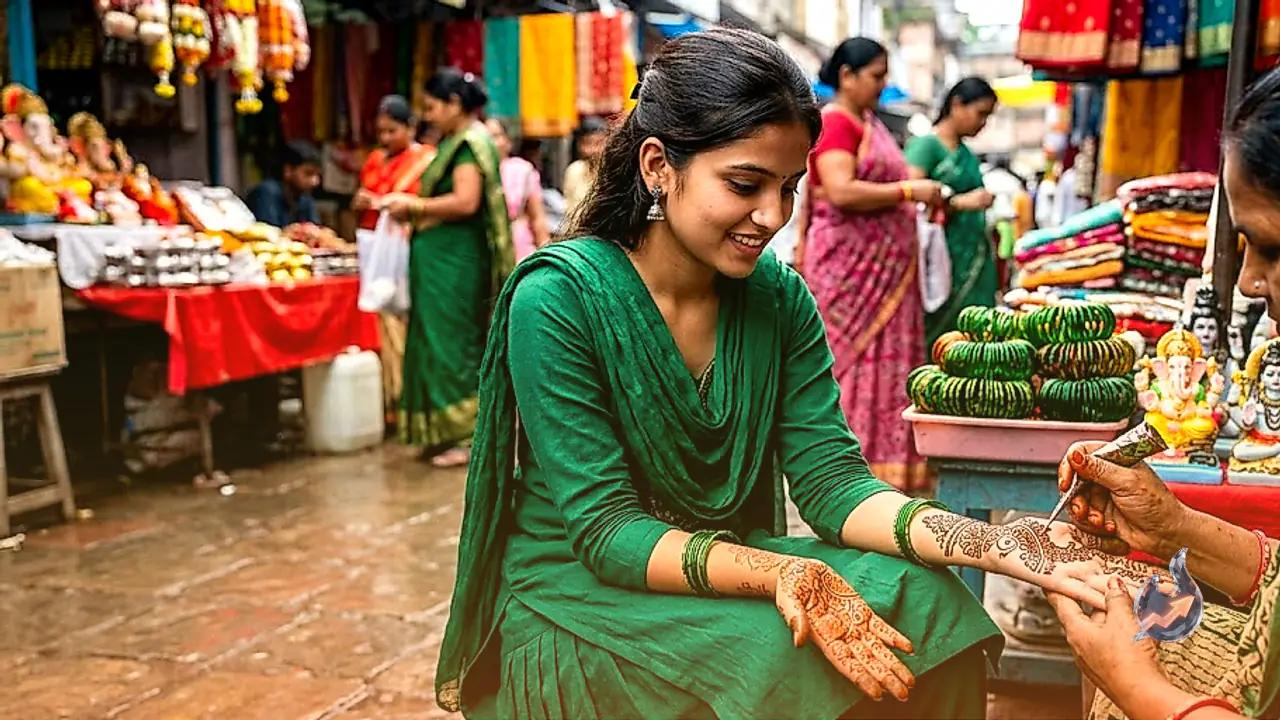

With the arrival of the holy month of Sawan, the surroundings transform into a vibrant landscape of lush greenery, intense devotion to Lord Shiva, and joyful festive celebrations. During this auspicious period, the rich green and red stains of henna adorning women's hands not only evoke a deep sense of festivity but also fill the atmosphere with sacred grace. In Indian tradition, applying mehendi during festivals like Teej and Sawan is an age-old custom. However, a common belief often persists that applying henna during Sawan is an exclusive privilege of married women. This widespread notion frequently leads to a recurring question among many people and young unmarried girls: Is applying mehendi during Sawan forbidden or inauspicious for unmarried women? A careful study of ancient sacred texts, astrological principles, and traditional Ayurvedic literature reveals the authentic spiritual and scientific truth behind this sacred tradition.
Scriptural Traditions and Mata Parvati's Sacred Penance
From a religious standpoint, the practice of applying henna during the month of Sawan is intimately linked with Lord Shiva and Goddess Parvati. Ancient Hindu scriptures, such as the Skanda Purana and the Shiva Purana, describe the rigorous penance undertaken by Goddess Parvati to obtain Lord Shiva as her divine husband. During her arduous spiritual devotion, Goddess Parvati applied pastes made from natural herbs and fresh henna leaves to enhance her beauty, elevate her spiritual energy, and please Lord Shiva.
Throughout sacred scriptures, henna is venerated not merely as a cosmetic adornment, but as a supreme symbol of purity, auspiciousness, and good fortune. Crucially, nowhere in the authentic scriptural texts is there any restriction prohibiting unmarried girls from applying henna during Sawan. On the contrary, scriptural tradition holds that when unmarried women adorn their hands with henna during Sawan with pure devotion and joy, they receive special blessings from Goddess Parvati. This sacred act is believed to create auspicious planetary alignments that help them find a suitable and desired life partner.
Astrological Insights: The Power of Mercury and Venus
From an astrological perspective, henna is directly associated with two prominent celestial bodies: Mercury and Venus. In Vedic astrology, Venus represents beauty, attraction, romantic love, artistic grace, and marital bliss. Meanwhile, Mercury governs intellect, skin health, communication, and mental calmness.
Experienced astrologers explain that when unmarried women apply henna during the sacred month of Sawan, it significantly strengthens the positions of Mercury and Venus in their birth charts. The favorable influence of these planets not only enhances a young woman's personal charm, grace, and confidence, but also helps resolve obstacles or delays in her marriage prospects. For this reason, astrological tradition considers the application of mehendi by unmarried women during Sawan to be exceptionally beneficial and auspicious.
Charaka Samhita and Ayurveda: Seasonal Wellness Benefits
Beyond religious and astrological values, applying henna during Sawan carries profound scientific and health benefits rooted in traditional Indian medicine. According to the classic treatise Charaka Samhita and traditional Ayurvedic texts, Sawan coincides with the peak of the monsoon season. This period is characterized by elevated atmospheric humidity and moisture, which frequently disrupts the natural balance of Pitta and Vata doshas in the human body.
Because natural henna possesses inherent cooling properties, applying it to the palms and feet draws out excess internal body heat and balances elevated Pitta. This cooling effect calms the nervous system, reduces mental stress, and alleviates mood swings. Furthermore, the damp conditions of the monsoon season heighten the risk of various skin infections. Henna contains natural antiseptic and antifungal properties that shield the skin against seasonal micro-organisms and atmospheric side-effects.
A Beneficial Custom for Both Married and Unmarried Women
These wellness and physiological benefits apply equally to both married and unmarried women. Therefore, it is entirely clear that applying henna during Sawan is by no means forbidden for unmarried girls. While married women observe this tradition as a symbol of unbroken marital bliss and the longevity of their husbands, unmarried women embrace it as a sacred practice for inviting positive energy, enhancing natural beauty, and attracting a compatible life partner. Girls and women can embrace this festive custom without hesitation and immerse themselves in the sacred celebrations of Shiva and Parvati.