























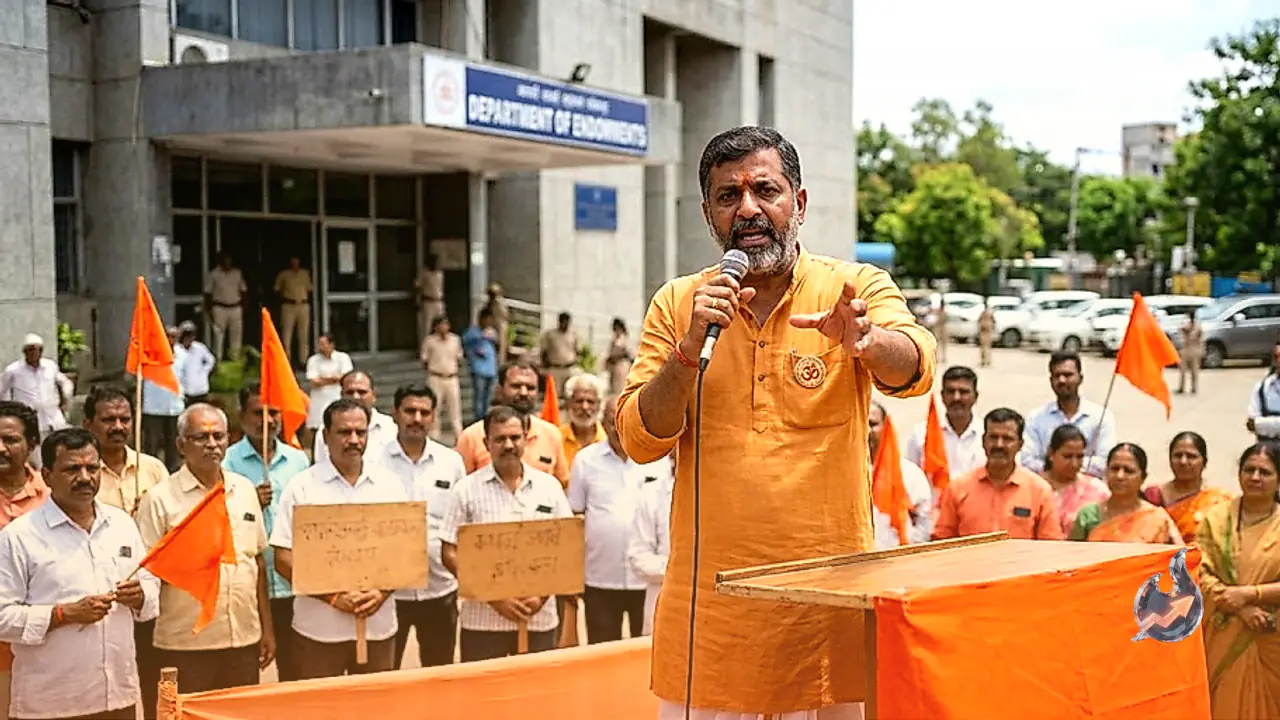

A comprehensive debate over the governance and management of religious places across India has resurfaced following a major announcement by Vishva Hindu Parishad. The organization has declared an intensified nationwide drive aimed at transferring the administrative authority of Hindu temples from state governments directly to the hands of devotees and representatives of the Hindu community. Speaking during a recent event in Mangaluru, Vishva Hindu Parishad President Alok Kumar emphasized that the campaign will seek systematic legislative changes across various states to end direct bureaucratic oversight of sacred shrines.
Mobilization Strategy and Outreaching Political Leaders
To translate this movement into concrete policy changes, Vishva Hindu Parishad is launching an extensive outreach strategy. Representatives plan to meet Chief Ministers, Governors, Members of Parliament, and Members of Legislative Assemblies throughout the country. During these high-level interactions, delegations will formally present memorandums advocating for the amendment or repeal of state laws that currently grant governments control over temple administration. This initiative builds upon a structured commitment made in February 2025, when the organization pledged to execute a phased movement titled Mandir Mukti Andolan. That broader roadmap incorporates public assemblies, legal resolutions, and direct political engagement across multiple regions.
Public Accountability and Financial Transparency Concerns
The escalation of this campaign comes at a time when public scrutiny regarding financial administration and transparency in prominent religious institutions has heightened. Recent public controversies, ranging from alleged theft of donations linked to the Ram Mandir in Ayodhya to historical disputes surrounding institutions like Vaishno Devi, have kept issues of trust and accountability at the forefront of national discussion. In the Ayodhya matter, the temple trust itself requested an official inquiry into the allegations. While subsequent investigative findings indicated that no major financial irregularity was proven, the episode nevertheless reignited broad public debate over how large religious donations should be managed and audited.
Core Arguments for Parity in Religious Governance
At the heart of the campaign lies the argument that state governments should maintain equal treatment across all faith traditions. Alok Kumar articulated this foundational perspective by pointing out that public authorities in India do not take over the direct administration of mosques, churches, gurdwaras, Jain institutions, or Buddhist monasteries. Consequently, the organization contends that keeping Hindu temples under state management reflects an unequal standard. According to Vishva Hindu Parishad, temple administration ought to be restored entirely to local devotees and governing bodies formed by the Hindu community.
The Proposed Four-Point Governance Framework
To address concerns regarding potential mismanagement if state control is removed, Vishva Hindu Parishad has outlined a specific four-point administrative framework designed for autonomous temple management
- Exclusive Use of Funds: All financial resources, offerings, and donations received by temples must be utilized strictly for religious, spiritual, and charitable causes associated with Hinduism.
- Financial Transparency: Financial accounts must be maintained with complete open transparency and subjected to mandatory, regular independent audits.
- Inclusive Representation: Governing committees must ensure meaningful representation for women as well as members of SC and ST communities to reflect broad social inclusivity.
- Protection of Staff Welfare: Priests, ritual performers, and temple administrative staff must continue to receive secure salaries, fixed allowances, and long-term service benefits.
Understanding State Control and HRCE Legislation
State administration over Hindu temples is currently operational across numerous regions in India, including states such as Tamil Nadu, Karnataka, Andhra Pradesh, Telangana, Kerala, and Odisha. In these territories, thousands of shrines function under specific statutory frameworks known as Hindu Religious and Charitable Endowments laws, commonly abbreviated as HRCE laws. These legislative measures grant state administrations wide-ranging statutory powers
- Authority to appoint, approve, or remove temple trustees under designated conditions.
- Mandatory oversight and auditing of financial accounts, public donations, and ritual offerings.
- Regulatory powers over the management, leasing, or sale of immovable temple properties and land assets.
- Direct administrative intervention during instances of financial disputes, procedural complaints, or operational mismanagement.
Proponents of HRCE laws argue that major temples manage vast land holdings, substantial monetary offerings, precious jewelry, and historical assets, making public regulatory oversight necessary to safeguard against financial impropriety. Conversely, critics contend that statutory intervention has evolved into heavy-handed bureaucratic interference, diluting the internal autonomy and traditional practices of sacred religious institutions.
Constitutional Framework: Article 26 and Judicial Rulings
From a legal perspective, the debate touches upon core constitutional rights guaranteed under Article 26 of the Constitution of India. This provision grants religious denominations the fundamental right to establish institutions and manage their own internal affairs in matters of religion. However, constitutional courts have consistently drawn a sharp distinction between core religious practices and the secular, financial, or administrative management of temple assets.
Through various landmark judgments, the Supreme Court has clarified that while essential religious rituals remain protected from state interference, secular aspects such as financial management, property handling, and administrative supervision can be validly regulated by the state to prevent corruption or mismanagement. Consequently, dissolving state control over temples is not an immediate or automatic constitutional outcome. Achieving autonomy requires state-level legislative amendments, which will inevitably be subject to detailed judicial review before constitutional courts.