






















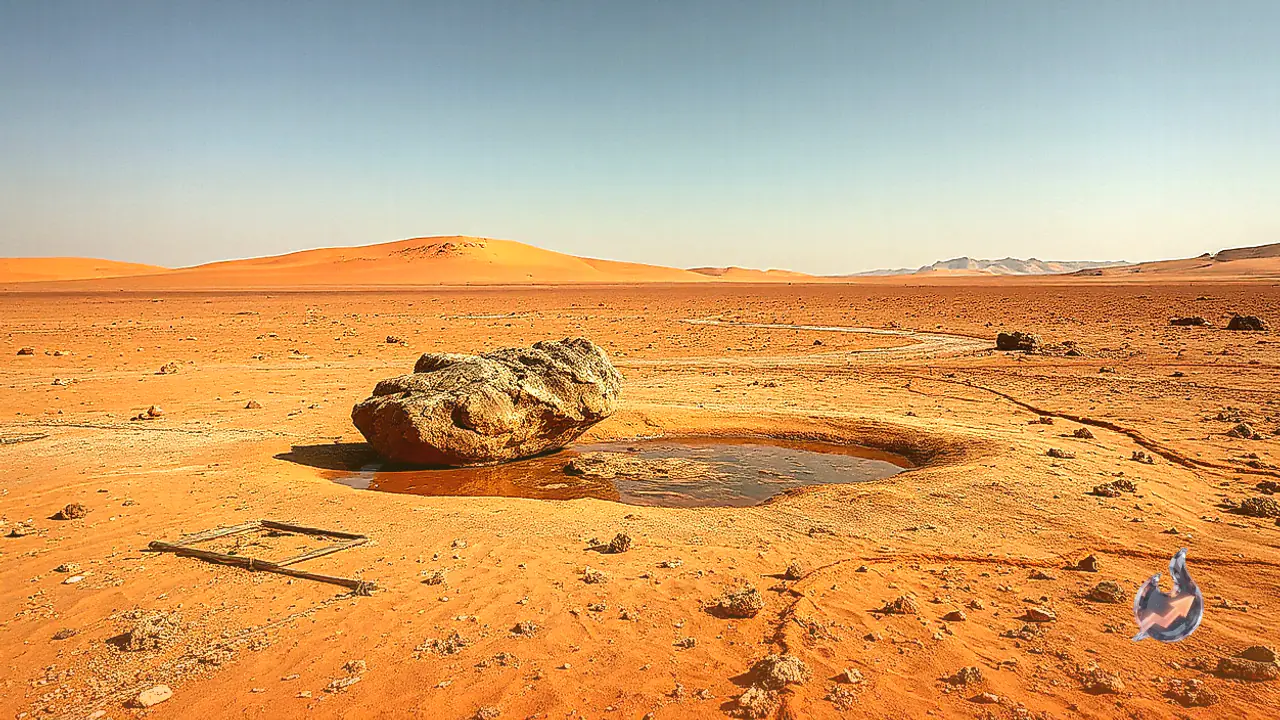

The Sahara Desert has long functioned as a vast terrestrial repository for natural archives tracing the origins of Earth and our wider solar system. Its dry sands preserve geological remnants spanning millennia, yielding everything from 40-million-year-old biological fossils to remnants of ancient planetary bodies. In 2019, researchers recovered a 4.5-billion-year-old fragment from the desert that recent studies trace to a lost protoplanet once roughly the size of the moon. Continuing this sequence of remarkable discoveries, a newly analyzed rock fragment dropped from space is offering scientists unprecedented access to the environmental dynamics of ancient Mars.
Teghaza 001: A Rare Window Into Crustal Composition
Identified as Teghaza 001, this space rock stands apart from typical Martian specimens recovered across our planet. While recovered Martian fragments provide valuable insights into the primary composition and structural geology of Mars, they rarely retain direct evidence detailing ancient environmental conditions on the Martian surface. However, a series of comprehensive studies published across the journals Science and Science Advances demonstrate that Teghaza 001 preserves a far more complex history. Beyond its sheer geological age, the rock retains distinct chemical traces of interactions between the Martian crust and an active ancient hydrosphere. Yang Liu of NASA’s Jet Propulsion Laboratory noted that one reviewer described the specimen as a Rosetta Stone for understanding Mars.
Apatite Minerals and Dual Hydrogen Signatures
The critical evidence lies within microscopic crystals of the mineral apatite embedded throughout the specimen. Laboratory assessments revealed that these apatite crystals capture signatures from two separate reservoirs of hydrogen: one originating directly from deep within the Martian interior, and another linked specifically to its ancient surface hydrosphere. Consequently, the rock proves that mineral components underwent alteration within an aqueous, water-rich environment. While prior space missions have established strong indications that liquid water once flowed across the Martian surface, major questions persist regarding whether that wet climate fostered microscopic biological life, as well as the exact mechanisms that turned a once-hospitable world into a barren desert.
Magmatic Activity and Volatile Exchange in Early Mars History
Structural evaluations indicate that a dynamic exchange occurred between deep magmatic sources inside Mars and its water-covered exterior. Because the meteorite dates back to roughly 500 million years following the birth of Mars and our solar system, this active volatile interchange took place during the planet's very earliest evolution. Lee Saper, another NASA scientist who worked on the investigation, highlighted that this represents the first sample of Martian crust collected from an entirely unsampled territory of Mars. According to Saper, the rock preserves the direct chemical dialogue between surface water and crustal rock, while potentially capturing an environmental imprint of the planet's atmosphere right as it began shedding its water reserves.
Planetary Transformation and Future Space Exploration
Modern Mars remains a frigid, desolate wasteland, yet substantial physical evidence collected by orbiters and robotic landers indicates a planet once dominated by active rivers, lake systems, and substantial reservoirs of surface liquid. Unlocking how that colossal planetary transition unfolded over billions of years continues to be a central objective guiding interplanetary rovers, exploratory probes, and conceptual crewed expeditions. Even as advanced exploration infrastructure expands outward into deep space, extraordinary geological flukes on Earth like Teghaza 001 demonstrate that crucial answers to planetary mysteries can sometimes land directly on our own doorstep.