





















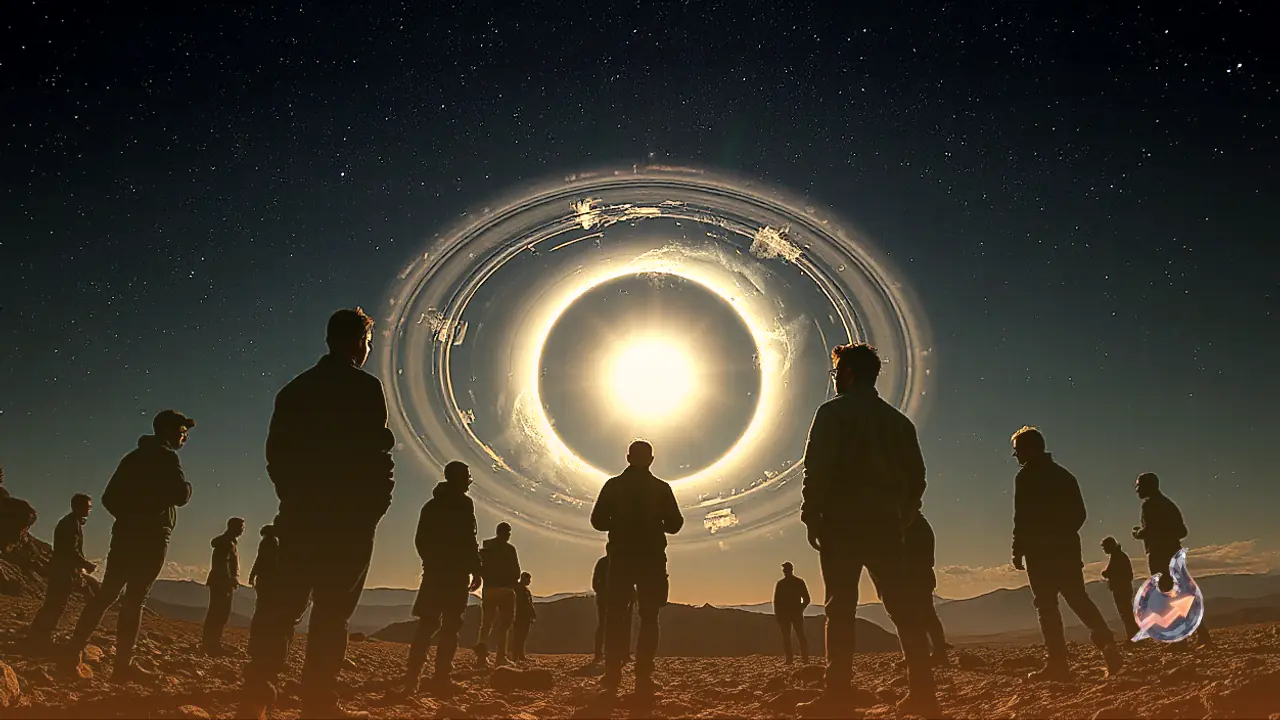

A distant dying star has offered astronomers a direct look into the potential fate that awaits our own planetary neighborhood billions of years from now. Fresh observations gathered through the Very Large Telescope of the European Southern Observatory have uncovered an unusual debris disk encircling the white dwarf cataloged as J1328−1450. Rather than a uniform cloud of matter, the structure consists of two distinct gas rings separated by a visible clear divide.
Remnants of an Obliterated Planetary System
Situated roughly 1,600 light-years away from Earth, the white dwarf was previously mapped in astronomical sky surveys, yet its surrounding architecture remained hidden until now. The debris encircling the stellar core is considered the wreckage of a planetary system that once circled the star during its active life. When the host star exhausted its primary fuel reserves, it swelled into an expansive red giant, tearing apart or consuming nearby worlds while subjecting distant rocky bodies to severe radiation and tidal forces. As the outer layers dissipated and left behind a dense white dwarf, the pulverised material settled into a flattened ring system of dust and gas.
A Blueprint for the Sun in 5 Billion Years
The evolutionary trajectory witnessed in this distant system mirrors the path awaiting our own solar system. In approximately 5 billion years, the sun will deplete its nuclear hydrogen supply and expand into an immense red giant. During that expansion phase, it is expected to swallow its nearest planetary companions. After shedding its outer envelope, only a compact white dwarf will remain at the centre of our system. Any surviving rocky fragments that endure the transition could gradually shatter, coalescing into an orbiting debris field around the dead sun just like the pattern currently visible at J1328−1450.
Unseen Planetary Survivors Shaping the Gas Gap
The dual-ring architecture of the debris field suggests that hidden objects may be sculpting the surrounding gas from within. Scientific measurements indicate that at least two planetary fragments may have made it through the violent stellar transformation, persisting amidst the cosmic rubble. Although instruments have not yet directly photographed these bodies, their gravitational presence offers the most consistent explanation for the gap carving the two rings apart.
These two postulated survivors appear to differ dramatically in physical scale. The fragment traveling closest to the white dwarf likely spans only a few kilometers across, whereas the more distant survivor could match Pluto or even Earth's moon in overall size. Their continuous gravitational interaction with surrounding dust would sustain the double-ring formation, though independent confirmation of their distinct status remains pending. Another working scenario suggests the concentric gas zones could have formed from different structural layers of a single destroyed world, such as its crust and metallic core breaking apart separately.