






















In his 1963 collection of sermons titled Strength to Love, civil rights leader Martin Luther King Jr. famously noted that forgiveness is not an occasional act, but a permanent attitude. While King urged love toward those responsible for racial segregation and violent oppression against Black Americans, his framework never condoned systemic harms. While King drew his perspective from Christian theology, modern academic psychology is increasingly examining whether forgiveness serves as a helpful or counterproductive mechanism when addressing broad societal grievances like racism. Historically, psychological research centered on interpersonal conflicts between friends or relatives, but recent efforts focus on intergroup offenses. Even individual conflicts between citizens take place within an inescapable societal reality shaped by racial dynamics. Consequently, for individuals from racially marginalized communities, deciding whether to forgive involves balancing personal mental wellness against historical legacies and ongoing social structures.
Societal Pressures and Public Forgiveness
Social psychologist Michael Perez of Wesleyan University emphasizes that forgiveness must be evaluated within its surrounding social conditions, particularly regarding racial dynamics. When structural justice remains unrealized, demanding forgiveness carries significant social risks. In October 2018, during a high-profile Dallas court trial, Brandt Jean embraced Amber Guyger, the off-duty white police officer convicted of fatally shooting his older brother Botham Jean inside his own apartment. The emotional scene captured widespread media attention, overshadowing the gravity of the murder conviction.
Perez, who was studying psychology at Texas A&M University at the time, observed troubling parallels to the public reaction following the 2015 racially motivated murder of nine Black congregants at Mother Emanuel AME Church in Charleston. He noted that when acts of public forgiveness become the central media focus, the systemic racial components of the crime fade into the background. Historian and journalist Stacey Patton wrote in the Washington Post that societal platforms often acknowledge Black pain only after forgiveness is extended to white perpetrators. She argued that celebrating compassion from traumatized families delegitimizes righteous anger and enables public denial about the ongoing damage caused by racial violence. When redeeming perpetrators is prioritized over demanding accountability, genuine truth and reconciliation become unattainable.
Communication scholar Daniel Morris documented how news reporters routinely ask surviving family members of police brutality victims whether they intend to forgive perpetrators. Scholars Andre Johnson and Earle Fischer noted that the wider public often expects a rapid, non-threatening rhetoric of forgiveness to soothe collective societal discomfort. Perez warns that this constant expectation creates forced forgiveness, burdening marginalized groups and perpetuating a false narrative of a colorblind society that avoids dismantling systemic injustice.
Psychological Coping and Mental Health
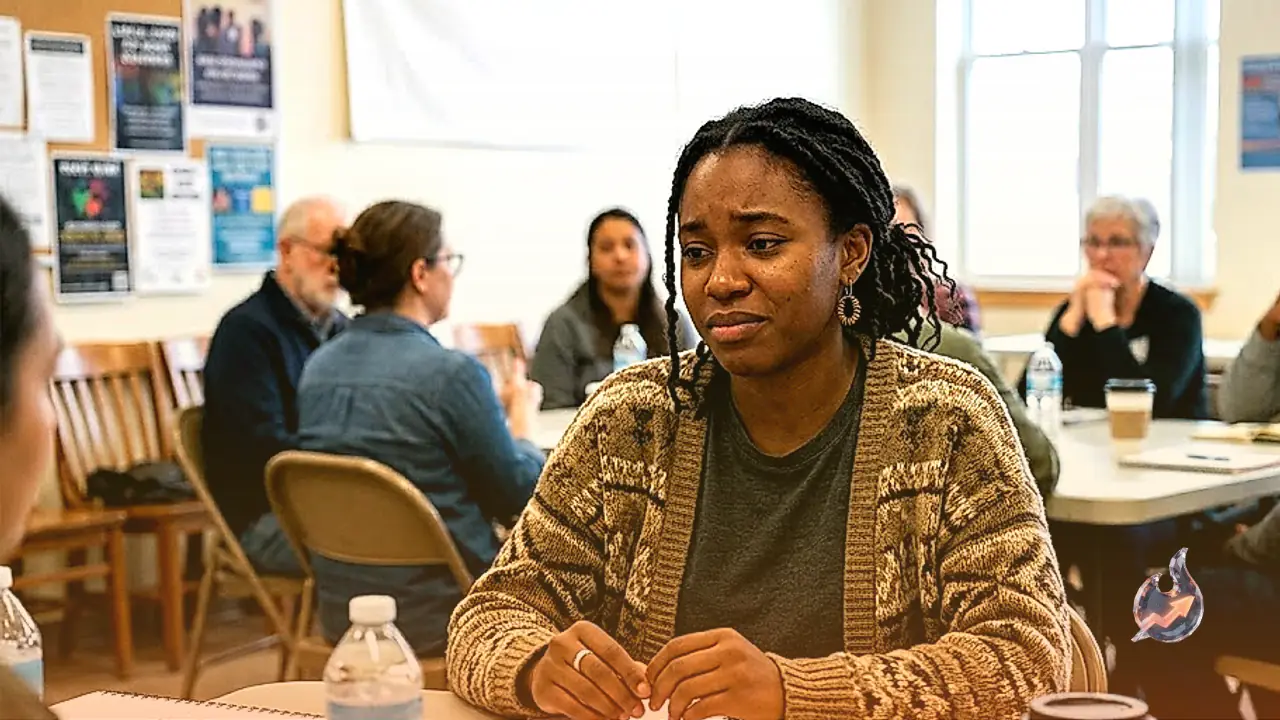
Despite these complex social pressures, individual victims sometimes choose forgiveness as a personal coping mechanism to navigate hostile social environments. Research indicates that this choice can yield specific psychological benefits. In a study conducted by University of California, Berkeley psychologist Jasmin Brooks Stephens, 101 African American college students who had experienced racial discrimination were surveyed regarding their mental health and forgiving disposition. Approximately 27 percent of participants met criteria for clinical depression. While higher exposure to racial discrimination correlated with elevated depressive symptoms, this connection was notably weaker among individuals who exhibited a higher general tendency to forgive.
These conclusions reinforced a 2017 study demonstrating that African American men who routinely practiced forgiveness developed fewer depressive symptoms when encountering everyday racial discrimination. However, younger men reported experiencing racism more frequently and struggled more with granting forgiveness. Health perspectives further illustrate these nuances. Sociologist Michael McFarland of Florida State University analyzed a 2001 national survey of older American Christians in a 2012 sociological study, finding that forgiving dispositions among Black adults were linked to lower rates of alcohol abuse and chronic health conditions. However, individuals residing in severely deteriorated neighborhoods did not experience these same health benefits, showing that environmental adversity can diminish the positive impacts of forgiveness.
Calculated Risks and Relationship Dynamics
Psychologist Michael McCullough of UC San Diego points out that withholding forgiveness can function as a protective adaptation, especially within underinvested communities. In environments where social safety is lacking, expressing forgiveness might be perceived as vulnerability, leaving individuals exposed to exploitation. Alongside Thomas McCauley, McCullough presented an evolutionary analysis of forgiveness examining how victims calculate their responses after experiencing harm. After an offense occurs, a victim can choose to avoid the perpetrator or seek retaliation, but both strategies carry significant trade-offs, such as losing access to employment, financial support, or vital social networks.
Therefore, deciding to forgive often involves an implicit assessment evaluating the risk of future harm against the value of the relationship with the offender. For instance, if a major financial benefactor of a youth nonprofit makes racially insensitive remarks, staff members might choose a form of transactional forgiveness to maintain organizational stability and essential funding while remaining cautious. Conversely, if the donor takes genuine responsibility and undergoes training, the organization perceives lower future risk, creating space for authentic relational forgiveness.
Intergroup Dynamics and Radical Forgiveness
In 2015, Georgia State University psychologist Don Davis tested intergroup forgiveness dynamics among African American students. His findings revealed that when participants viewed relationships with an offending group as low-value or anticipated recurring harm, they overwhelmingly preferred avoidance over forgiveness. Increased perceptions of exploitation were linked to higher desires for retaliation. However, among participants with a strong racial or ethnic identity, 72.5 percent demonstrated higher willingness for intergroup forgiveness. Additionally, individuals with deep religious commitments exhibited conscious choices to grant forgiveness as an active coping mechanism.
Psychologist Robert Enright highlights examining anger as a crucial phase of emotional healing. Perez asserts that individuals must be permitted to process anger on their own timeline, as constructive anger often drives necessary social reform. During the Civil Rights Movement, Black activists repurposed forgiveness not as submission, but as a strategic force. Martin Luther King Jr. highlighted that forgiving repeatedly transforms forgiveness into an enduring character trait. Through non-violent civil action, activists exposed the moral failure of systemic racism, seeking to awaken the public conscience and achieve lasting justice.