






















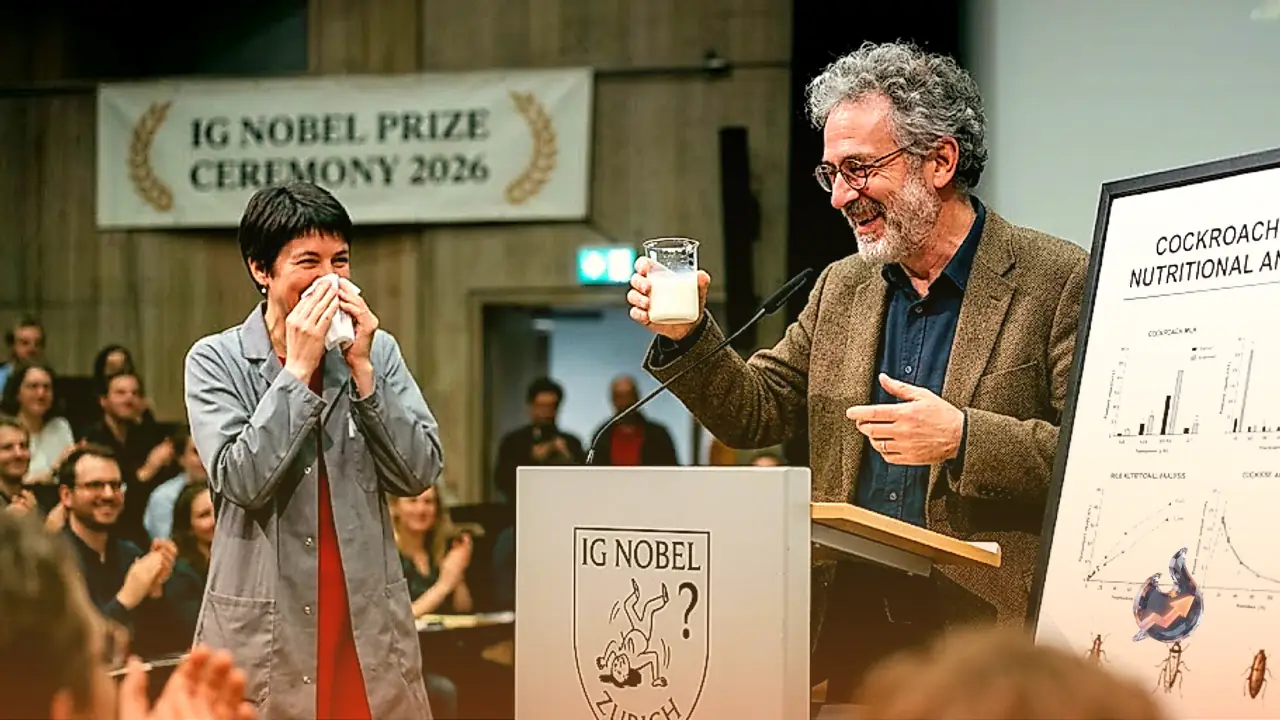

This year the annual ceremony took place in Zurich, Switzerland, recognizing 10 research projects that spanned quirky topics from attempting to scientifically define a kiss to employing buried underwear for evaluating soil health. The awards continue a long tradition of celebrating science that first makes people laugh and subsequently makes them think deeply about the world around them.
Biomechanics Prize: A Scientific Definition For Kissing
What exactly constitutes a kiss? A group of researchers set out to establish a rigorous scientific definition that would apply universally across all animals rather than just humans. They categorized a kiss as a non-agonistic interaction involving directed intraspecific oral-oral contact, accompanied by some movement of the lips or oral structures and without any transfer of food. Under this specific definition, other great ape species qualify as kissers, alongside domestic dogs, cats, pigeons, penguins, squirrels, black bears, and tortoises, though the underlying social meanings of these kisses differ vastly.
Economics Prize: Having More Money Might Make You a Unethical
In the study titled Higher Social Class Predicts Increased Unethical Behavior and published in PNAS, researchers conducted seven distinct experiments to investigate whether socioeconomic status correlates directly with unethical actions. These behaviors included breaking traffic regulations, failing to yield the right of way, cheating on tasks, and even taking candy meant for children. The findings suggested that individuals belonging to higher social classes exhibited, on average, a greater propensity to prioritize self-interest over communal well-being, proving that increased wealth can bring distinct behavioral complications.
Chemistry Prize: Cockroach Milk Is Surprisingly Nutritious
Adding to the growing body of research suggesting that the future of human nutrition might lean toward insects, this prize focused on a unique substance. The milk in question is a high-protein fluid produced by mother cockroaches of the species Diploptera punctata, which concentrate essential proteins, fats, and sugars into an extraordinarily energy-dense form. A team of scientists analyzed the microscopic crystals forming inside the developing embryos to understand how these crystalline structures store vast amounts of nutrients within such a minuscule space.
Medicine Prize: How to Blow Your Nose the Right Way According to Science
This proved to be one of the most popular studies in the entire competition owing to the remarkable background story behind it. It represented a posthumous award granted to scientist Unno Tokuji, who dedicated his final years to researching the correct methodology for blowing one's nose. He analyzed parameters ranging from the aerodynamics and overall volume of nasal breathing to the specific pressure exerted on the auditory ears. The ultimate recommendation was to blow one nostril at a time during periods of heavy congestion and to execute this with a long, relatively forceful exhalation instead of short, weak puffs.
Biology Prize: When Do Snakes Decide to Bite You Have to Step on Them
To determine the precise triggers for a defensive strike, researchers applied controlled pressure to different anatomical parts of Bothrops jararaca snakes, which are a highly venomous species of South American pit vipers, and observed their behavioral reactions. Wearing heavy boots in a controlled environment, they stepped directly onto various sections of the snake. Stepping squarely on the head triggered a 44 percent probability of a defensive bite, while applying pressure to the mid-body yielded a 20 percent probability of an attack. For anyone forced to step near a snake, the tail area represented the lowest risk, with a probability of only 11 percent.
Physics Prize: How to Make a Urinal Splash Free
According to advanced mathematical models, an optimal angle exists for a stream of liquid to strike a urinal if one wishes to avoid messy droplets bouncing back onto the user. The researchers discovered that lower impact angles significantly decrease splashing, prompting them to design functional prototypes based on this physical principle. Such scientifically engineered urinals can substantially assist in maintaining cleanliness and hygiene in busy public restrooms.
Technology Prize: Dead Mosquitos Can Transform Into 3D Printers
While the market price of 3D printers has decreased significantly over the past decade, researchers demonstrated that you can construct precision components using something as low cost as a dead mosquito. The proboscises that mosquitoes use to extract human blood function naturally as extremely fine needles. Because one of the most delicate components of a 3D printer is its nozzle, which is essentially an ultrathin tube, scientists realized they did not need to invent everything from scratch when evolution had already optimized the mosquito mouthparts for microscopic precision.
Olfaction Prize: Your Baby Smells Wonderful Your Teenager Not So Much
Confirming what many parents likely suspected through intuition, researchers analyzed how adults perceive the body odor of their children across different developmental stages. Participants rated the natural scent of young children much more favorably while giving significantly lower ratings to the body odor of teenagers. The research team believes that scent plays an underappreciated role in familial communication, potentially aiding in the neural recognition and strengthening of bonds between parents and growing children.
Peace Prize: We Want Mean Friends Sometimes
What kind of personality traits do people genuinely desire in a best friend? To explore this question, researchers administered detailed questionnaires asking participants how an ideal friend should behave toward them, toward a complete stranger, and toward a designated enemy. The overall preference leaned toward individuals who remained kind and supportive toward their friends while acting aggressively or cruelly toward their enemies, suggesting that an ideal friend does not have to embody a universally good persona.
Soil Science Prize: Old Underwear Can Reveal Soil Health
In a citizen science experiment involving about 1,000 participants, individuals buried cotton underwear in their fields and returned later to examine the extent of decomposition. This resulted in the creation of the underwear index. The presence of more holes in the buried garments indicated higher biological activity, specifically driven by microorganisms capable of breaking down cellulose, which is a natural molecule found in plant cell walls. A thriving population of these microbes remains essential for agricultural productivity, and testing for them now requires little more than an old pair of cotton briefs.
The entire awards ceremony is currently available for viewing online.