




















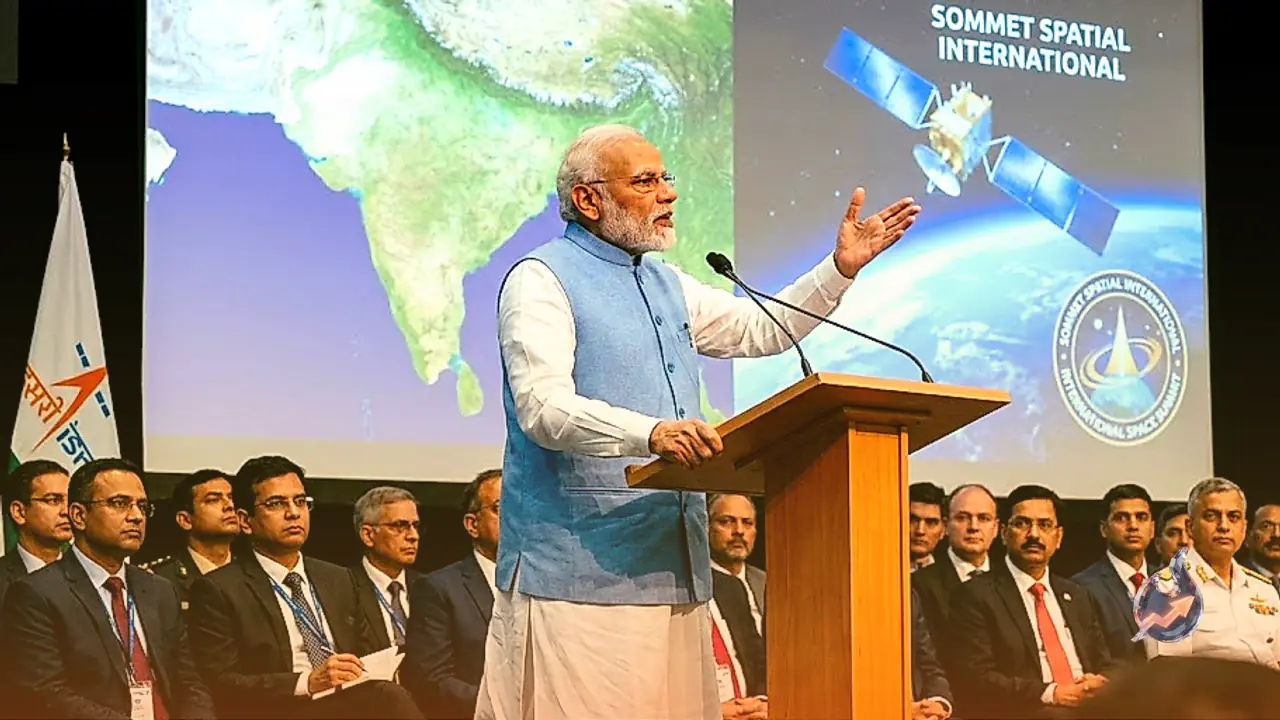

New Delhi. Prime Minister Narendra Modi stated on Thursday that India firmly supports a safe and sustainable space sector grounded in international law, emphasizing that the potential of space is infinite and collective responsibility is paramount. Speaking via video link at the International Space Summit held in Paris, he called upon France and other global nations to become active co-travelers in India's next-generation space research endeavors.
He reiterated that scientific data must be utilized with integrity toward a shared global objective, pointing out that India's ongoing space journey reflects this very philosophy. The Prime Minister noted that India's overarching vision is rooted in the timeless ethos of Vasudhaiva Kutumbakam, translating to one earth, one family, and one future, a spirit that must extend seamlessly from our planet outward into the cosmos. Space has captivated human imagination for centuries, he added, and is now actively aiding the preservation of life back on Earth.
Detailing the contributions of the Indian Space Research Organisation, the Prime Minister highlighted that ISRO has earned global acclaim by executing cost-effective, highly reliable space missions. He explained that these technologies now provide critical support across diverse domestic sectors, including agriculture, fisheries, weather forecasting, disaster management, and advanced navigation systems.
The Prime Minister credited the unwavering dedication of multiple generations of scientists, engineers, and technicians for building ISRO's stellar reputation through relentless day-and-night labor. Pointing to concrete deployment metrics, he shared that more than 430 satellites originating from 34 distinct countries have already been successfully launched into orbit using Indian launch vehicles, serving as undeniable proof of the world's growing confidence in India's technical prowess.
Highlighting recent landmark missions, he recalled that Chandrayaan-3 etched its name in history by executing a successful soft landing near the lunar south pole, while the Aditya-L1 mission continues gathering vital scientific insights regarding the Sun. Looking ahead toward future milestones, the Prime Minister reaffirmed India's definitive timeline to establish its own independent space station by the year 2035 and land an Indian astronaut on the surface of the Moon by 2040.
Furthermore, he noted that alongside the state-backed agency, India's private space ecosystem is accelerating at an unprecedented pace, with numerous startups and private enterprises reshaping the national space economy. Combining ISRO's engineering excellence with entrepreneurial vigor, this synergy is driving rapid commercial and industrial expansion.
Recalling bilateral ties, the Prime Minister mentioned that space cooperation between India and France dates back to the formative 1960s, evolving over decades to encompass earth observation, satellite technology, and advanced research. Concluding his remarks, he welcomed broader international participation, asserting that global partnerships will remain essential for driving future space exploration and technological innovation.