





















Deep within the fabric of space and matter lies one of the most enigmatic entities in particle physics: the neutrino. Trillions of these phantom particles streak through our planet, our buildings, and our bodies every single second without leaving a trace. Characterized by almost zero mass and no electric charge, neutrinos interact so weakly with ordinary matter that catching them seemed impossible for decades. Yet, to unravel how stars shine and how the early universe evolved, scientists had no choice but to construct some of the largest, deepest, and most extraordinary experimental traps in human history.
The Lost Energy Crisis and Wolfgang Pauli's Desperate Hypothesis
The story of the neutrino began in the late 1920s when physicists faced a troubling breakdown in fundamental laws. During a radioactive process known as beta decay, a portion of total energy consistently disappeared. No existing physical model could account for the missing energy, threatening the law of conservation of energy. In 1930, Austrian physicist Wolfgang Pauli proposed a daring theoretical remedy. He postulated that an unseen, electrically neutral particle was quietly carrying away the unaccounted energy.
Pauli was famously hesitant about his own invention, lamenting to a colleague that he had performed a terrible action by predicting a particle that could never be detected. Dubbed the neutrino, this subatomic entity lacks electromagnetic charge and interacts almost exclusively via the weak nuclear force. Because neutrinos pass through dense solid matter as if it were empty space, proving their actual physical existence required an unprecedented experimental strategy that took more than a quarter of a century to realize.
Project Poltergeist: Catching a Ghost at the Savannah River Plant
In 1956, American physicists Clyde Cowan and Frederick Reines set out to design a detector capable of recording these elusive interactions. They selected the Savannah River Plant in South Carolina, which housed a powerful nuclear production reactor capable of emitting an intense flux of neutrinos. Their setup was officially christened Project Poltergeist, reflectively named after its objective to trap a ghostly particle.
Cowan and Reines engineered a custom-built 10-ton detector packed with water and cadmium chloride. To shield the delicate instruments from background cosmic rays and ambient radiation, they encapsulated the entire vessel inside thick lead walls and heavy wet sandbags. When neutrinos from the reactor occasionally collided with protons in the detector, they generated distinct paired signals of positrons and neutrons. This monumental experiment provided the first definitive empirical proof of neutrinos, earning Reines a Nobel Prize decades later.
The Solar Mystery Inside the Homestake Gold Mine
With the existence of neutrinos confirmed, astrophysicists turned their attention to the heavens. If nuclear fusion inside the core of the Sun releases endless streams of neutrinos, capturing them on Earth would offer a direct window into the solar engine. However, because neutrinos rarely collide with matter, detecting a meaningful number required an immense volume of target atoms, placed deep underground to eliminate atmospheric interference.
In the 1960s, Raymond Davis Jr. and his team from Brookhaven National Laboratory constructed a massive tank 1.5 kilometers below the surface inside the Homestake gold mine in Lead, South Dakota. They filled the vessel with roughly 400,000 liters of perchloroethylene, a chlorine-rich dry-cleaning chemical. On the rare occasion a solar neutrino struck a chlorine nucleus, it converted it into a radioactive isotope of argon. Over 25 years of continuous monitoring, Davis observed only one-third of the solar neutrino flux predicted by standard stellar models, giving rise to the famous solar neutrino problem.
Water, Cherenkov Flash, and the Breakthrough of Neutrino Flavor Oscillations
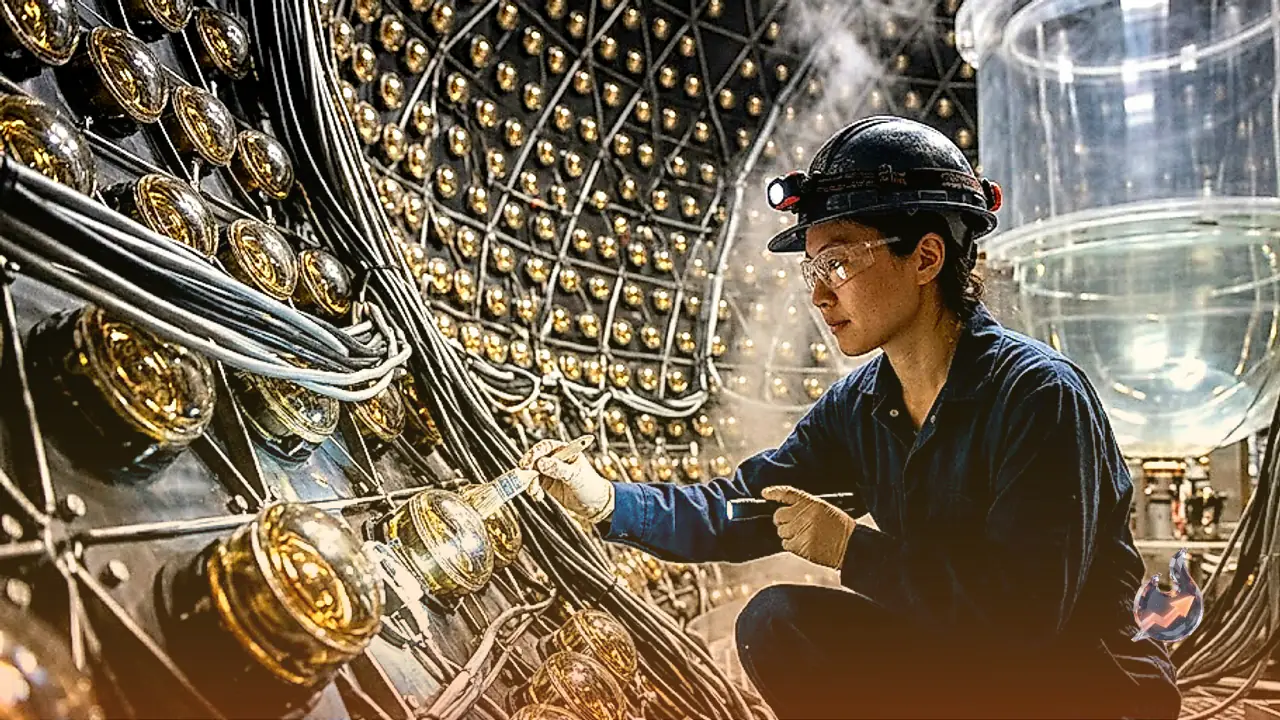
The mystery of the missing solar neutrinos persisted until colossal next-generation detectors emerged. In Japan's Kamioka mine, physicist Masatoshi Koshiba constructed Kamiokande, utilizing 3 million liters of ultrapure water. When a high-energy neutrino collides with an atomic nucleus inside the water, it releases a fast-moving electron or muon traveling faster than light travels in water. This phenomenon produces a conical shockwave of blue light called Cherenkov radiation, captured by sensitive photomultiplier tubes lining the tank walls.
Kamiokande, along with its massive successor Super-Kamiokande and Canada's Sudbury Neutrino Observatory (SNO), finally solved the riddle. Scientists discovered that neutrinos exist in three distinct types or flavors: electron, muon, and tau. As neutrinos travel vast distances from the Sun or through Earth's atmosphere, they morph or oscillate between these flavors. Because quantum mechanics dictates that a particle must possess mass to undergo oscillation, this breakthrough proved that neutrinos are not mass-less, challenging the original Standard Model of particle physics.
The New Frontier: SNO+, Borexino, KM3NeT, and the DUNE Project
Today, particle astrophysicists are deploying increasingly sophisticated liquid technologies and ocean arrays to push neutrino research further. In Canada's Creighton mine, the SNO+ experiment repurposed its predecessor's acrylic sphere, replacing heavy water with linear alkylbenzene (LAB), an industrial fluid used in dish soap manufacturing. Under the leadership of director Art McDonald, LAB produces optical signals 50 times brighter than water, enabling ultra-precise low-energy measurements.
In Italy, the Borexino detector located at the Gran Sasso National Laboratory in Abruzzo delivered the first direct proof that the Sun fuses hydrogen into helium through secondary CNO cycles alongside primary proton-proton chains. Concurrently, deep in the Mediterranean Sea off the coast of Sicily and near Toulon in France, workers are assembling KM3NeT. This underwater observatory will anchor nearly 200,000 optical sensors 3,500 meters beneath the surface to detect Cherenkov light generated by cosmic neutrinos passing through seawater and ocean bedrock.
Looking ahead, the Deep Underground Neutrino Experiment (DUNE) represents the most ambitious facility under construction. DUNE will fire trillions of artificial neutrinos from the Fermi National Accelerator Laboratory in Illinois through 1,300 kilometers of solid Earth to a giant liquid argon detector situated 1.5 kilometers beneath South Dakota. Prototype detectors known as ProtoDUNE are currently undergoing rigorous testing at CERN on the Franco-Swiss border, ensuring that the seven-decade quest to decode the ghost particle continues to illuminate the cosmic unknown.