






















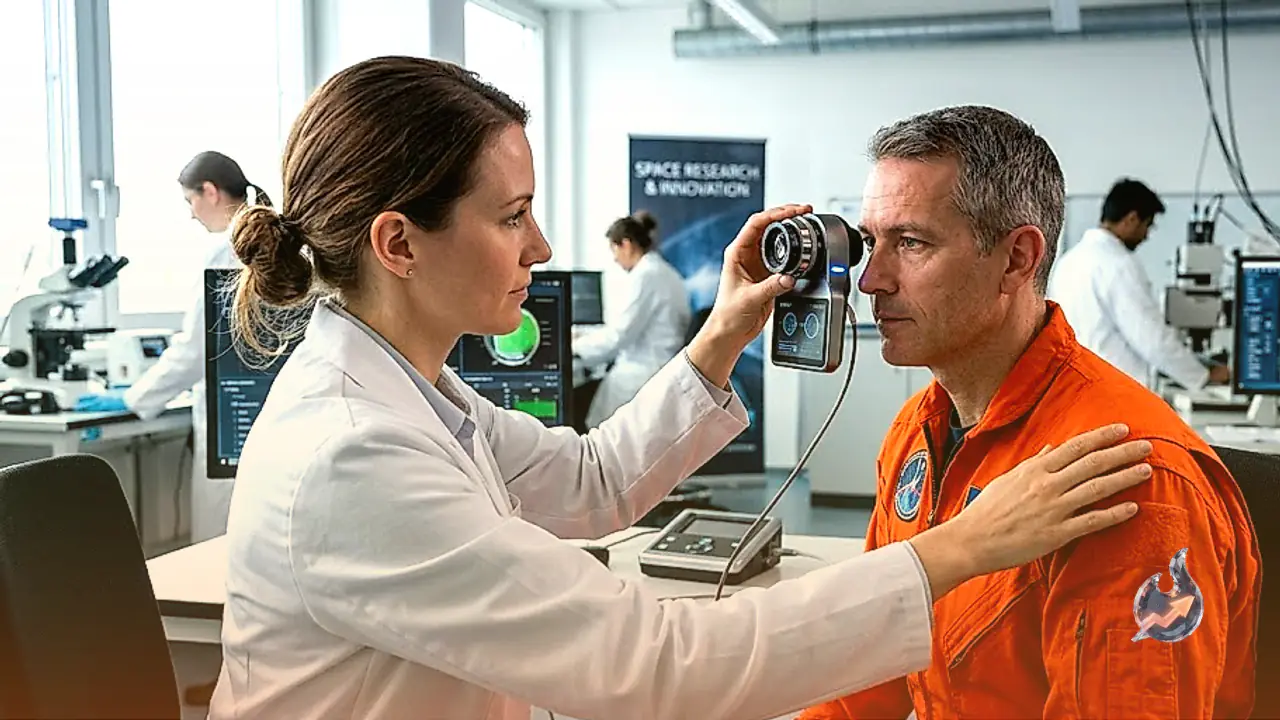

Space agencies are working to protect astronauts from severe vision loss during upcoming deep-space missions and lunar flights under the Artemis program by commissioning a novel technological solution. The space agency has tasked British eye-scanning startup Siloton with developing a specialized tool ahead of these upcoming missions. This advanced health technology leverages quantum mechanics to downscale the bulky core components typically found in standard optometrist eye-testing equipment, condensing them onto a photonic microchip smaller than a coin.
Established by physicists in 2020, Siloton currently collaborates with the National Health Service in the UK to enable patients suffering from retinal disorders to conduct self-scans in their own homes. The European Space Agency shares remarkably similar technical requirements, though operating within an entirely different environment, according to cofounder and chief technology officer Euan Allen.
Spaceflight-associated neuro-ocular syndrome, commonly known as SANS, represents a combination of ocular and neurological alterations triggered by extended periods spent in microgravity conditions. According to NASA data, this syndrome affects roughly 70 percent of all astronauts stationed aboard the International Space Station. One of the most severe documentation cases involves NASA astronaut John Phillips, who departed for the ISS in 2005 possessing pristine 20/20 visual acuity, only to return six months later with his vision degraded to 20/100, which qualifies as a moderate visual impairment. During his orbital tenure, bodily fluids accumulated within his cranial region due to the absence of gravity, exerting physical pressure on his eyeballs, swelling his optic nerve, and physically displacing his retina forward.
Although returning to Earth's gravitational pull can successfully reverse a portion of this damage, space agencies remain deeply troubled by both the operational dangers of astronauts experiencing mid-mission visual degradation and the long-term consequences for ocular health. SANS constitutes a severe health hazard confronting astronauts undertaking extended space missions, explains Rebecca Evernden, director of the UK Space Agency. Medical engineers are eager to deepen their comprehension of the condition and its underlying triggers so they can effectively manage, treat, or entirely prevent ocular trauma.
Researchers already track the physiological toll of spaceflight on human vision aboard the ISS using modified iterations of optometric hardware designed to measure the thickness of internal retinal layers. However, this existing instrumentation remains excessively heavy and necessitates continuous live remote oversight from ground-based specialists. As human exploration pushes deeper into the cosmos, expanding communication latency with Earth renders this reliance on ground control entirely unfeasible.
The proposed device from Siloton would empower astronauts to perform frequent retinal scans independently by automating significant portions of the diagnostic routine, thereby eliminating the need for ground-station assistance. The European Space Agency anticipates that this capability will yield richer datasets regarding ocular degeneration and potentially deliver early warning indicators well before structural eye modifications manifest as actual vision loss.
Additional engineering hurdles involve circumventing the use of conventional chemical batteries to power the apparatus, as they introduce unacceptable fire hazards inside sealed cabins. Within spacecraft interiors where usable volume is severely restricted, mission designers must also determine the optimal placement for the binocular-sized diagnostic hardware and engineer methods to physically secure an astronaut's head in zero gravity, a task traditionally handled by a simple chin rest on Earth.
However, overcoming these engineering constraints is relatively straightforward compared with compelling elderly patients with failing eyesight to cooperate during examinations, notes Allen. Confidence remains high because researchers are actively attempting these procedures with 80-year-old patients already experiencing visual deficits, whereas the orbital missions will utilize highly disciplined, younger astronauts possessing fully functional eyesight, Allen explains.
Many technological breakthroughs developed for aerospace applications will naturally filter down to improve consumer medical devices, and vice versa, Allen adds. Ultimately, this comprehensive research and development initiative serves to elevate the quality of medical products destined for everyday clinical deployment within the National Health Service.