























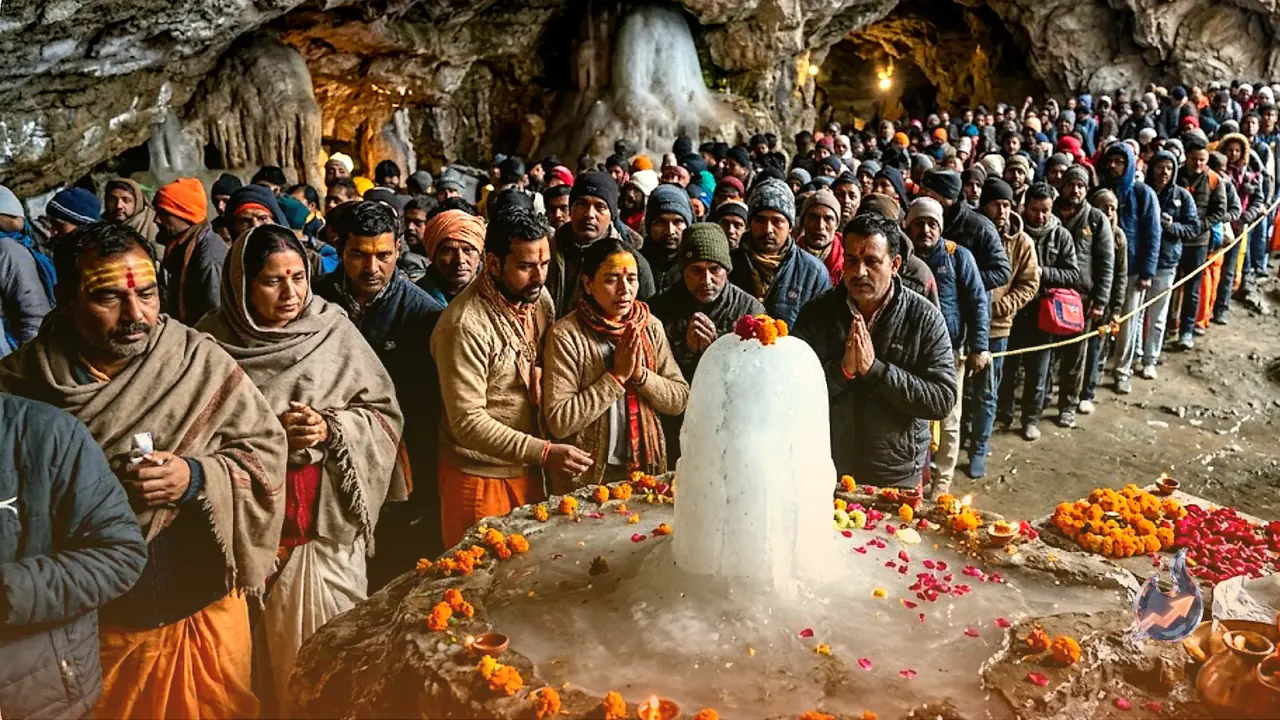

Just four days into this year's Amarnath Yatra, 85,779 pilgrims have already had darshan at the sacred cave shrine of Baba Barfani, with 28,818 devotees alone making the trip to the cave on Monday. While the administration says footfall keeps rising by the day, a surprising update has emerged alongside those numbers, the holy ice lingam inside the cave is melting at a rapid pace and has now shrunk to just 1 foot. Fresh photographs taken on Monday show the formation looking far smaller than it did in the early days of the pilgrimage, yet the shrinking ice has done nothing to dampen the devotion of pilgrims, who continue arriving in large numbers to see it.
From seven feet to one foot in barely six weeks
According to media reports, the Amarnath ice lingam measured around 7 feet on May 23. By June 29, it had reduced to 5 feet, and the images that surfaced on Monday confirm it has now melted down to just a single foot. Several devotees returning from darshan say that, given the speed at which the ice is disappearing, it may not survive more than another four or five days. This year's yatra began on July 3 and is scheduled to run until Raksha Bandhan, so the lingam shrinking this drastically so early in the pilgrimage has become a talking point among those making the journey.
Not the first time, and experts point to global warming
Experts note this isn't the first time the ice lingam has melted well ahead of schedule, this pattern has repeated for several years now. Rising temperatures and global warming are being cited as the main reasons. The Amarnath cave sits surrounded by glaciers, and when large crowds of pilgrims gather there, the surrounding temperature rises, which in turn accelerates the melting of the glaciers. A similar situation played out in 2016, when the ice lingam melted completely within just 10 days of the yatra starting. The same thing happened back in 2013 too, when the lingam disappeared even before that year's pilgrimage had ended.
A 57-day pilgrimage ending on August 28
This year's Amarnath Yatra started on July 3 and will conclude on Friday, August 28, coinciding with Raksha Bandhan. The pilgrimage runs for 57 days every year. According to religious belief, undertaking the Amarnath Yatra destroys all of a person's sins and frees them from the cycle of birth and death. That belief is a big part of why Amarnath is considered one of the holiest pilgrimages in Hinduism. Tradition holds that it was inside this very cave that Lord Shiva revealed the secret of immortality to Goddess Parvati, a story that adds to the deep spiritual significance pilgrims attach to the journey.
Heavy rain couldn't stop pilgrims from reaching the cave
Officials said heavy rain lashed several areas throughout the day on Monday, but the bad weather didn't stop devotees. Pilgrims travelling via both the Baltal and Pahalgam routes reached the cave, located at a height of 3,880 metres, and had darshan of Baba Barfani. By Monday evening, they had returned safely to the Baltal base camp after completing their darshan. Officials also point out that the return journey to the Nunwan base camp in Pahalgam, in south Kashmir, takes three to four days, which is why most pilgrims who start their journey via the Pahalgam route prefer to return via Baltal instead, since that route lets them get back to a base camp on the same day.
Wide-ranging arrangements in place for devotees
To make sure pilgrims face no difficulties, the administration has put together extensive arrangements. All the necessary facilities have been set up at both base camps as well as at the halting points along the route. Various social and religious organisations have set up langars, community kitchens, at multiple points to provide free food to travellers. Thousands of tents have also been pitched all the way from Baltal and Nunwan-Pahalgam up to the holy cave, so that pilgrims don't run into trouble finding shelter during the journey or while resting along the way.