



















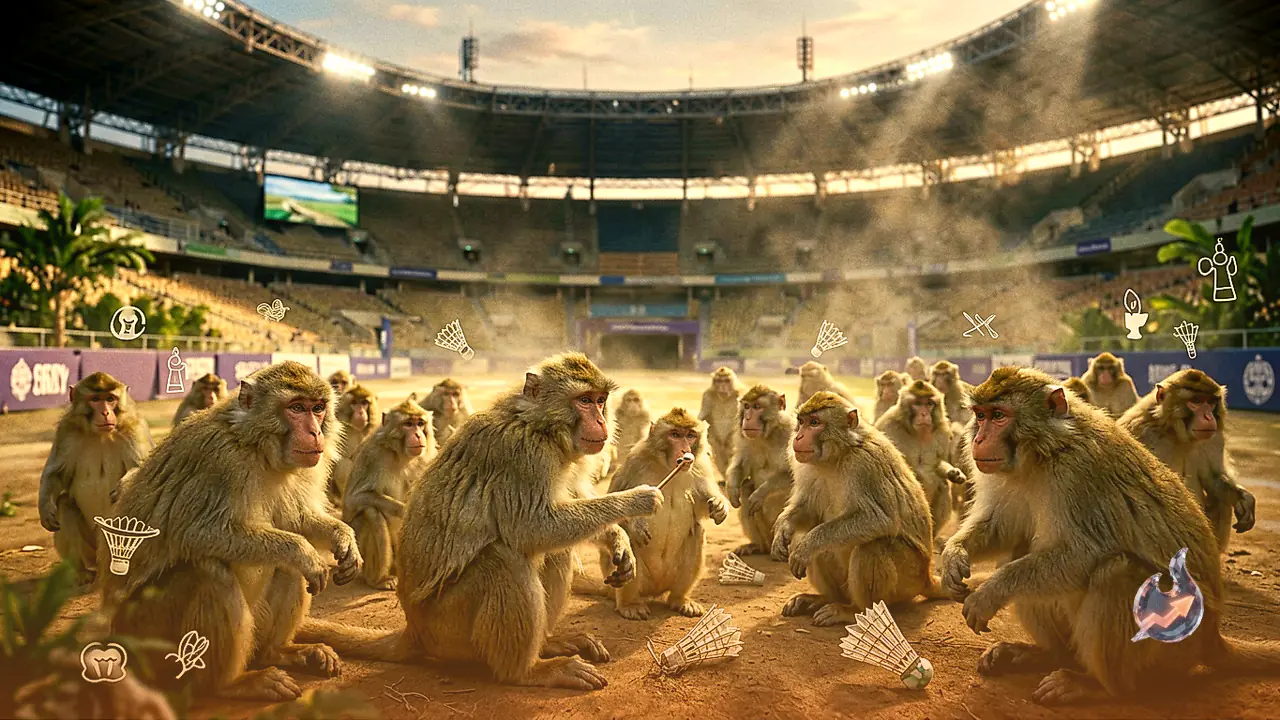

When the Indira Gandhi Indoor Stadium in New Delhi hosts a prestigious event like the Badminton World Federation World Championship, spectator attention naturally centers on the high-speed court action and the shuttles floating through the air. However, right outside the shining boundaries of this massive sporting venue, a parallel and unique battle unfolds between human ingenuity and animal instincts. The central figures of this effort are dedicated young individuals commonly known as monkey whisperers or professional langur voice imitators.
Vigilant Guardians at Stadium Gates
Along sensitive perimeter routes and near Gate Number 16 of the Indira Gandhi Stadium, young workers like Irfan and Abbas maintain strict patrol throughout the day. Armed with neither heavy wooden batons nor modern electronic deterrent devices, their primary weapon resides entirely in their vocal cords. From their throats emerge specialized rhythmic sounds such as eek-eek-eek and hoop-hoop. This is far from generic human noise; it represents a precise and powerful mimicry of the aggressive warning call uttered by territorial Gray Langurs.
From a biological standpoint, Rhesus Macaques, the common red-faced monkeys found across Northern India, possess an innate fear of the larger and more aggressive Gray Langurs. Whenever a troop of macaques attempts to descend upon stadium floodlight poles, spectator stand roofs, or adjacent tree branches, these workers project their commanding mimicry into the air. Terrified by the convincing calls of their natural predators, the monkey troops rapidly alter their course and retreat away from the venue.
Administrative Ambiguity and Contractual Deployment
The reliance on this traditional indigenous approach at high-profile international sporting events has frequently sparked administrative debate and public controversy. Official bodies such as the Sports Authority of India and the Municipal Corporation of Delhi generally distance themselves from directly listing monkey whisperers on their formal payrolls. Nevertheless, private contractors routinely deploy these specialized personnel on shift duty from 9 AM to 5 PM to secure stadium boundaries and ensure uninterrupted tournament operations.
PV Sindhu Backs Tradition with Wimbledon Parallel
Amid ongoing debates regarding the practice, Indian badminton icon PV Sindhu took to social media to offer her enthusiastic endorsement of the strategy. Drawing a thoughtful comparison with global sports traditions, PV Sindhu pointed to the prestigious Wimbledon tennis championship in London. She noted that Wimbledon organizers have long employed a trained hawk named Rufus to deter pigeons from settling on the tennis courts. Sindhu emphasized that every major international sports venue faces distinct local environmental challenges, and for Delhi, managing macaque intrusion demands practical, field-tested solutions.
Four-Decade Family Heritage and Professional Shift
The profession of driving away nuisance monkeys from public infrastructure in Delhi carries a rich family history spanning four decades. Veteran practitioners like Shahrukh Khan and Waseem Khan recall that their father, Nazar Ali, arrived in Delhi from Lucknow nearly 40 years ago with four live langurs. Initially, Nazar Ali performed street shows with the animals to entertain children across Lutyens' Delhi. Recognizing the animals' effectiveness, government officials soon encouraged him to utilize the langurs to clear persistent monkey troops from government office buildings.
The 2012 Ban and Adapting Livelihoods to Vocal Artistry
A fundamental turning point occurred in the year 2012 when the Central Government enacted strict wildlife protection enforcement, prohibiting the commercial keeping and captive use of wild animals. Consequently, these families were compelled to release their captive langurs into wild forest sanctuaries. Faced with a sudden loss of income, the practitioners transformed decades of intimate observation and living alongside langurs into a refined vocal skill. While the physical langurs returned to nature, their aggressive calls survived within the throats of these young men.
Occupational Hazards, Modest Wages, and Future Outlook
Ensuring orderly surroundings across high-security zones like Sansad Marg, Shastri Bhawan, Krishi Bhawan, and major sports complexes exposes these monkey whisperers to extreme hazards. Earning a daily wage of approximately 800 rupees for an arduous 8-hour shift, they endure relentless heat, dust, and direct physical danger. During patrols, workers must frequently engage in intimidating eye contact with aggressive alpha male macaques. Severe monkey bites pose constant health risks, with workers often resorting to applying traditional mixtures of quicklime and turmeric over deep lacerations before resuming duty.
While environmental scientists and zoologists view vocal mimicry as a temporary stopgap and advocate for permanent netting and natural habitat balance, municipal administrators continue to view it as the most immediate and effective defense. Today, veterans such as Shahrukh Khan and Waseem Khan express a strong desire to educate their children for safer corporate or civil careers rather than pushing them into this hazardous lineage. Yet, as long as monkey troops roam Delhi streets and international sports arenas, the echoing calls of these human langurs will remain an uncredited but indispensable pillar of public security.