























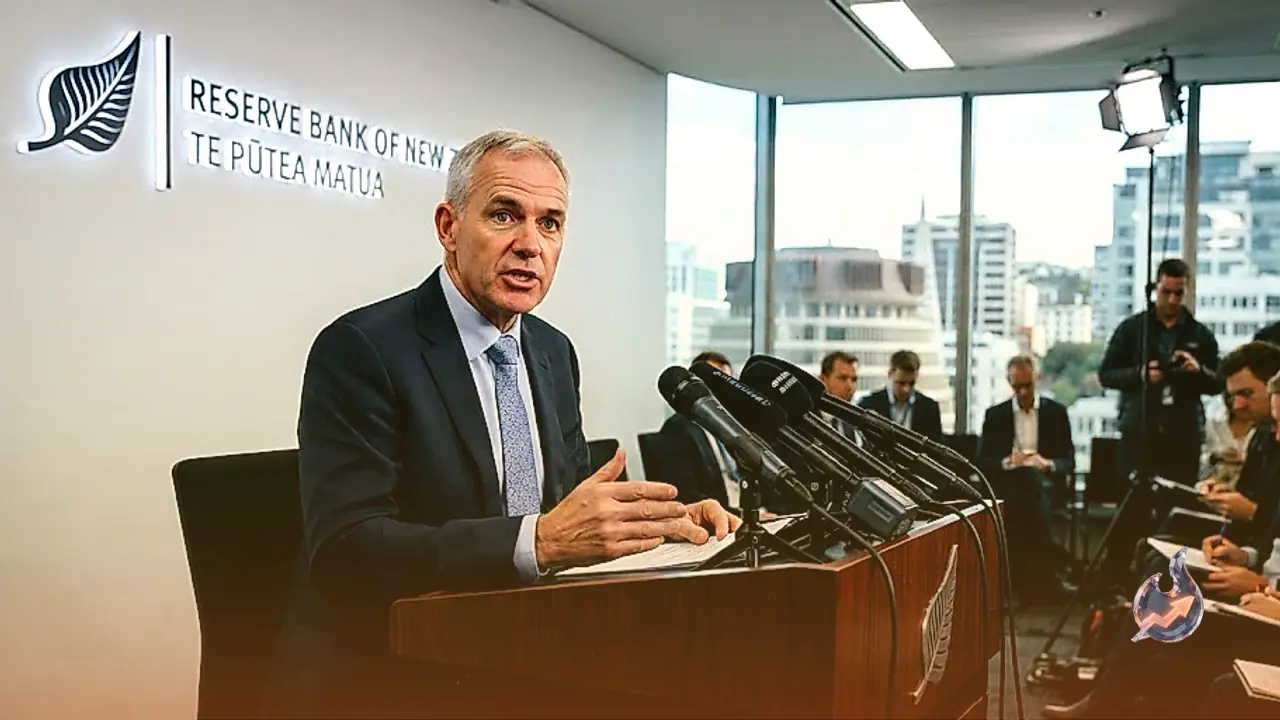

Anticipation across international currency markets is running high ahead of key central bank decisions, with the Reserve Bank of New Zealand standing on the verge of delivering another policy tightening move. On Wednesday, October 28 at 01:00 GMT, the central bank, operating under Governor Anna Breman, is scheduled to announce its latest monetary policy decision, where money markets have already baked in a 100% probability of a 25 basis point increase in the Official Cash Rate. This adjustment would lift the benchmark rate from its existing 2.75% up to 3%, keeping the focus squarely on the policy statement and future rate trajectory.
Inflation Trends and the Policy Backdrop
The macroeconomic environment in New Zealand continues to justify a firm stance against consumer price pressures. Domestic inflation stands stubbornly at 3.7%, running noticeably above the upper boundary of the target band and underpinning the need for further monetary restraint. During its prior monetary review in September, the Monetary Policy Committee reached a unanimous decision to lift the Official Cash Rate, determining that withdrawing economic stimulus was vital to navigate inflation back toward its 2% midpoint while still fostering economic expansion and employment. That move was calculated to curb the potential necessity of sudden, steep rate hikes later, while allowing policymakers complete flexibility regarding subsequent adjustments.
Governor Anna Breman noted at the time that additional interest rate hikes remained on the table, indicating that officials intended to evaluate how previous policy tightening was transmitting through the economy. Such guidance underscores a central bank biased toward monetary tightening, even though the precise schedule of future adjustments depends heavily on upcoming economic readings.
Foreign Exchange Dynamics and Technical Indicators
Prior to the announcement, the New Zealand Dollar versus US Dollar (NZD/USD) currency cross has remained pinned near the lower end of its intraday range of 0.5675 to 0.5708. Real-time market data shows NZD/USD trading at 0.5684, representing a 0.32% retreat from the previous close of 0.5702, within a 52-week band of 0.5567 to 0.6093. Current technical indicators reveal a 14-period Relative Strength Index (RSI) at 51, signifying neutral momentum, while the MACD registers -0.00 against a signal of -0.00, accompanied by a bullish histogram reading of 0.00. Moving average metrics place the 20-day EMA at 0.5668, the 50-day EMA at 0.5717, and the 200-day EMA at 0.5794, alongside a 50-day SMA at 0.5754 and a 200-day SMA at 0.5837. A death cross where the 50-day EMA resides below the 200-day EMA highlights a prevailing long-term downward trend. Bollinger Bands (20,2) span from 0.5565 to 0.5710 with a baseline of 0.5637, while the 14-period ADX sits at 38, pointing to an active trend. The stochastic oscillator shows the fast line at 81 and the signal line at 86. Crucial chart barriers feature a central pivot at 0.5691, resistance marks at R1 0.5701 and R2 0.5719, and support boundaries at S1 0.5674 and S2 0.5664, framed by 20-day boundaries around support at 0.5567 and resistance at 0.5711.
Traders navigating the currency pair are preparing for substantial volatility, positioning for the combined impact of the New Zealand announcement and the Federal Reserve's looming policy release. Should the Reserve Bank of New Zealand deliver a hawkish outlook, the currency could target the convergence formed by the 50-day and 100-day Simple Moving Averages located at 0.5748 and 0.5769. Breaking above this barrier would open the path toward the 0.5800 mark. Conversely, an unexpectedly dovish message could send the pair sliding toward 0.5650 and the critical 0.5600 threshold, an area heavily defended following two weeks of persistent tests. A breach below that level would expose the year-to-date low of 0.5564.
Mandate, Price Stability, and Policy Instruments
The Reserve Bank of New Zealand serves as the nation's monetary authority, tasked with preserving price stability and fostering maximum sustainable employment. Price stability is formally attained when annual inflation, tracked via the Consumer Price Index, settles within the prescribed 1% to 3% corridor. The Monetary Policy Committee utilizes the Official Cash Rate as its primary mechanism to steer these outcomes. When inflation overshoots the target, raising the benchmark borrowing cost tempers economic demand by making credit more expensive for consumers and commercial enterprises. Higher interest rates typically bolster the New Zealand Dollar by increasing capital yields, rendering local assets more enticing to international capital, whereas rate cuts typically soften the exchange rate.
Employment conditions represent an equally vital variable because an overstretched labor supply frequently triggers wage-driven inflation. Maximum sustainable employment is defined as the fullest application of labor capacity that can persist over time without driving an acceleration in consumer price inflation. According to the institution, maintaining employment at this equilibrium supports mild, consistent price changes, but allowing labor demand to exceed capacity for too long causes runaway price pressures, obliging the committee to hike borrowing costs. In extraordinary crises, the institution can turn to unconventional mechanisms such as Quantitative Easing. Through this process, the bank creates domestic currency to purchase sovereign or corporate debt securities from commercial banks, expanding the money supply to reignite growth. Quantitative Easing routinely depresses the New Zealand Dollar and remains a tool of last resort when conventional interest rate reductions cannot deliver the necessary stimulus, a method previously deployed during the Covid-19 disruption.
Broader Financial Markets and Currency Trends
Market movements across other international assets highlight an active macro environment. The Australian Dollar regained traction against the greenback on Tuesday, shaking off an earlier setback to push beyond the key 0.7000 threshold despite ongoing strength in the US Dollar ahead of the Federal Open Market Committee meeting. Upcoming Australian inflation statistics scheduled for Wednesday will serve as the immediate domestic catalyst for that currency.
Simultaneously, USD/JPY captured persistent demand for a third consecutive trading session, rebounding from its one-month trough ahead of the Federal Reserve decision and the Bank of Japan's rate review on Friday. Speculation that Japanese policymakers may pause before pursuing aggressive monetary tightening exerted pressure on the Yen, allowing the greenback to touch a nearly two-week peak and boosting the currency cross. Gold edged modestly upward during Tuesday's US trading hours after spending earlier hours in negative territory, drawing some support from softer crude oil prices even as the resilient US Dollar capped upside momentum. The US Dollar Index rallied 0.6% across three sessions to print fresh two-week highs above 102.00, supported by expectations of a hawkish hold from the Federal Reserve and declining prospects for an immediate US-Iran diplomatic resolution.