























Ram Singh, a resident of the Itiyathok development block in Gonda district, has set a remarkable example of resilience. Having lost his father during his childhood, he had to shoulder the financial responsibilities of his family at a very tender age. Due to these weak economic conditions, he could only complete his education up to the fifth grade. To sustain his household, he migrated to another city for work, but his heart remained in his village. He eventually returned home and decided to transform agriculture into his full-time profession.
Inspiration From a Neighboring District
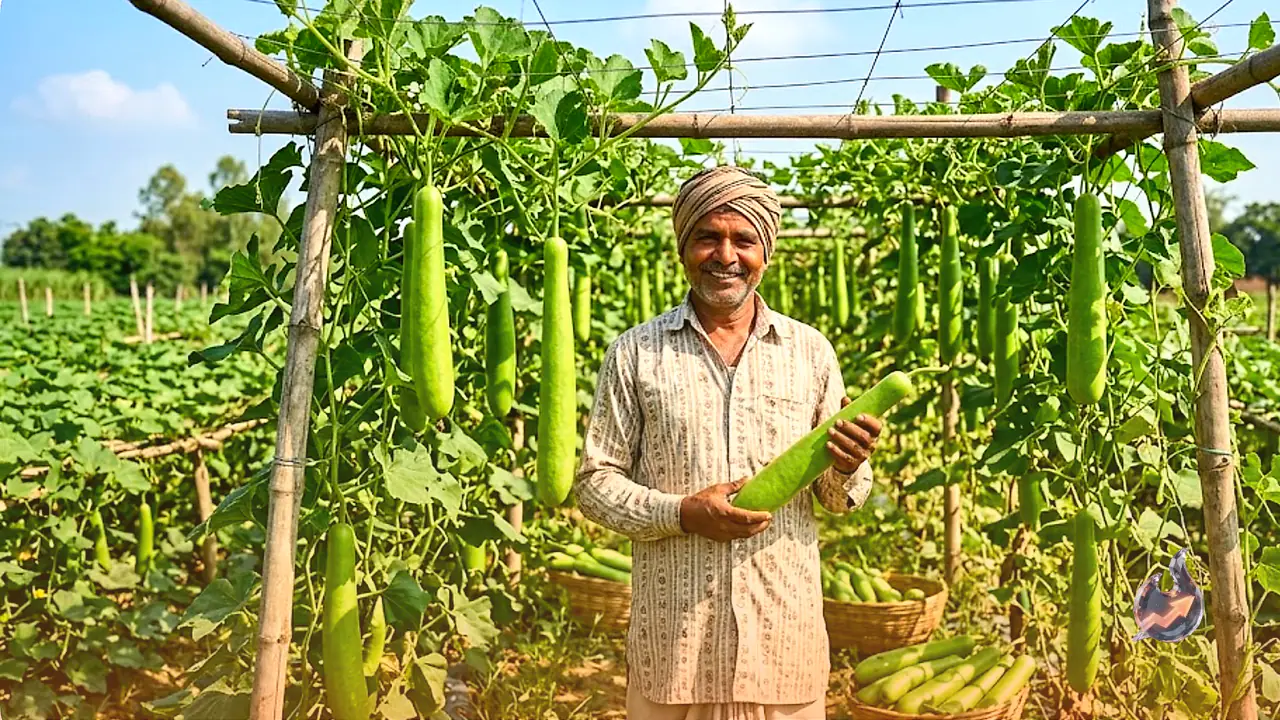
Seeking to move away from conventional and low-yield agricultural practices, Ram Singh integrated modern techniques into his work. In a conversation with TrendKia, he revealed that the idea of cultivating bottle gourd using the machan (trellis) method came to him after observing a farmer in the neighboring Balrampur district. Inspired by that farmer's success, he decided to replicate the technique on his own land, which soon proved to be highly beneficial.
High Yield and Great Profits with Low Investment
Currently, Ram Singh is cultivating bottle gourds on approximately one bigha of land using the machan method. This trellis system allows the vines to grow upwards, protecting the crop from ground-level moisture and pests, which significantly enhances both the quality and quantity of the yield. Proper seeds, timely irrigation, and regular monitoring have further boosted his production.
Speaking about the financial aspects, Ram Singh told TrendKia that the total investment for cultivating one bigha of bottle gourd was only around 2,000 to 2,500 rupees. Under favorable crop conditions, he anticipates a return of about 50,000 to 60,000 rupees. He noted that the final income fluctuates based on the prevailing market rates when the produce is sold.
Motivating the Next Generation of Farmers
The cycle of the bottle gourd crop lasts for about 5 to 6 months. By managing multiple crop cycles, Ram Singh earns lakhs of rupees annually, securing a comfortable livelihood for his family. His success serves as a powerful inspiration for young people and fellow farmers who often view agriculture as a low-income occupation. His journey shows that with modern techniques, patience, and hard work, farming can indeed become a lucrative business.