























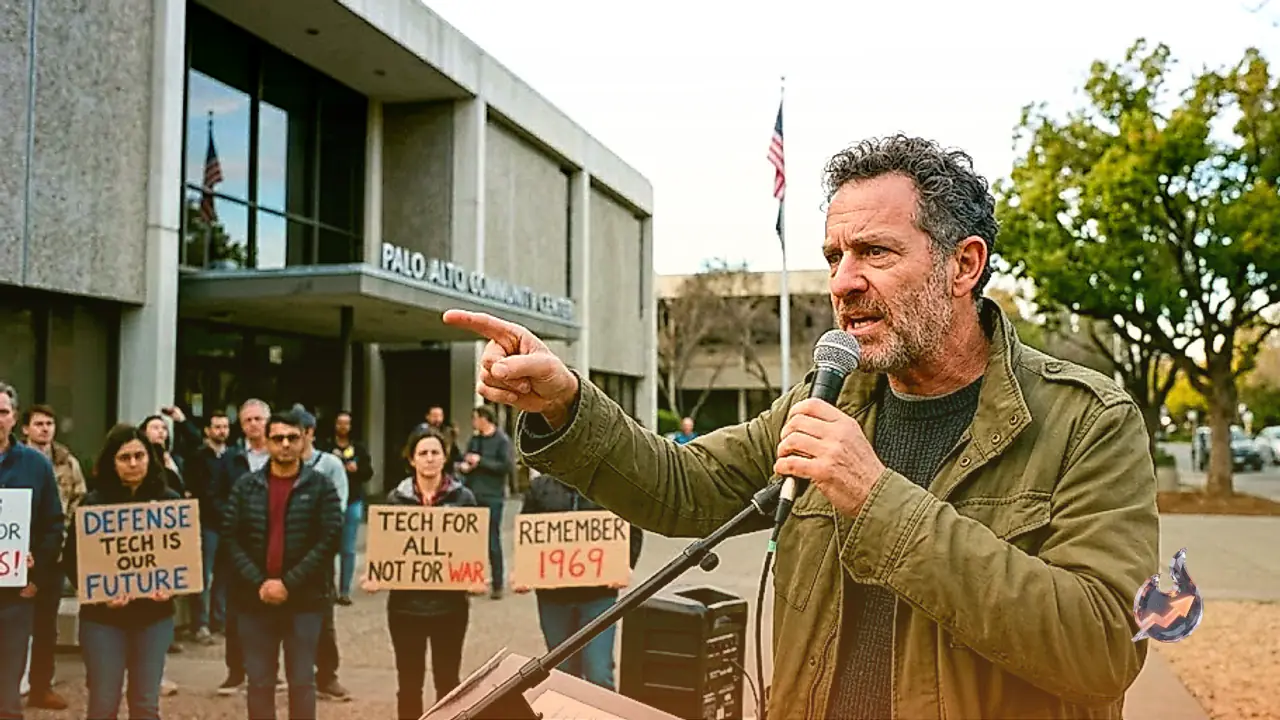

A growing rush by modern technology firms to secure lucrative defense contracts has reignited a deep debate over the historical soul and founding principles of Silicon Valley. Back in September 2015, Founders Fund organized an exclusive retreat at an eco-resort nestled in British Columbia, bringing together venture capitalists, portfolio founders, and a tiny group of outside thinkers. Among them was Alan Kay, the revered computer pioneer who formulated the concept of the Dynabook, the direct conceptual ancestor of every modern laptop and tablet used across the globe today. While sitting at a long breakfast table, Kay was cheerfully recounting the development of the graphical mouse and his early technical advice to Steve Jobs. Peter Thiel, the venture capitalist leading Founders Fund, sat down beside him and listened with mounting skepticism before finally demanding to know who Kay even was. Stunned, the mustachioed computer pioneer began explaining his career before stopping himself, recognizing that to someone unfamiliar with the history of computing, the list of achievements sounded almost mythical. Kay simply sighed, labeled himself a relic of the past, and returned to his meal, capturing an unbridgeable disconnect between the pioneers who invented consumer computing and the financial titans who inherited it.
That symbolic breakfast clash gained fresh relevance following an essay by national security analyst Sharon Weinberger, timed alongside her book Valley of Death: How Big Tech Is Fueling the Future of War. In her argument, the popular depiction of Silicon Valley as an ecosystem driven by countercultural rebellion and a desire to democratize society is essentially a myth. She contends that the modern tech sector's aggressive wealth accumulation, subservience to political authority, and enthusiasm for lethal military technology do not mark a sudden fall from grace. Instead, she argues that these behaviors simply reveal what the technology sector has always been beneath its public relations surface. In her reading, the industry has never experienced a fundamental shift in values, only a shift in its paying customers, making its pivot to military contracts a straightforward matter of market adaptation rather than a political transformation. To that viewpoint, the entire rhetoric of personal empowerment and freedom during the 1980s personal computer revolution and the 1990s internet boom was merely an opportunistic marketing strategy designed to move hardware and software off store shelves.
Defense Subsidies, Post-Cold War Realities, and Market Creation
Yet historians and long-time industry observers reject this mercenary reading of tech history. They point out that starting in the late 1970s, an entirely new generation of technologists emerged whose outlook was deeply shaped by the counterculture, creating an environment that unlocked massive technical innovation and unexpectedly laid the groundwork for today's vast digital wealth. It is undeniable that early computing grew out of government defense spending. Crucial programs funded by the Defense Advanced Research Projects Agency, or DARPA, provided the financial backing that led to early interactive graphical displays, the underlying architecture of the internet, and early algorithmic projects that informed modern search engines like Google. However, the culture that took hold among the young engineers working on those projects was defined by an anti-authoritarian mindset, a hacker desire to build beautiful tools, and an utter disregard for corporate orthodoxy. Before Apple Computer arrived on the scene, corporate executives in America would never have dared to walk into an office without a formal suit and tie, an unwritten rule that early tech founders shattered.
When confronted with this perspective, Weinberger maintains that generational values are themselves byproducts of economic circumstances. As the Cold War wound down and defense spending contracted during the peace-dividend era, military technology jobs dried up, forcing ambitious minds to seek fortune elsewhere. In her interpretation, the historic migration of engineering talent away from missile guidance systems toward consumer products like the Macintosh was dictated primarily by market demand. Under this logic, today's renewed partnership between high-tech startups and military buyers does not represent a betrayal of historic ideals, but a natural response to the Pentagon's renewed desire to purchase commercial software and automated systems. She argues that workers did not suddenly decide military work was fashionable; rather, corporate entities invariably seek out the largest pools of capital. According to her view, early personal computer makers did not work directly with the military simply because a booming consumer marketplace allowed them to ignore government contracts entirely.
The Radical Laboratories and the Homebrew Revolution
However, that economic reading misses a fundamental historical reality: companies like Apple did not merely enter an existing consumer marketplace, they had to invent it from scratch. The foundational work upon which Steve Jobs, Bill Gates, and their contemporaries built their businesses did not come from defense contractors wearing pocket protectors at aerospace firms like Lockheed. Instead, it was developed by unconventional researchers working inside experimental university and corporate research centers. In What the Dormouse Said, author John Markoff detailed how countercultural values became the primary engine driving Silicon Valley's explosive early expansion. The pivot from a defense-focused industrial base to an open, consumer-oriented ecosystem emerged from three specific research environments: John McCarthy's artificial intelligence laboratory at Stanford University, the Stanford Research Institute where Douglas Engelbart pioneered interactive computing and the mouse, and Alan Kay's team at Xerox PARC, which created the fundamental architecture of modern personal computing.
Far from operating as corporate arms of the military establishment, these labs functioned as vibrant creative sanctuaries for young thinkers. A significant number of the researchers who staffed these institutions took jobs there specifically to secure draft deferments that kept them from being deployed to the Vietnam War. Financial enrichment was not the motivating impulse for these pioneers. The startup culture of Silicon Valley grew out of an organic marriage between radical countercultural hackers who genuinely believed software could liberate humanity and a practical semiconductor sector that was deliberately escaping its initial military origins. Meanwhile, outside institutional walls, an eccentric coalition of hobbyists and activists formed the Homebrew Computer Club, led by political radical Lee Felsenstein. That self-organized circle provided the intellectual spark and shared schematics that birthed the commercial personal computer industry, including the early prototypes assembled by Apple.
Challenging Industrial Norms and Resisting Corporate Conformity
The turn toward everyday users was not an effortless path to easy profits. Throughout the 1980s and into the 1990s, Apple had to fight persistent criticism from mainstream corporate buyers who dismissed its computers as childish toys because the machines rejected the cold, imposing industrial aesthetic of old mainframe systems in favor of friendly visual interfaces and rounded curves. It took decades of persistent engineering and design advocacy for consumer-facing computing companies to break down corporate resistance and gain enterprise acceptance. There is a deep irony in the fact that today's defense-focused tech figures obsess over traditional masculine posturing, given that the entire modern digital landscape was built by rejecting that exact posturing. Even when Google grew into a massive corporate enterprise and prepared for its public offering, its founders deliberately defied Wall Street conventions, explicitly declaring their desire to build a company that prioritized user trust over short-term financial maneuvering.
Historian Margaret O'Mara, whose book The Code: Silicon Valley and the Remaking of America explores the delicate intersection between defense roots and digital counterculture, emphasizes that the industry's shift toward civic technology was a genuine ideological transformation rather than a calculated mercenary scheme. The shift away from military contracts mirrored a broader generational and political realignment across Northern California. During the 1980 and 1984 presidential races, voters across Silicon Valley backed Ronald Reagan by substantial margins. Yet as the software industry expanded and absorbed progressive cultural norms, the region transitioned into a reliable bastion of progressive politics. O'Mara points out that the modern cohort of defense-oriented tech billionaires closely aligned with political figures like Donald Trump represents only a vocal minority within the broader tech workforce. In her view, extreme concentrations of private wealth have created an insulated echo chamber where billionaires and political figures struggle to comprehend how their embrace of military hardware is viewed by ordinary citizens.
The Moral Stakes of Erasing Silicon Valley's Counterculture
While today's tech entrepreneurs building battlefield systems often claim to be motivated by national defense and patriotic duty, their public enthusiasm frequently resembles an obsession with action cinema and tactical combat video games rather than sober statesmanship. For nearly four decades, the mainstream technology industry deliberately kept its distance from lethal weaponry, even though the United States defense budget consistently represented one of the largest pools of capital on the planet. Rewriting the past to claim that tech founders never cared about social progress or human liberation does a profound disservice to history, and it convenient provides cover for modern executives seeking to normalize the development of autonomous weapons systems.
The interaction between Peter Thiel and Alan Kay in British Columbia remains an enduring portrait of what Silicon Valley risks discarding. Venture capitalists who now channel resources into mechanized warfare are themselves the direct beneficiaries of the idealistic computer science pioneered by Kay and his contemporaries. Those early dreamers worked to construct tools that amplified human intelligence rather than automated violence. Erasing their moral contributions not only distorts the historical record, but it also strips today's technological landscape of the ethical foundation it desperately needs to preserve.