























When newly applied plaster on walls and floors begins to crack or flake away shortly after construction, homeowner investment and hard work go completely to waste. People often assume that defective cement or substandard supplies are entirely responsible for the failure, yet the real culprit frequently lies in the preparation of the mixture itself. The long-term strength of any plaster surface depends centrally on balancing cement and sand accurately. Adhering to balanced measurements alongside structured mixing steps ensures the finished surface remains robust and durable over extended periods.
Standard Ratios for Cement, Maurang, and Coarse Aggregate
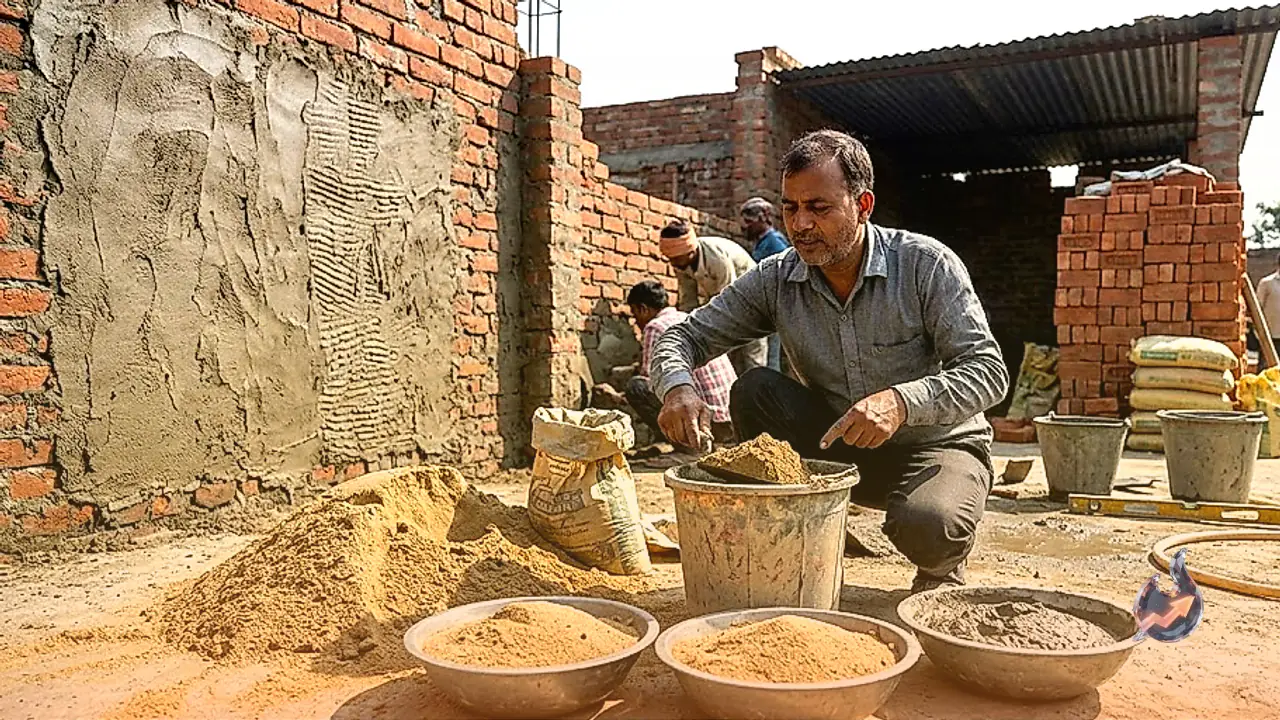
Drawing on a decade of construction experience in Sultanpur, mason Yogesh Kumar explains that preparing mortar for floors and walls requires a strict three-to-one standard. Under this guideline, every single bag of cement must be combined with three bags of maurang sand. To achieve optimal density and structural stability, that sand volume should be divided between two bags of Banda maurang and one bag of Chilla maurang. Similarly, for coarse concrete work, blending one bag of cement with three bags of black grit aggregate delivers the ideal standard. Mortar blended according to these specific volume guidelines consistently yields superior durability.
Mixing Protocols and Water Incorporation
Proper physical blending matters just as much as precise volume measurements. Yogesh points out that when combining three bags of maurang and dust with one bag of cement, the dry elements should be turned over and mixed thoroughly by hand at least three times. This thorough blending ensures an even distribution of binding particles throughout the aggregate. Once mixed dry, the materials are arranged into a wide circular ring with a crater excavated in the center. Approximately two buckets of water are poured into this depression, after which workers gradually push the outer edges of the dry pile into the pool. The wet batch is subsequently turned and beaten two to three times with a spade to produce an even, work-ready compound.
Applying Slurry Before Spreading the Mortar
Securing an enduring bond between the base surface and the mortar demands one final protective measure. Yogesh recommends coating floors and walls with a thin cement slurry wash immediately prior to spreading the plaster compound. Spraying this liquid cement mixture over the substrate allows the sand-cement mortar to adhere firmly, preventing premature detachment and hollow spots. This preparation step not only anchors the plaster securely to the underlying base, but also provides a substantially smoother, refined surface finish.