



















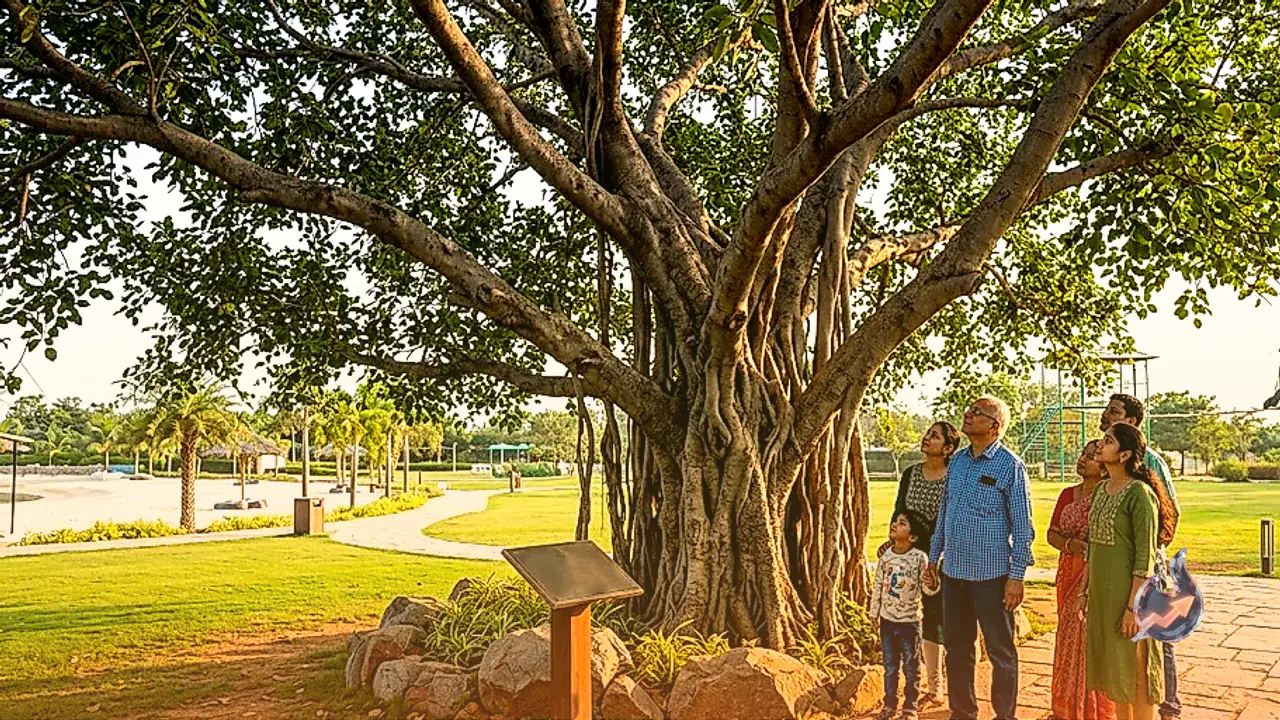

On the outskirts of Hyderabad, a sprawling 150-acre green space has quietly become one of the country's most talked-about tourist draws, not for a ride or a monument, but for a single tree valued at roughly ₹85 lakh. The site, called Experium Eco Park, is being described as India's largest eco-recreational park, and visitors are travelling from far to see the rare, centuries-old specimen at its heart.
A Tree Worth ₹85 Lakh
The park's marquee attraction is an ancient tree whose price tag has been placed at close to ₹85 lakh, a figure that has made it the centre of attention among nature enthusiasts and casual visitors alike. Its unusual form, its estimated age running into hundreds of years, and the rarity of the arboriculture craftsmanship behind it are what set it apart, park officials say this kind of specimen is seldom found anywhere in India.
Two and a Half Decades in the Making
Behind the park stands Ramdev Rao, founder of a company called Unique Trees, who spent 25 years researching, sourcing and nurturing trees before bringing this project to life. Rao and his team sourced close to 25,000 rare and old plant and tree species from more than 85 countries around the world, including Argentina, Mexico, Italy and Spain. These plants were packed in specially built crates and flown into India so they would survive the long journey intact.
Not Just One Expensive Tree
Park management's own figures show the ₹85 lakh tree is far from a one-off. Several other ancient bonsai and historically significant trees on the property carry individual price tags ranging from ₹1 lakh all the way up to ₹3.5 crore, underlining just how much rare botanical material has gone into building this collection.
A ₹150 Crore Park Built for More Than Trees
The park itself came up at a cost of around ₹150 crore, and its ambitions go well beyond expensive greenery. Among its headline attractions is India's first man-made artificial beach, spread across 12 acres. After dark, a Glow Garden lights up in a spread of colourful illumination. Adventure seekers can try out a one-kilometre-long zipline that runs in four directions, while an indoor Snow Park built purely for family entertainment gives children a place to enjoy artificial snow.
Taken together, the rare tree collection and the infrastructure built around it have turned the site into more than a weekend outing. Backers of the project are positioning it as a model for sustainable, eco-luxury tourism in India, one that pairs the conservation of rare plant species with modern recreational experiences for ordinary visitors.