























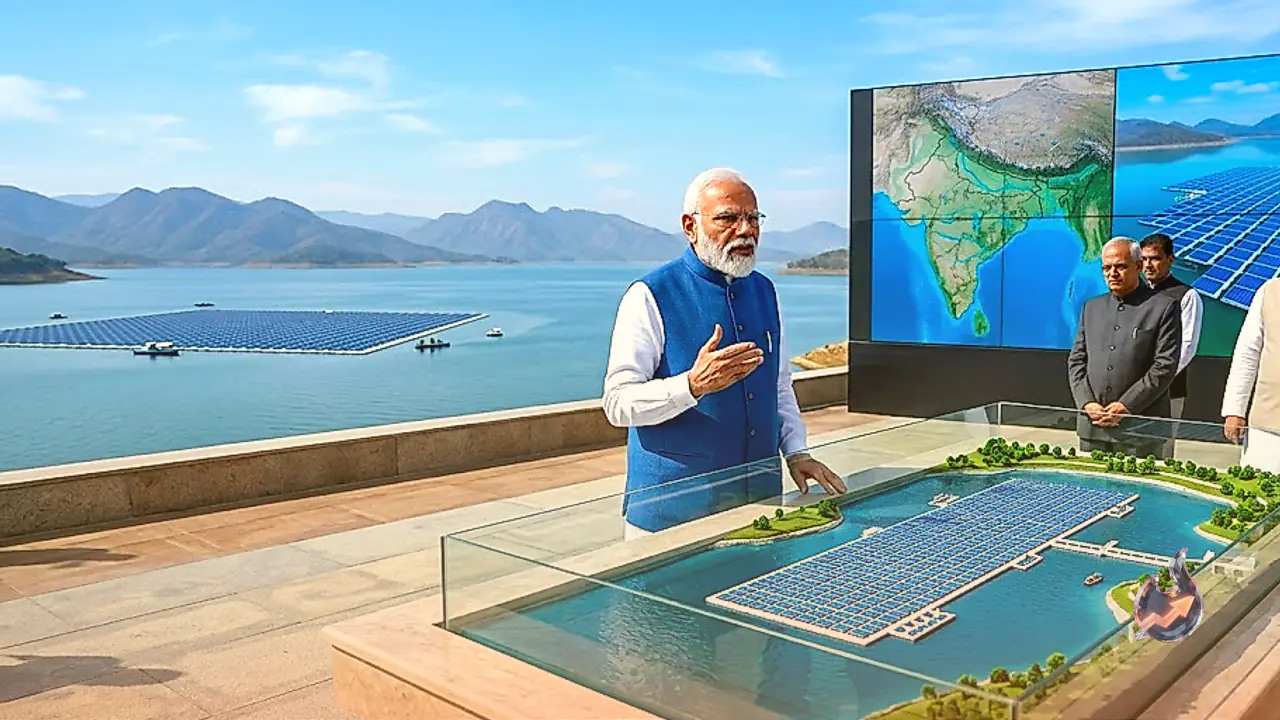

In a major boost to India's renewable energy infrastructure, the Union Cabinet chaired by Prime Minister Narendra Modi has officially approved the Pradhan Mantri Surya Sarovar Yojana. The flagship scheme focuses on deploying floating solar power plants across water reservoirs and industrial ponds nationwide. Under this initiative, the government aims to complete floating solar projects with a total capacity of 5,000 MW (5 GW) over the next five years. By harnessing water surfaces, India will generate billions of units of green electricity annually without acquiring fertile agricultural or commercial land, preserving ecological balance.
Financial Outlay, Subsidies, and Energy Storage Specifications
The Union Cabinet has sanctioned a total financial outlay of Rs 5,070 crore for the scheme. Project approvals will be rolled out between FY 2026-27 and FY 2030-31. A key requirement of the initiative is that every floating solar plant must feature an integrated Energy Storage System with at least two hours of backup capacity. This storage mechanism will capture solar power generated during peak production hours, enhancing national grid stability and ensuring reliable electricity distribution.
To incentivize participation from private and public power developers, the government has announced attractive financial assistance packages. Upon successful project completion, developers will receive central financial assistance of Rs 1 crore per megawatt. Furthermore, to facilitate preliminary work, the scheme offers upfront financial support of up to Rs 50 lakh per project for conducting initial surveys and feasibility studies. The program will be accessible across all states and Union Territories for eligible energy developers.
Power Generation Potential and City-Scale Electricity Impact
India currently possesses around 700 MW of operational floating solar capacity. Adding 5,000 MW under this new scheme will elevate the country's total floating solar capacity to approximately 5,700 MW. Operating at an estimated 85 percent capacity utilization factor, this 5 GW solar infrastructure will generate nearly 37 billion units (kWh) of clean electricity annually. This massive energy yield is sufficient to meet the annual electricity requirements of roughly 1 to 1.5 crore residential and commercial consumers, operating with zero carbon emissions during generation.
To put 37 billion units into perspective, the output can be compared against the energy demand of major Indian urban centers. For instance, the annual power demand capacity of Lucknow, the capital of Uttar Pradesh, is around 1,000 MW. The 5,000 MW project capacity will generate roughly five times the total annual electricity consumption of Lucknow, effectively powering five cities of similar size. For medium-sized cities like Jaipur, the annual generation under this scheme could satisfy the total power consumption of 8 to 10 such cities.
Environmental Sustainability, Job Creation, and Domestic Manufacturing
From an environmental standpoint, the PM Surya Sarovar Yojana will play a critical role in advancing India's climate goals. The successful implementation of these projects is projected to reduce carbon dioxide emissions by approximately 1 crore tonnes annually. Beyond environmental benefits, the green energy expansion is expected to generate significant employment opportunities, creating 16,000 to 17,000 direct and indirect jobs across project development, installation, and maintenance.
The scheme will also provide a major push to domestic manufacturing under the Make in India initiative. The demand for specialized floating solar components, solar panels, photovoltaic modules, floating pontoons, anchoring systems, and advanced battery storage units will spur industrial growth. By optimizing water body utility and expanding renewable energy capacity, the initiative supports India's long-term vision of sustainable economic development.
Ground vs Floating Solar: Capital Cost and Operational Advantages
A crucial question in solar infrastructure planning is whether ground-mounted or water-based installations offer better economic value. Capital cost data indicates that ground-mounted solar installations remain less expensive, costing between Rs 3 crore and Rs 4 crore per megawatt. In contrast, setting up floating solar plants on water bodies costs between Rs 4 crore and Rs 6 crore per megawatt, representing a 30 percent to 50 percent higher initial capital expenditure.
The higher upfront cost of floating solar is primarily driven by specialized engineering components, including floating pontoon structures, underwater anchoring and mooring systems, moisture-resistant cabling, and corrosion-proof frameworks. Nevertheless, floating solar offers distinct long-term operational advantages that justify the investment. Crucially, it avoids land acquisition costs and preserves valuable agricultural land for farming.
Furthermore, the natural cooling effect provided by the underlying water reduces panel overheating, boosting solar panel power generation efficiency by 5 percent to 10 percent. Covering large surface areas of reservoirs also significantly reduces water evaporation losses, conserving millions of liters of water annually. In regions where fertile land prices are high, deploying solar arrays on reservoirs represents an economically viable and environmentally sound long-term strategy.