



















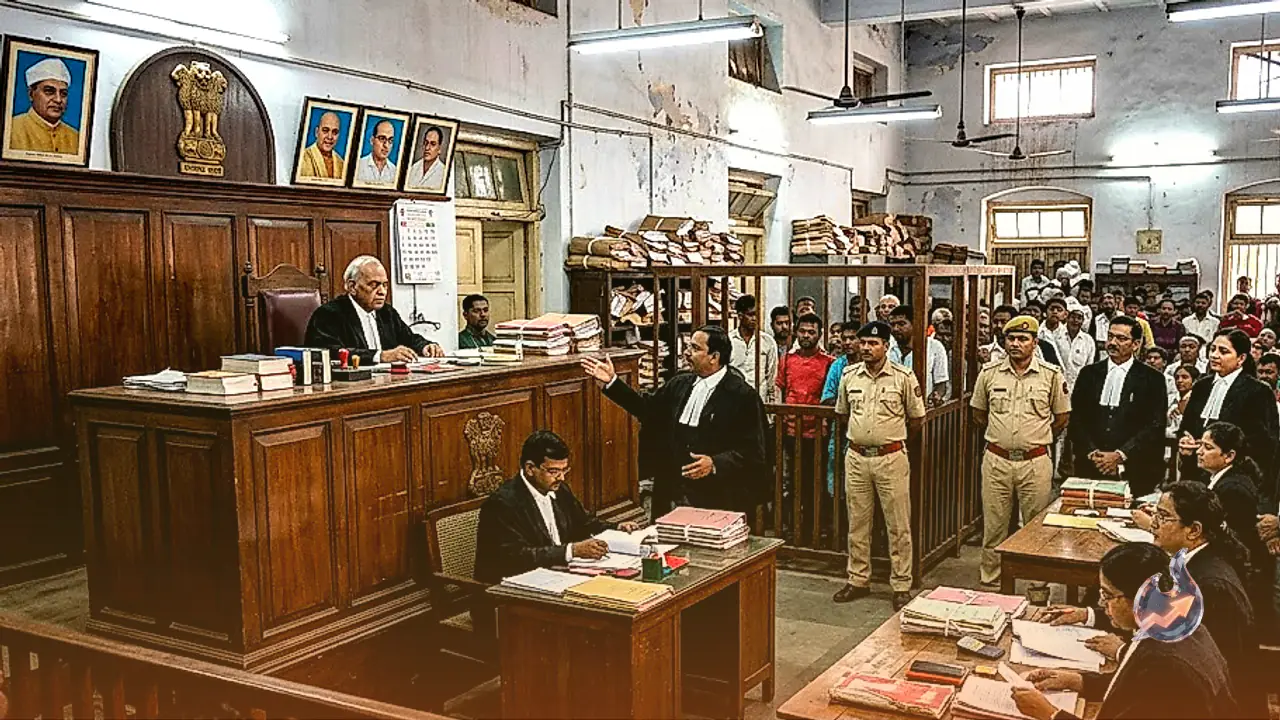

A local court in Meerut, Uttar Pradesh, has delivered a defining verdict in the killing of Saurabh Rajput, awarding the death penalty to convicts Muskan Rastogi and Sahil Shukla. District Judge Arvind Kumar Mishra drew widespread attention during the pronouncement, not only for the severity of the capital sentence but also for the profound philosophical perspectives and symbolic gestures witnessed within the courtroom. The proceedings were marked by references to ancient epics, allegories on natural law, and the quiet disposal of the judicial pen after recording the decree.
Capital Punishment Returns to Meerut Courtroom After Twenty-Three Years
The intense legal battle spanned roughly 13 months, requiring the court to conduct rigorous hearings across 126 scheduled dates before arriving at its final decision. District Judge Arvind Kumar Mishra established that Muskan Rastogi and Sahil Shukla were unequivocally culpable for the murder of Saurabh Rajput, deciding that their actions warranted the death penalty. Within the regional judicial landscape, this ruling stands as an exceptional landmark, representing the first capital punishment issued by the district court in approximately 23 years. The previous instance in which a death sentence was handed down in Meerut occurred in 2003, involving the conviction of a medical doctor.
Reflections on Judicial Duty and the Teachings of the Mahabharata
While framing the sentencing order, District Judge Arvind Kumar Mishra invoked the Mahabharata to articulate the relationship between human justice, retribution, and judicial righteousness. He observed that prescribing a punishment commensurate with the exact gravity of the crime constitutes the fundamental duty of the judiciary. His reasoning underscored that the core role of codified law extends beyond punitive measures to safeguarding public order and sustaining societal security.
To illustrate the relationship binding humanity and the rule of law, the judge presented an allegory featuring a tiger and its surrounding forest. He explained that just as a forest remains protected when a tiger inhabits it, the tiger is likewise preserved only when the forest endures. Law is fundamentally designed for humanity, serving to shield individuals while establishing necessary boundaries for human behavior. The court emphasized the pressing need for this enduring principle of order and deterrence to be recognized by broader society.
The Disposal of the Writing Pen Following the Decree
Moments after signing the capital verdict, the judge engaged in an action that quickly drew widespread attention among courtroom observers. Having finalized the decree ordering the execution of the two convicts, he deposited the pen used to write the judgment directly into a waste bin. Given that the directive involved terminating the lives of two individuals, the gesture resonated across the legal fraternity. Although no formal explanation or institutional commentary was offered regarding the disposal of the instrument, the moment, paired with the philosophical invocations of the Mahabharata, formed a solemn closing chapter to the trial.
Major Ruling Delivered Within Five Months of Assumption of Office
District Judge Arvind Kumar Mishra had formally assumed charge of the Meerut district court merely five months prior to issuing this historic verdict. Resolving such an extensively scrutinized trial within a relatively short tenure placed the proceeding in the public spotlight. The judicial trajectory progressed systematically: the court initially declared Muskan and Sahil guilty of murder on September 30, before officially announcing their death sentences approximately two weeks later. The convicts faced charges of murdering Saurabh Rajput, dismembering his remains, and concealing them inside a blue drum, an act whose details had shocked people far beyond district boundaries.