


















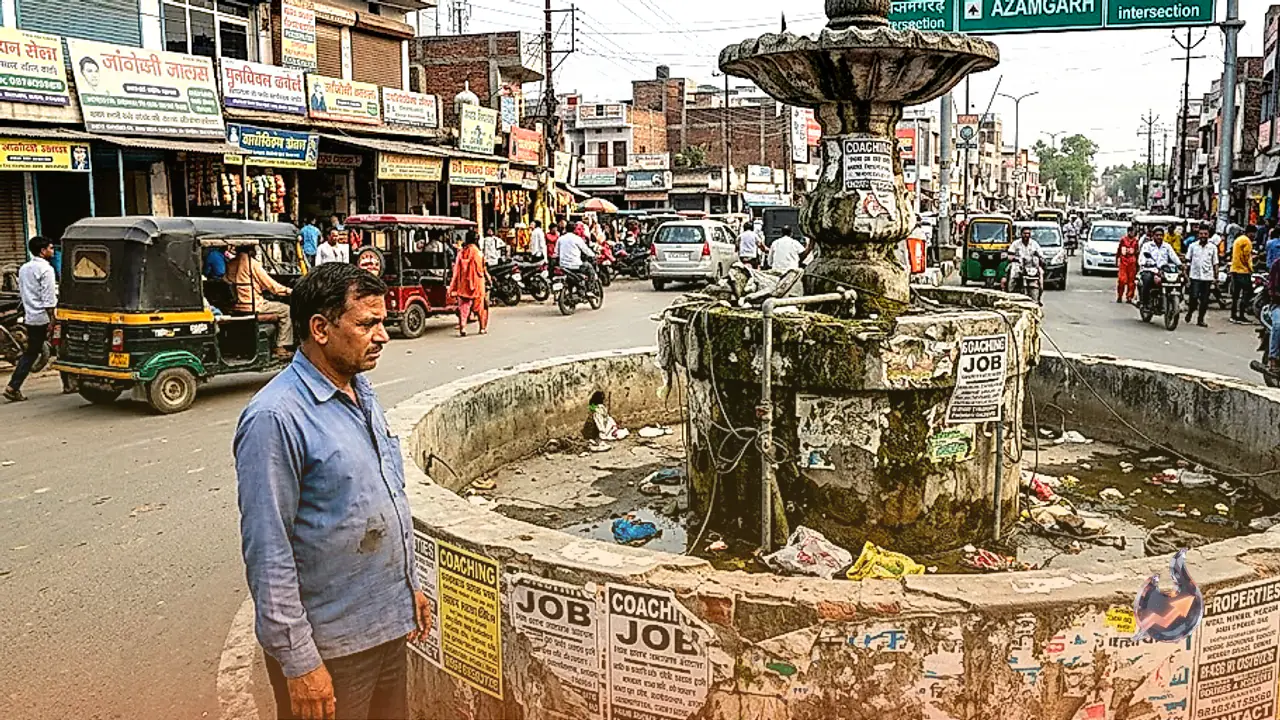

An ambitious plan to impart a modern aesthetic to the public spaces of Azamgarh through the public-private partnership (PPP) model has ground to a halt, leaving several prominent roundabouts in acute decay. Under this urban beautification drive, private organizations, civic groups, and local individuals were entrusted with developing major traffic junctions by erecting grand decorative fountains and artistic installations. While these landmarks were originally envisioned to enhance the town's streetscapes, a prolonged absence of routine maintenance has reduced them to neglected installations that fail to serve their purpose. Rather than circulating clean water through working fountains, these structures now hold stagnant wastewater and accumulating garbage.
Bawali Mor and Kartalpur Intersections Show Severe Decay and Neglect
The state of Bawali Mor, one of the busiest crossroads in Azamgarh, clearly demonstrates the magnitude of this infrastructural neglect. The fountain and accompanying decorative setup developed here under the private partnership arrangement are presently blanketed in thick layers of road dust. Commercial advertisements, banners, and promotional posters have been plastered across the masonry, transforming the entire structure into an unsightly billboard. The original architectural styling of the installation is completely obscured behind these unauthorized promotional materials.
A similarly troubling scenario persists at Kartalpur tri-junction. At this location, the depression intended for the decorative fountain and its central model has become a receptacle for stagnant, foul-smelling liquid. The accumulated dirty water creates an unpleasant odor for passersby while functioning as an active breeding ground for mosquitoes. Local residents and daily commuters face heightened risks of infectious diseases as wastewater continues to collect without any functional drainage or operational maintenance.
Broken Boundaries and Stolen Fixtures Across Key Road Junctions
The deterioration is not confined to these two spots; traffic junctions across the rest of the town reflect an identical state of abandonment. Without structural upkeep, boundary walls around multiple islands have started crumbling onto adjacent roadways. Decorative floor tiles have come loose or disappeared entirely, while the electrical illumination systems installed to light the islands after dark are broken or missing. Once intended to elevate the pride of the locality, these urban spaces have been completely lost behind layers of commercial hoarding boards.
Municipality Directs Junior Engineers to Conduct On-Site Inspections
Addressing the growing filth and infrastructural decay, the local municipal administration has initiated procedural action. Executive Officer Brijesh Kumar confirmed that the condition of these junctions has deteriorated significantly. He explained that a majority of the town's intersections had been handed over to private societies, commercial entities, or prominent individuals under the PPP framework for beautification and construction. Because these entities failed to conduct timely maintenance following the initial installation, the structural assets deteriorated progressively over time.
To address the lapses, the executive officer has instructed both Junior Engineers (JEs) serving the municipal board to carry out a comprehensive ground survey of all such intersections within the municipal limits. The two engineers have been tasked with visiting every site to prepare an exhaustive inventory of structural damage. Their field assessment will specifically record defunct lighting fixtures, damaged boundary walls, missing or shattered tiles, and holes or water retention issues within the fountain basins, comparing current conditions against the assets originally installed.
Formal Notices Planned to Compel Restorative Maintenance
Executive Officer Brijesh Kumar emphasized that as soon as the engineering survey is compiled, formal written notices will be served to the relevant organizations and individuals responsible for constructing each junction. The directives will demand that these partners carry out necessary repairs and restore the sites to functional order. The administration highlighted that since these partner entities originally constructed the landmarks, they hold both an ethical and operational obligation to keep them preserved.
The municipal authority observed that properly maintained traffic intersections elevate the image of the town while honoring the legacy and public standing of the patron organizations and their forebears. The administration has urged these partner groups to proactively inspect the sites and undertake the required restoration. Whether this administrative survey and subsequent notices will succeed in reviving Azamgarh's neglected landmarks, or whether the fountains will remain buried under dirt and posters, remains to be seen.