























Tucked deep within the forest along Kailash Marg in Uttar Pradesh's Agra district stands a weathered colonial-era edifice locally known as Shyam Kuti. Constructed during the British era, the desolate property has remained largely abandoned for nearly 50 years, attracting persistent curiosity and local folklore. The dense surrounding woodland and solitary atmosphere lend a brooding aura to the structure, causing nearby residents to steer clear of the premises once twilight sets in.
Colonial-Era Roots and Royal Ties to Dholpur
Historical accounts preserved by Devki Baba, a resident ascetic residing at the site, trace the building back to pre-independence governance. The estate was commissioned during British rule by Shyam, an influential minister in the court of the ruler of Dholpur. Because the minister had no children or direct descendants to inherit the estate, the property fell into disuse following his passing and remained shuttered for an extended period.
Decades later, a young ascetic arrived at the deserted site at approximately 15 years of age and chose to take up residence within its walls. He dedicated the entirety of his life to spiritual contemplation on the premises, eventually passing away inside Shyam Kuti at around 70 years of age. Devki Baba recounts that the elderly hermit frequently spoke of unusual acoustic disturbances and fleeting silhouettes during his decades in solitude, accounts that further heightened caution among villagers in the surrounding belt.
Haunting Claims and Decades of Rural Superstition
The eerie reputation surrounding Shyam Kuti took firm root roughly half a century ago. According to local lore, residents passing by the desolate structure around 50 years ago reported hearing unaccounted-for noises echoing from within and observing white-clad figures wandering the grounds after dark. Over time, word of mouth turned the colonial property into a fixture of regional ghost lore.
Devki Baba notes that during his own initial days living at the compound, he experienced unusual auditory sensations and perceived the uncanny presence of shadow-like figures. Years of severe neglect have left the physical masonry weakened and dilapidated, heightening its haunting appearance amidst the trees. While none of these supernatural claims carry scientific verification, the oral folklore continues to preserve the aura of mystery surrounding the site.
Multilingual Religious Inscriptions to Ward Off Negative Energies
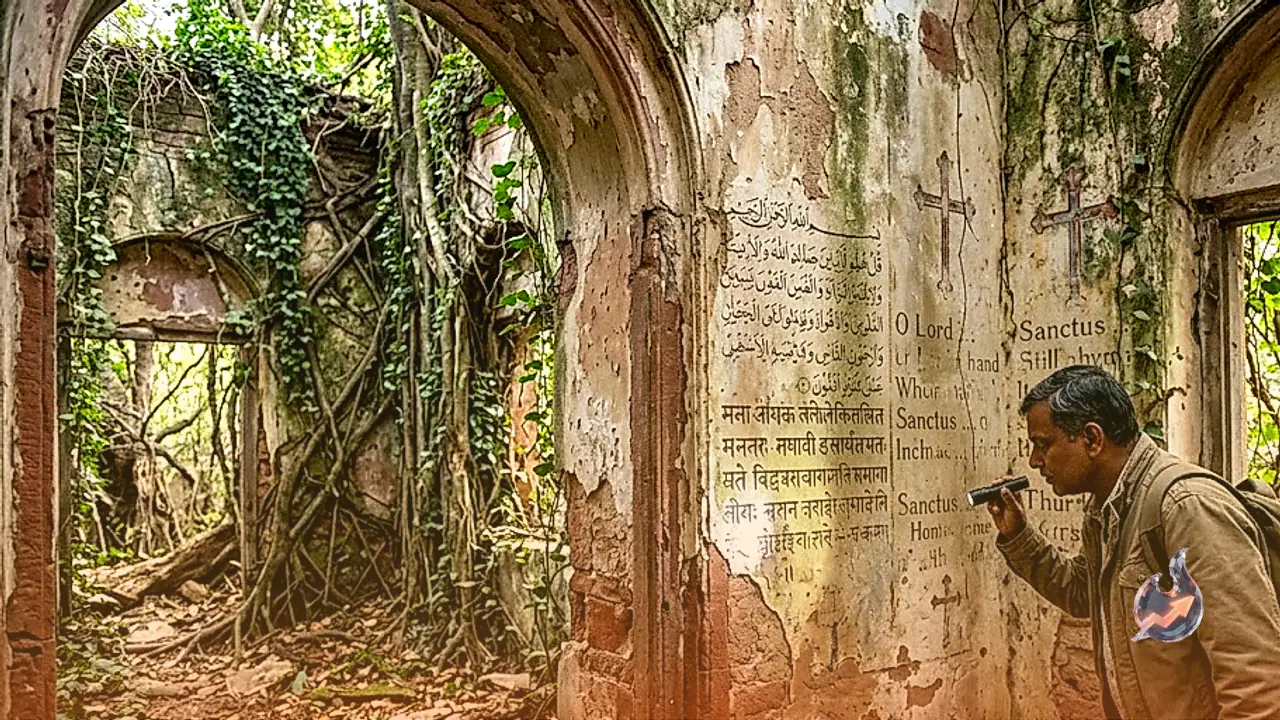
The most unusual architectural attribute of Shyam Kuti lies in the inscriptions covering its central interior walls. To counter recurring panic and alleged paranormal occurrences, extensive religious rituals and protective ceremonies were organized at the building in decades past. As part of these spiritual rites, sacred verses from three major religions were permanently inscribed directly onto the interior masonry.
Devki Baba explains that the central hall features Hindu mantras written in Hindi, Christian devotional prayers in English, and Quranic verses inscribed in Urdu script. The deliberate inclusion of these sacred lines across multiple traditions was intended to purge malevolent forces and grant eternal peace to any unsettled souls believed to linger on the grounds. Today, this unique convergence of faith and folklore remains a subject of intense intrigue for local observers.