














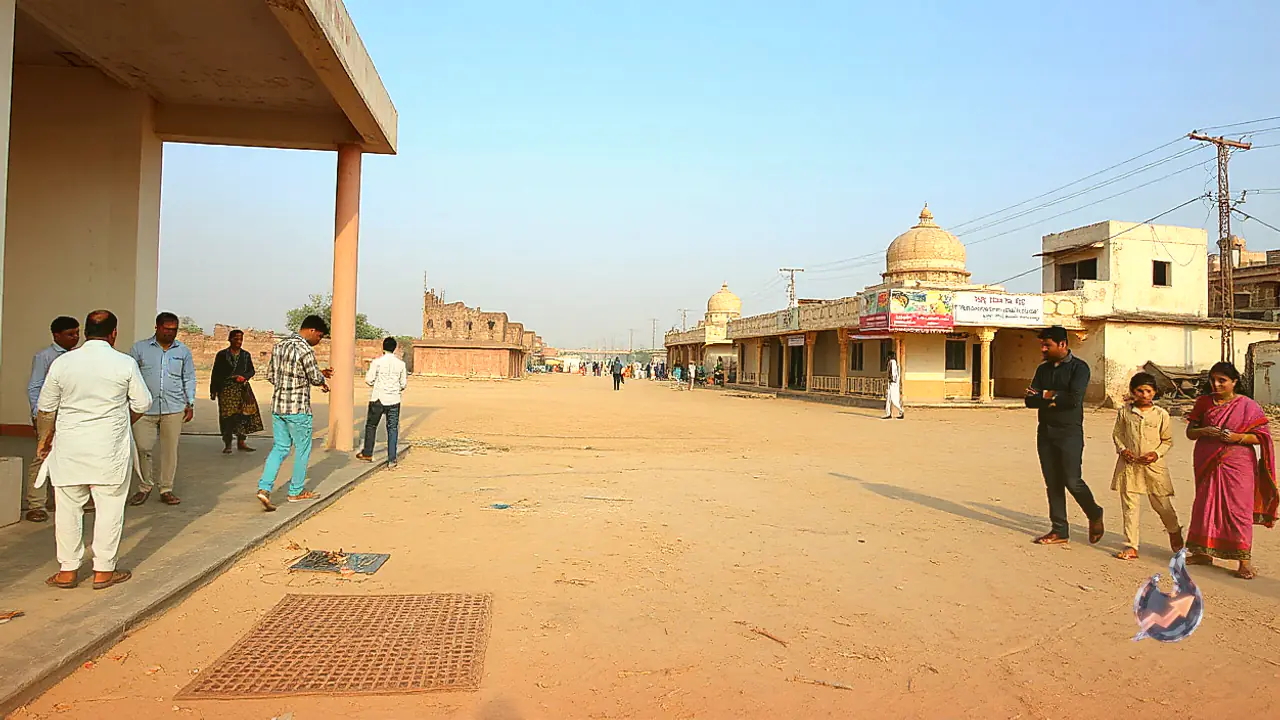

The Baraut assembly constituency in Baghpat district has historically stood out as one of the most politically charged and closely watched seats in Uttar Pradesh. Re-established in 2008 following a fresh delimitation process after its earlier run ended after 1969, the constituency encompasses the entire Baraut municipal area along with numerous surrounding villages across Baghpat. Administratively, Baraut forms a vital segment of the broader Baghpat parliamentary constituency and is officially designated as assembly constituency number 51. The demographic structure of the region is heavily defined by a dominant Jat population, alongside significant numbers of Muslim, Other Backward Classes, and general category voters. Since the 2008 delimitation, the constituency has witnessed three general assembly elections, resulting in two victories for the Bharatiya Janata Party and one win for the Bahujan Samaj Party. Interestingly, the Rashtriya Lok Dal has consistently finished as the runner-up in all three of these electoral contests.
BSP Brahmin candidate emerged victorious in the 2008 post-delimitation debut
The inaugural assembly election in Baraut following the delimitation took place in 2012, where the Bahujan Samaj Party made a strong opening statement by securing victory. Lokesh Dixit, contesting on a BSP ticket, gathered 57,209 votes to defeat Rashtriya Lok Dal candidate Ashwani Kumar by a margin of 5,676 votes. During this election, the RLD fought in alliance with the Congress party, and its candidate Ashwani Kumar finished his run with 51,533 votes. The Samajwadi Party lagged behind in third place, managing only 15,212 votes for its nominee Ajay Kumar. Meanwhile, the Bharatiya Janata Party faced a distant fourth-place finish, as voters awarded its candidate Naveen Kumar a mere 8,395 votes.
BJP swept the 2017 wave while BSP slipped to the fourth spot
Political momentum shifted drastically during the 2017 assembly elections as a powerful statewide wave swept the ruling party into a dominant position across Uttar Pradesh. The BJP secured an overwhelming 312 seats independently across the state, with Baraut falling comfortably into its column. Krishan Pal Malik of the BJP triumphed with 79,427 votes, while Sahib Singh of the RLD took the second spot by securing 52,941 votes. The BJP candidate clinched the contest with a commanding margin of 26,486 votes. In contrast, Lokesh Dixit, the sitting MLA and former BSP winner from 2012, managed only 22,071 votes to drop to fourth place, while Samajwadi Party contender Shokendra captured the third position with 28,376 votes.
BJP defended the seat by a razor-thin margin of 315 votes in 2022
The 2022 assembly elections witnessed the BJP successfully retaining the Baraut seat for a second consecutive term through an intensely fought battle. Krishan Pal Malik secured 90,931 votes to defeat RLD opponent Jayveer by an exceptionally narrow margin of just 315 votes. Despite the high-stakes friction, the ruling party managed to edge past its rival. Jayveer finished closely behind with 90,616 votes. The BSP finished in the third position during this cycle, with its candidate Ankit Sharma securing 11,244 votes, while Congress candidate Rahul Kashyap remained at the fourth spot with 1,849 votes according to data provided by the Election Commission of India.
Shifting political dynamics and upcoming projections for the 2027 elections
Reviewing the electoral trajectory in Baraut from 2012 through 2022 reveals that the winning party has consistently faced its primary challenge from the RLD. With two consecutive wins for the BJP, one for the BSP, and a nail-biting finish decided by 315 votes in the last cycle, the constituency remains fiercely competitive. Looking toward the 2027 assembly elections, the ground equations have fundamentally evolved since the RLD is now aligned with the BJP. This realignment places the BJP and RLD within the same political camp, while the opposition is likely to see the SP and Congress alliance on the opposing side. Meanwhile, the electoral footprint of the BSP has witnessed a continuous downward slide in the area, leaving questions about which voter base their future candidate might disrupt. Ultimately, the outcome of the 2027 electoral battle in Baraut will heavily rely on candidate selection, formal seat-sharing agreements, and the intricate mobilization of caste dynamics.