


















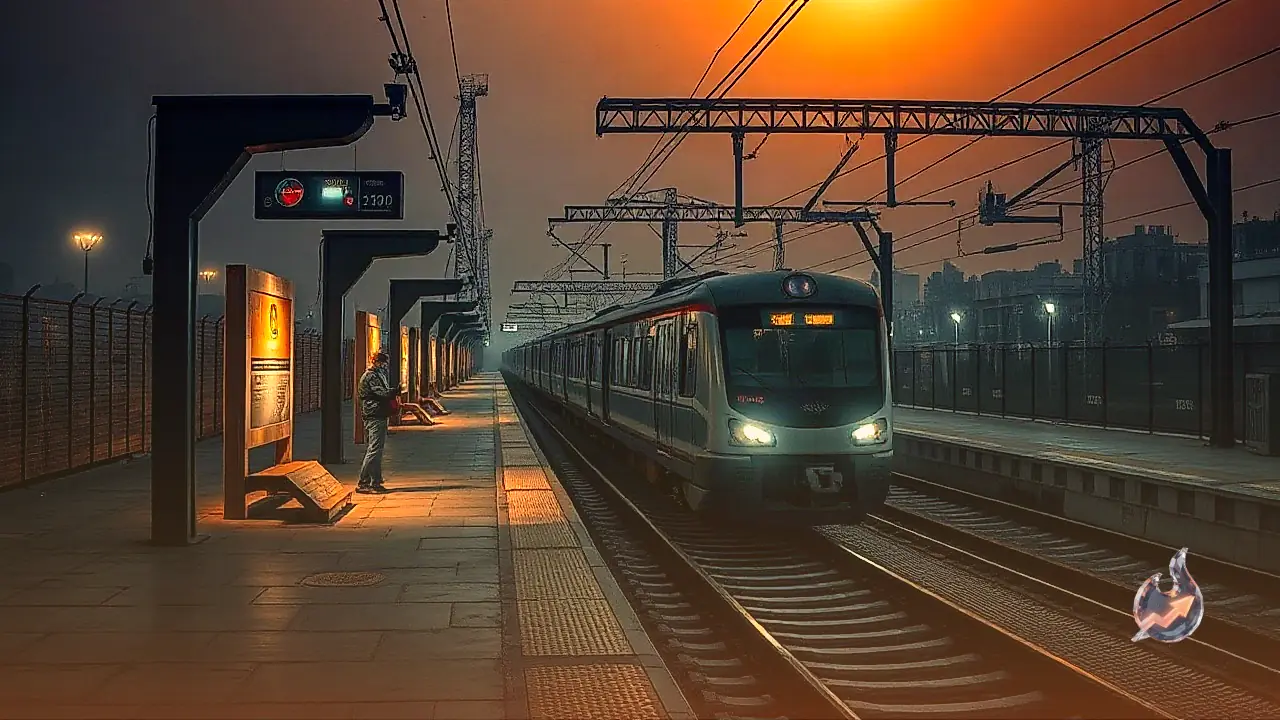

Urban transit in Kanpur is witnessing a significant transformation as expansion work across two vital corridors reaches advanced milestones. Commuters currently have access to operational services between IIT Kanpur and Kanpur Central railway station. Work on extending this initial route toward Naubasta in South Kanpur is virtually complete, while civil and systems construction on the second corridor connecting CSA University with Barra 8 is proceeding rapidly toward a December trial run target. The integrated transit web will bridge north and south Kanpur, providing a seamless commuting option for over 2.5 million residents.
Seven Stations Added in Corridor One Extension to Naubasta
Commercial metro operations in the city initially launched in December 2021 on the priority section between IIT Kanpur and Motijheel. That inaugural stretch featured stations at IIT Kanpur, Kalyanpur, SPM Hospital, CSJMU, Gurudev Chauraha, Rawatpur, LLR, and Motijheel. Subsequently, in May 2025, network coverage expanded from Motijheel to Kanpur Central, integrating Chunni Ganj, Naveen Market, Bada Chauraha, Nayaganj, and Kanpur Central into active passenger operations and taking the total tally on this line to 14 operational stations.
The ongoing south-bound extension of Corridor One stretches from Kanpur Central to Naubasta across seven newly built stops. To navigate dense civil terrain, Jhakarkati and Transport Nagar have been constructed as underground transit stations. In contrast, the subsequent stops at Baradevi, Kidwai Nagar, Vasant Vihar, Bauddh Nagar, and Naubasta feature elevated architecture above ground level. Civil work across these seven stations has wrapped up, and passenger operations are set to commence following final administrative approvals, bringing the corridor's total count to 20 stations.
Corridor Two Scope from CSA University to Barra 8
Parallel construction is reshaping public movement along Corridor Two, which covers eight stations connecting CSA University to Barra 8. The engineering alignment incorporates underground facilities at Rawatpur, Kakadeo, and Double Pulia, while CSA University, Vijay Nagar, Shastri Chowk, Barra 7, and Barra 8 are situated on elevated viaducts above ground.
Providing an update on site execution, Panchanan Mishra, Joint General Manager of the Public Relations Department, noted that work on Corridor Two is advancing briskly. The project team has established December as the timeline to initiate trial runs on this corridor. Following testing protocols and the completion of formal safety validations, passenger transit will open to the public. This link will directly connect major coaching and commercial centers in Kakadeo and Rawatpur with Barra and university campuses, eliminating cumbersome road detours.
Fleet of 39 Trains Across a 32.5 km Footprint
Once Corridor Two is commissioned, Kanpur's comprehensive metro grid will span approximately 32.5 kilometers. Transport authorities plan to deploy a total operational pool of 39 metro train sets across the interconnected network. To handle dense passenger movement during daily commuting hours, services are scheduled to run at five-minute headways.
Currently, passenger demand between IIT and Kanpur Central is managed by six to seven operating trains. Fleet deployment plans allocate between 16 and 22 trains on the Kanpur Central to Naubasta stretch, alongside roughly 10 trains dedicated to the CSA University to Barra 8 corridor. This extensive connectivity will significantly alleviate chronic vehicular gridlock across bottleneck arteries such as GT Road, Govindpuri bridge, and Dadanagar bridge.
Distance-Linked Ticket Fares
Passenger ticketing across the network operates on a graded distance-based slab system. Commuting for a single station from IIT costs 10 rupees, while travel covering two stations is priced at 15 rupees. Trips spanning three to six stations cost 20 rupees, and moving across seven to nine stations requires a fare of 30 rupees. For longer journeys, journeys across 10 to 13 stations cost 40 rupees, 14 to 17 stations cost 50 rupees, and traveling the maximum distance across 18 to 20 stations costs 60 rupees.