





















Seychelles, a small island nation in the Indian Ocean, is celebrated across the world for its turquoise lagoons and white-sand beaches. But for centuries, the archipelago has carried a secret far more gripping than any scenic view. Somewhere beneath its soil is believed to lie the world's greatest pirate treasure, valued at roughly 100 million pounds, equivalent to approximately 1,170 crore rupees. This hoard is widely regarded as the holy grail of lost treasures. More than 305 years have passed since it was hidden, searchers have come from every corner of the globe, and not one of them has found it. The legend has fascinated people on Seychelles and Reunion Island alike for generations.
The 1721 Raid That Set the Legend in Motion
The story traces back to Olivier Levasseur, a celebrated and feared French pirate of the 18th century, known for the terrifying speed of his attacks. His piracy career began in 1716 and by 1721 had reached its most audacious peak. That year Levasseur commanded 750 pirates who swept down on the Portuguese vessel Nossa Senhora do Cabo as it lay anchored in the port of Reunion Island under the British flag. The pirates seized the ship and killed every member of the crew. When they searched the hold, they were stopped cold by what they found inside.
The ship was, in every sense, a floating treasury. Its holds were packed with gold and silver bars, uncut diamonds, precious gemstones, gold guineas, gold and silver church plates, goblets and a vast quantity of other priceless objects. The scale of the plunder was so enormous that the pirates sailed to Madagascar to divide it. Every ordinary crew member received 42 diamonds and 5,000 gold guineas. Officers were awarded larger shares. The biggest and most valuable portion, however, Levasseur reserved entirely for himself.
A Secret Sealed Under Mahé
Levasseur chose Mahé island in Seychelles as the hiding place for his share of the treasure. He divided his crew into groups of 20. The treasure was first secured inside a cave, and when the moment came to move it to its permanent burial site, only a hand-picked team was present. After the burial was complete, those men were killed to ensure no one could ever disclose the location. From that point on, only one person in the world knew exactly where the treasure lay: Levasseur himself.
The Coded Message Thrown from the Gallows
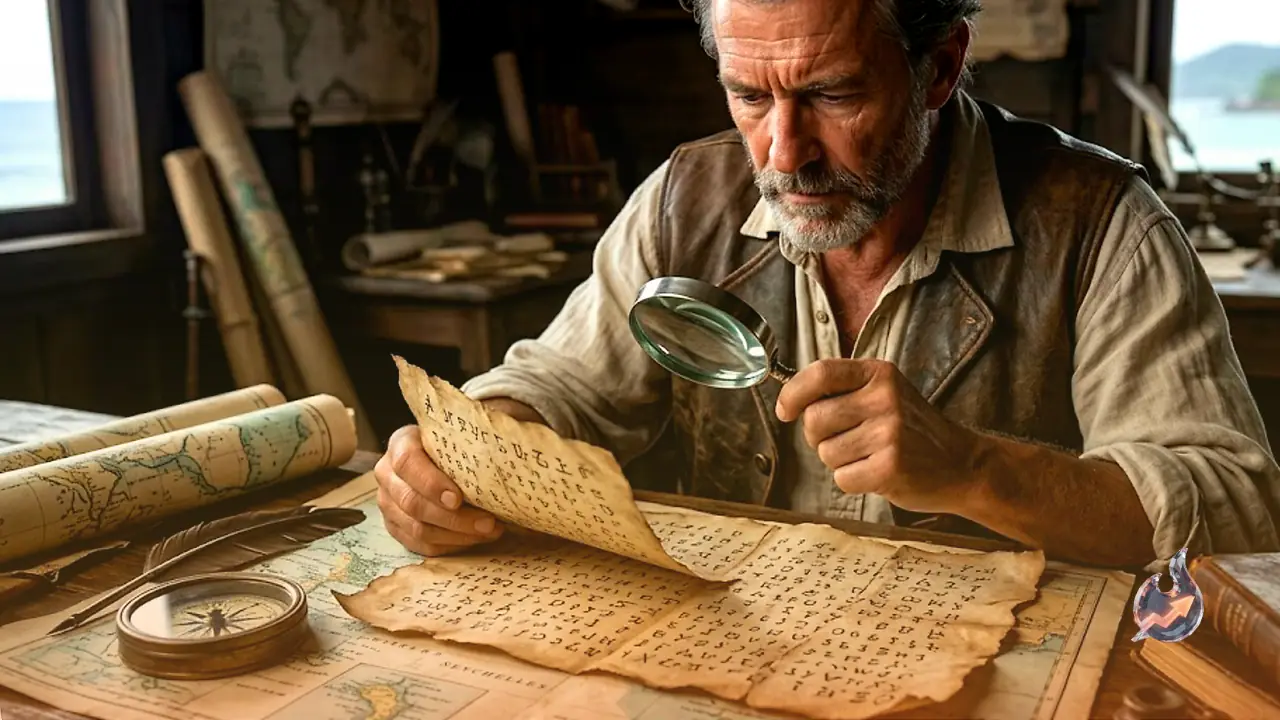
Levasseur was captured in 1730 and sentenced to hang. As he stood at the gallows he spotted familiar faces among the crowd gathered below. In his final moments he flung an old parchment into the air and shouted, "My treasure to the one who can understand this." The parchment proved to be a cryptogram of 17 lines. The British Museum has since confirmed that the document is a genuine 18th-century artefact. Levasseur was a scholar of Greek and Latin and possessed deep knowledge of Masonic symbols. The code he constructed was extraordinarily complex, and despite every effort made across three centuries, no one has managed to fully decipher it.
A Father and Son Who Gave Their Lives to the Search
Two men have poured their entire lives into the pursuit of this treasure. Reginald Herbert Cruze-Wilkins, known locally as the Treasure Man, dedicated 27 years of his life to the search. After his death in 1977, his son John Cruze-Wilkins took up the quest and has never set it down. John explains that his father used knowledge of Greek, Hebrew, astrology, astronomy, mythology and the occult to decode the cryptogram. His father's conclusion was that the treasure was buried in accordance with the riddle of Herakles. The location he identified is the Bel Ombre area on Mahé island, a breathtakingly scenic stretch where blue waters meet dense vegetation and towering granite formations.
When John walks visitors through that site, his eyes take on a particular brightness. He moves through the landscape like the protagonist of an adventure novel, maps and bags in hand, absorbed in a puzzle that has defined his life. Mahé is a small island where this legend is woven into everyday conversation and every child grows up knowing the story. Taxi drivers and guesthouse owners bring it up without prompting. Many locals consider John somewhat eccentric, but he refuses to be put off. For him the search is not primarily about money. It is his father's unfinished work, a lifelong passion and an unshakeable belief that the answer has not vanished but is simply still waiting.
Whether the treasure truly rests beneath the hills of Bel Ombre or has long since passed into pure legend, nobody can say with certainty. Yet Levasseur's cryptogram, his electrifying final words, and the fierce dedication of the Cruze-Wilkins family continue to draw thousands of fascinated visitors and treasure hunters to these quiet islands. Perhaps one day someone will find the final key to the puzzle. Until then, the question that has haunted Seychelles for over three centuries remains open: is a hoard worth 1,170 crore rupees truly still buried out there, waiting for the one person who can understand the clue?