


















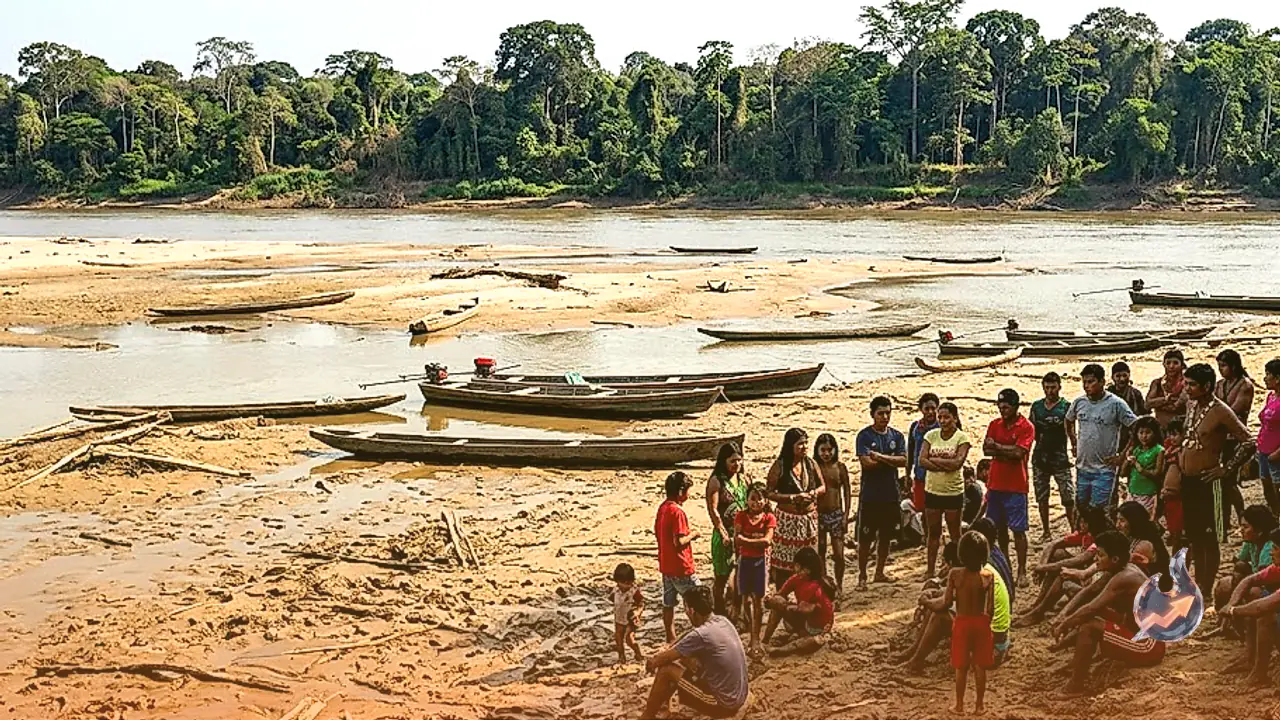

A critical transport deficit in the most isolated reaches of Brazil's Amazon basin threatens to disenfranchise remote Indigenous voters ahead of the October 29 runoff election. Across the Javari Valley in Amazonas state, where communities depend heavily on organized river travel to reach designated ballot boxes, shallow waterways and bureaucratic inaction have created steep barriers. Voters in this crucial round are scheduled to cast ballots in high-stakes races for both state governor and the national presidency.
State Electoral Court Dismisses Emergency Transport Plea
The Amazonas state electoral court turned down an urgent appeal for logistical assistance on Tuesday. The petition was submitted by Univaja, the civic association representing Indigenous populations throughout the Javari Valley. Judicial authorities justified the rejection by asserting that the legal filing arrived far too late for administrative action. The court further pointed out that extreme geographic distances combined with receding river depths create severe bottlenecks, slowing down watercraft and frustrating emergency transit planning.
In its written ruling, the bench emphasized that moving boats between spread-out settlements and polling stations was mathematically impossible in the time remaining before ballots open. Beyond river challenges, election officials highlighted unusual logistical hurdles in delivering voting hardware. Military aircraft had to be commissioned to transport electronic voting machines and election staff into inaccessible jungle sectors. The court noted that public agencies lacked the resources and rapid-response capabilities needed to orchestrate complex river journeys under current drought-like conditions.
High-Stakes Political Clash in Amazonas
The ballot carries heavy political consequences for the region and the country. Voters across Amazonas face a direct choice between President Luiz Inácio Lula da Silva and Sen. Flávio Bolsonaro. Bolsonaro, representing the far-right and running as the son of former President Jair Bolsonaro, has maintained a narrow edge in recent public opinion polls. The initial round of balloting highlighted deep regional divisions: Bolsonaro captured the urban stronghold of Manaus, whereas Lula swept the majority of interior riverine municipalities.
Treacherous Distances and Logistical Breakdown
Under Brazilian electoral statutes, public authorities are mandated to provide travel assistance to remote Indigenous communities. While certain villages inside the Javari Valley serve as centralized voting hubs for neighbouring settlements, severe geographic isolation persists. Some registered voters reside up to 895 kilometres away from their designated polling station. Undertaking these river voyages often demands between three and five full days of continuous boat travel, with the regional dry season drastically compounding travel times.
Eliesio Marubo, an Indigenous legal representative working with Univaja, disclosed that pre-election coordination collapsed prior to the opening round. "We usually help the electoral authorities organise the logistics so these voters can get to the polls," Marubo said. He stressed that administrative practices shifted drastically this cycle, noting that election officials made no initial outreach to arrange essential river transit.
Marubo directly linked the absence of municipal boat services to depressed voter participation earlier in the month, pointing to a very steep abstention rate during the primary vote. Although Univaja submitted its formal plea on October 13 to avert a recurrence, the judicial dismissal leaves the group fearful that large segments of the local electorate will remain physically unable to cast their ballots.
Legal Intervention and Geographic Realities
The Indigenous rights division of the Amazonas Public Defenders Office also lodged formal petitions with the government. Public defenders stepped in following direct alerts from community leaders and grassroots organizations detailing the impossibility of reaching river polling sites. The full magnitude of the expected voter suppression remains unquantified by official agencies.
Although the wider demographic footprint of the Amazon basin has shifted toward urban centres, significant family clusters remain settled in small jungle villages. Numerous riverside communities sit separated by days of water travel from the nearest municipal outpost. The Javari Valley ranks as one of the most secluded zones on the planet, home to roughly 6,300 inhabitants along with several groups living in voluntary isolation.
The Shadow of the 2012 Humanitarian Disaster
Securing the right to vote has historically carried severe human costs in this river territory. Until 2012, all registered voters had to journey to the border municipality of Atalaia do Norte to cast ballots. During that election cycle, a local mayoral candidate distributed gasoline to roughly 1,200 Indigenous travelers. However, the fuel rations proved insufficient for the return journey, leaving hundreds of people stranded along riverbanks for weeks without clean water, shelter, or sanitation.
The resulting conditions triggered a catastrophic health crisis when a rotavirus epidemic swept through the makeshift river encampments. Five Kanamari infants died of dehydration and complications, while approximately 100 additional individuals required emergency hospitalization. That disaster forced a reckoning within Brazil's electoral system, sparking urgent campaigns to move voting stations directly into native territories.
Reforms and the Legacy of Bruno Pereira
By 2014, authorities established the very first in-territory voting centres across the Javari Valley Indigenous Territory. That reform was spearheaded by Bruno Pereira, a veteran Indigenous rights defender who was murdered in 2022 alongside British journalist Dom Phillips while working on assignment in the valley. At the time of the post-2012 reforms, Pereira directed the local bureau of Funai, Brazil's Indigenous affairs agency.
During the aftermath of the 2012 tragedy, Pereira coordinated vital relief interventions, securing emergency food and clean water while establishing quarantine perimeters to prevent viral infections from invading interior villages. Later, Pereira collaborated with tribal leaders to map out navigation routes for deploying electronic voting machines via small riverboats, demonstrating that democratic access was possible even in deep forest environments.
Constitutional Guarantees and Environmental Context
Official inquiries directed to the Amazonas electoral court, the Brazilian Superior Electoral Court, and Funai yielded no public statements on the matter. Marubo stressed that the issue strikes at foundational civic protections: "The right to vote and run for office is guaranteed by the Constitution. That right is not being guaranteed, because authorities are responsible for organising the logistics so everyone can exercise it without difficulty," he remarked.
The electoral confrontation intersects directly with competing environmental visions for the Amazon. Deforestation spiked by 60 per cent during the administration of former President Bolsonaro. Conversely, Lula's incumbent administration recently celebrated data showing the lowest Amazon deforestation rate recorded in years. For the Indigenous peoples of Amazonas, however, high-level policy debates mean little without the basic river transport required to have their voices counted on election day.