






















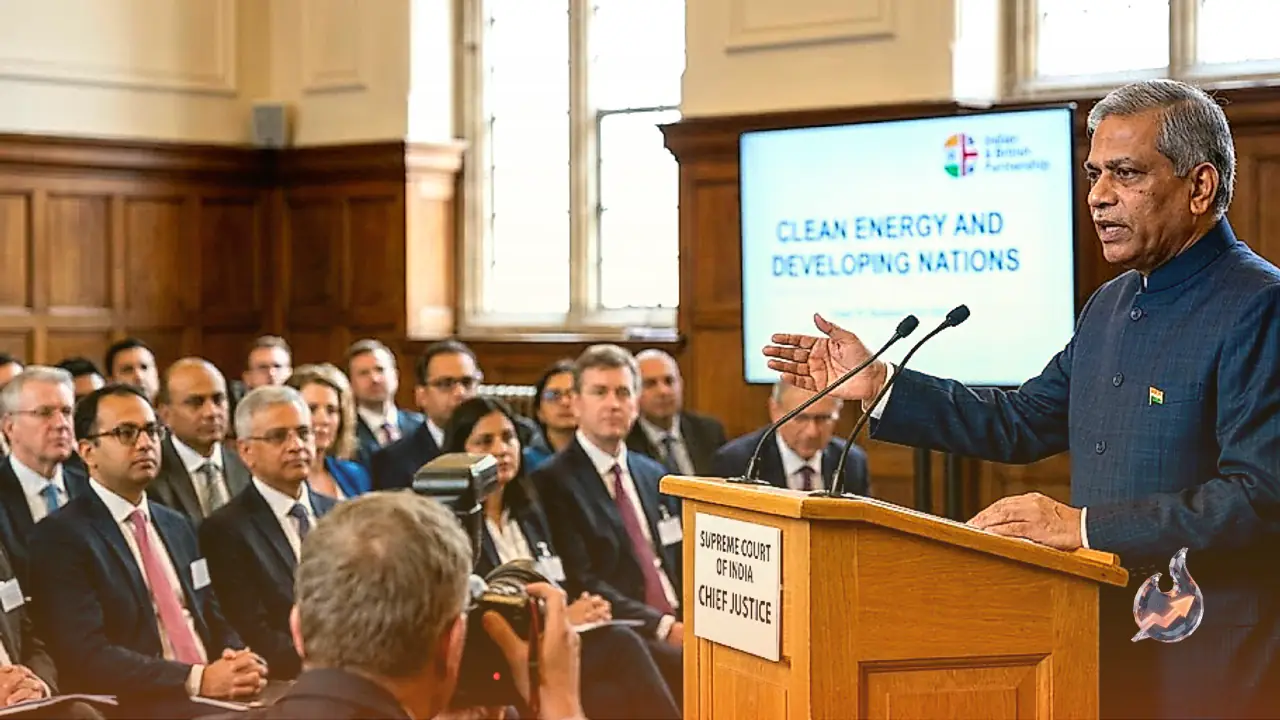

Chief Justice of India Suryakant launched a strong critique against developed nations over climate change policies and energy transition expectations. Speaking in London, he firmly stated that putting intense pressure on developing nations to urgently shift toward clean energy is entirely unjustified. He questioned how nations, which spent nearly two centuries exploiting coal and oil to build their own economic might, can now expect industrializing countries to make the transition to renewable sources overnight without facing unfair criticism.
Holding Up a Mirror to Developed Economies
According to news agency ANI, CJI Suryakant delivered these remarks on Friday at the High-Level Commonwealth Policy Dialogue on Climate Justice held at Marlborough House in London. During the gathering dedicated to discussing climate justice issues, he pointed out the unfair expectations placed upon Commonwealth nations. He argued that it is wrong for industrialized countries, which took two centuries to establish their own clean energy frameworks, to demand that nations currently undergoing industrialization make the same shift within a matter of decades, only to criticize them when they fall short.
The Dual Injustice of the Climate Crisis
Expanding on the gravity of the situation, CJI Suryakant noted that while the climate crisis is indeed a massive global challenge requiring a shift toward clean energy, the burden of this transition cannot be distributed equally across nations with vastly different realities. He explained that some countries have already achieved a level of industrial maturity allowing for rapid green transitions, whereas many others are still struggling to strengthen their basic industries, power grids, and domestic economies.
Historical Emissions Versus Modern Expectations
Highlighting the structural flaws in the current global dialogue, he pointed out a clear double injustice regarding the climate emergency. The first layer of injustice is that the severe impacts of climate change do not affect all nations and communities equally. The second layer involves bearing the immense economic costs of moving away from coal, oil, and gas. Those nations lecturing the world today on green energy built their own formidable economic strength through two centuries of heavy reliance on fossil fuels, yet they readily penalize emerging nations for taking a more gradual path.
Environmental Concerns Over Transition Minerals
CJI Suryakant did not restrict his observations solely to the historical use of fossil fuels. He also raised serious concerns regarding the environmental and social damage associated with extracting the critical minerals required for green energy infrastructure. He cautioned that the rush toward renewable technologies must account for the local ecological degradation and social disruptions caused by mineral mining, urging a more balanced and equitable global approach.