





















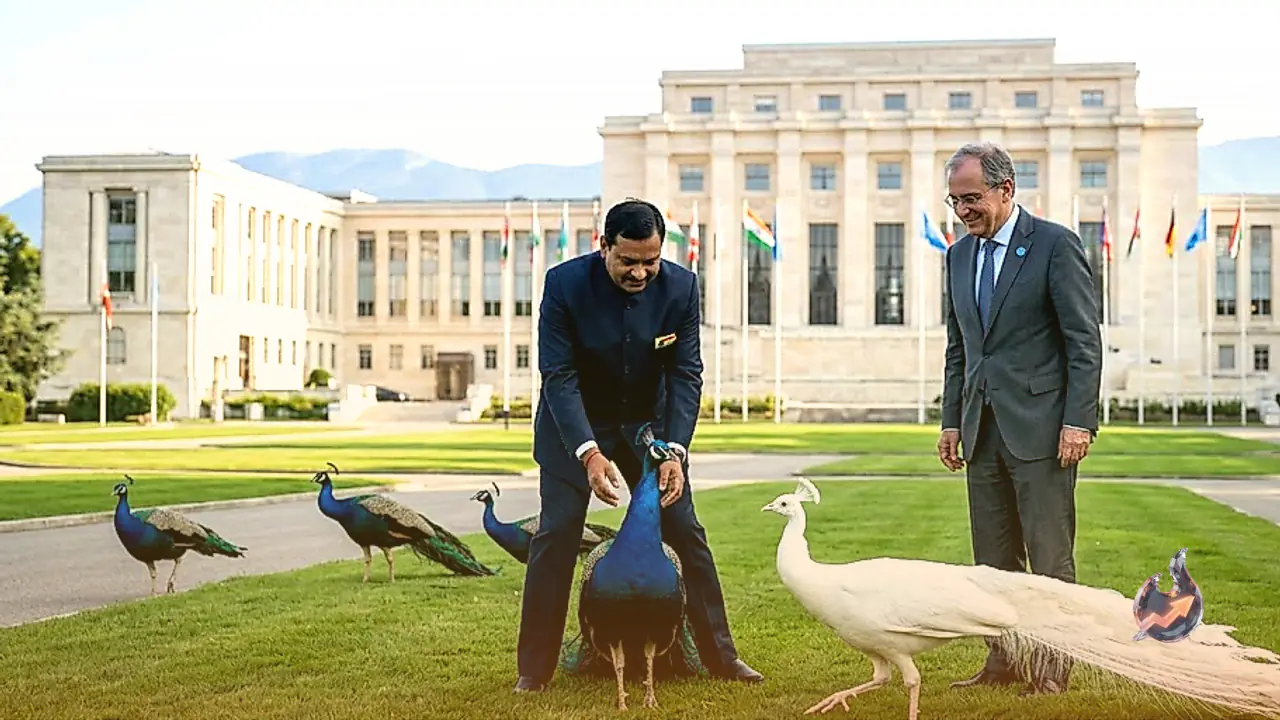

The United Nations European headquarters in Geneva is once again welcoming India's national bird to its sprawling grounds. India has transferred five new peacocks to the UN office, consisting of four common blue peacocks and one rare white peacock. These birds will roam freely across the historic Palais des Nations complex. This unique initiative involves much more than mere wildlife conservation or aesthetic enhancement, as it is tied to a historical condition dating back nearly two centuries and a diplomatic tradition initiated by India some forty-five years ago.
Only One Peacock Remained at the UN Compound
Historically, numerous peacocks used to wander openly around the Palais des Nations grounds. Over the passage of time, however, their population steadily dwindled until circumstances reached a point where only a single peacock was left residing on the property. This steep decline not only threatened to extinguish the local bird population but also endangered a longstanding historical custom that mandates the free movement of peacocks within the premises.
The 19th-Century Mandate Behind Free-Roaming Birds
The roots of this narrative stretch back to the nineteenth century. The land comprising Ariana Park, which forms part of the site where the UN European headquarters now stands, was originally granted under a specific historical stipulation. According to this condition, peacocks must be allowed to roam freely throughout the area. Their presence is therefore not merely decorative, but an integral part of the property's historical heritage. Even as the complex evolved into one of the most vital centers of global diplomacy, this avian tradition remained intact alongside it.
Indira Gandhi Sent a Breeding Pair in 1981
The connection between India and the Geneva peacocks previously made headlines roughly forty-five years ago. In 1981, the then Prime Minister Indira Gandhi dispatched a breeding pair of peacocks from the Delhi Zoo to Geneva. That pair established a new home within the Palais des Nations grounds, and their numbers gradually multiplied over subsequent years. The descendants of those birds sustained the campus population for decades, which is why India did not need to send replacement birds for a very long time. Now, in 2026, India has renewed this tradition after a gap of forty-five years.
Why No New Peacocks Were Needed for Decades
The forty-five-year interval between these transfers might initially seem unusually long, but it involved no political disputes or diplomatic estrangement. The original pair sent in 1981 and their offspring sustained the local bird community for generations. Peacocks typically live for fifteen to twenty years in natural surroundings, and occasionally longer under protected conditions. As time progressed, the descendants of the original pair aged and their numbers decreased due to natural causes, eventually leaving just one survivor and bringing India's role back into focus.
A Special Blend of Colors and Diplomatic Message
India has provided five peacocks this time, featuring four standard blue birds and one rare white specimen. The coloration of these birds carries a subtle alignment with the official colors of the United Nations. Thus, India's national bird reflects both the country's natural and cultural heritage while establishing a visual harmony with the identity of the global organization. The Indian national bird holds a cherished place in local culture and bears the scientific designation Pavo cristatus.
Official Handover and Ongoing Partnership
While the handover of the five peacocks resembles a wildlife conservation effort on the surface, it carries a distinct diplomatic message. The permanent representative of India to UN Geneva, Ambassador Arindam Bagchi, officially handed over the birds to the Director-General of UN Geneva, Tatiana Valovaya. This occasion highlighted the enduring cooperation and partnership between India and the international body. In a sense, India has not merely provided five birds to Geneva, but has sustained a tradition first initiated during the tenure of Indira Gandhi.