






















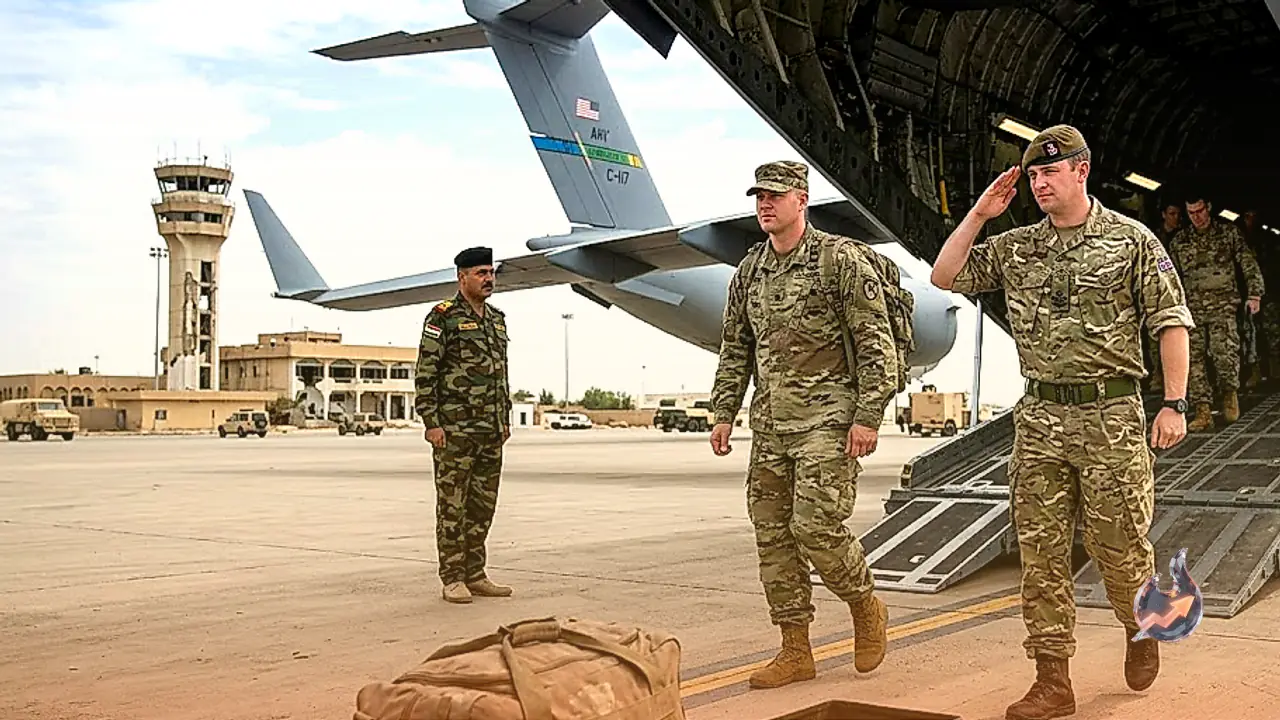

A military chapter spanning more than ten years reached its definitive end as the final contingents of British and American armed forces completed their departure from Iraq. The withdrawal involved roughly 100 remaining UK military personnel stationed in Irbil, situated within the northern Kurdistan region, operating in close coordination with American units that also exited on Wednesday. With the international coalition wrapping up its presence, domestic defence and security responsibilities across the country now rest entirely on the shoulders of Iraqi authorities. To commemorate this transition of power, Iraq declared a four-day national holiday designated as Sovereignty Days.
The scheduled military departure marks the fulfillment of a bilateral accord negotiated two years ago between Iraqi leaders and the United States, which established a deadline to pull foreign troops out before the close of the current month. Deployed in 2014 as the core of a multinational alliance to crush the sweeping territorial control of the Islamic State extremist faction, the forces have brought the mission known as Operation Inherent Resolve to a close. Iraqi Prime Minister Ali al-Zaidi highlighted the exit as a turning point, noting that the nation is now transitioning into an era where it assumes full authority over sovereign peace and defense.
Evaluating the Territorial Fall of IS and Ongoing Militant Remnants
Baghdad initially proclaimed victory against the territorial caliphate of the Islamic State in 2017, yet foreign coalition contingents remained on the ground to halt any underground resurgence. Reviewing the decade-long endeavor, the UK Ministry of Defence observed that sustained operational guidance, tactical mentoring, and structural capacity building enabled the Iraqi Security Forces alongside Kurdish Peshmerga fighters to secure the enduring territorial collapse of the terrorist network. British defense authorities stated that local units are now thoroughly prepared to shoulder primary responsibility for safeguarding their territory, clearing the way for future bilateral security partnerships steered by Iraqi commanders.
Reflecting on the drawdown from the northern airfield, Pentagon spokesman Sean Parnell stated that the coalition's departure from Irbil signifies the successful conclusion of the combat effort directed against the extremist group. Recent intelligence documented by the United Nations indicates that relentless counter-terrorism pressure applied by domestic armed forces has decimated the militant outfit down to several hundred scattered operatives, who remain capable of executing only rudimentary, unsophisticated operations. Nonetheless, Washington pointed out that maintaining stability against these residual cells as well as mitigating the influence of Iran-aligned paramilitary factions now falls squarely on the sovereign Iraqi administration.
Sectarian Armed Groups and Regional Escalations
The total departure of foreign boots on the ground leaves Iraqi authorities facing an entrenched domestic hurdle: heavily armed pro-Iranian militia factions. Prime Minister Zaidi, who assumed leadership in May, pledged to systematically disarm these autonomous armed networks and place every weapon under state command following the foreign military exit. However, prominent paramilitary groups have openly resisted disarmament efforts, raising fears that their political and security leverage could expand considerably in the void left by departing western soldiers.
The vulnerability of international bases was underscored earlier this year as hostilities involving the US, Israel, and Iran flared across the wider region, triggering frequent strikes against western personnel stationed in Irbil. Escaped tensions had already forced hundreds of NATO service members based in Baghdad to leave the country in March. By April, amidst a tenuous pause in hostilities between Washington and Tehran, transport aircraft carrying visiting personnel had to circle the northern airfield while incoming drones were being launched nearby. During peak periods of the confrontation, the Irbil base absorbed bombardment from up to 28 missiles and drones on a single day. Specialist RAF Regiment gunners shot down more than 100 aerial drones over the opening six weeks of combat, with a significant portion of those unmanned systems traced directly to Iraqi-based paramilitary units.
Capacity Building Statistics and Shifting Operational Centers
Marking the formal closing of the campaign, British military leaders highlighted the vast footprint of training delivered since the coalition was assembled. UK instructors provided extensive instruction, technical resources, and operational assistance to upwards of 111,000 personnel within the Iraqi Security Forces, a tally that encompasses over 21,000 Peshmerga fighters based across the autonomous Kurdish north. In the skies, the Royal Air Force carried out thousands of combat sorties, striking more than 2,300 hostile Islamic State targets. Royal Air Force aircraft are slated to sustain aerial patrols over Syrian territory to deny militants room to reorganize.
For its part, the United States Department of Defense affirmed that while its combat mission in Iraq has closed, technical partnerships will endure through specialized intelligence sharing and targeted instructional support. United States Central Command confirmed that the coalition joint task force remains active, having relocated its operational headquarters to Jordan. Furthermore, the American counter-terrorism mission will maintain its active deployment inside Syria, where United Nations analysts warn that approximately 3,000 Islamic State fighters remain scattered across remote pockets.
A Thirty-Year Cycle of Foreign Interventions
This historic exit marks the third separate occasion over the past three decades that British and American military personnel have pulled out of Iraq. A massive international force was initially dispatched in 1991 to push back Iraqi forces following Saddam Hussein's invasion of Kuwait. Western troops returned over a decade later in 2003 when US President George W Bush initiated Operation Iraqi Freedom to topple the regime and locate suspected weapons of mass destruction, stockpiles that were ultimately never discovered.
The protracted sectarian warfare and armed rebellion that erupted in the wake of the 2003 invasion took an immense toll on human life, claiming tens of thousands of Iraqi citizens alongside nearly 4,500 American military members and 179 British personnel. Allied contingents withdrew in 2011, only to be drawn back into the theater three years later when the rapid expansion of the Islamic State threatened to overwhelm the Iraqi state. With the completion of this final departure, the country now enters an uncharted phase governed entirely by its own domestic institutions.