























Security dynamics across the Asia-Pacific region are evolving rapidly as nations recalibrate their defense posture against rising security challenges posed by China. Following Donald Trump's return to the presidency of the United States, strategic expectations from Washington toward regional partners have shifted significantly. This adjustment has prompted several allied governments, including Japan, to accelerate domestic security self-reliance. As part of this broader regional push, multiple nations have moved to acquire BrahMos cruise missiles from India, with agreements already signed by some and others pursuing acquisitions. Amid these shifting alignments, Japan has achieved a pivotal military milestone by integrating a domestically engineered hypersonic strike capability directly into operational field units. The newly showcased weapon travels at Mach 5 or higher, exceeding 6,200 kilometers per hour. Moving at Mach 5, such a weapon could potentially reach the Chinese capital of Beijing in roughly 20 minutes. Modern air defense batteries face immense technical hurdles when attempting to track and neutralize incoming targets traveling at such extreme velocities.
Operational Readiness Displayed at Camp Fuji
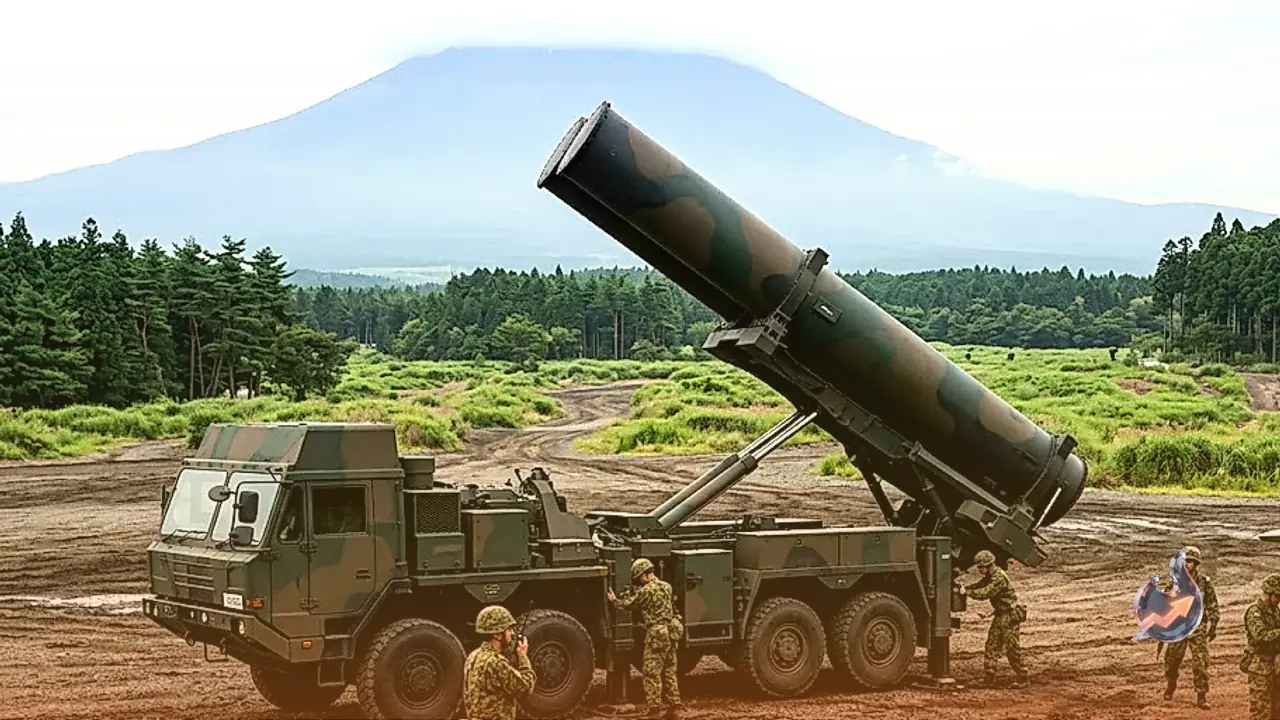
The Japan Ground Self-Defense Force (JGSDF) recently conducted a public operational demonstration of the Type 25 Hyper Velocity Gliding Projectile at Camp Fuji. Footage from the location showed Japanese military personnel driving the road-mobile launcher into a designated firing location, setting up the hardware into launch orientation, and subsequently withdrawing from the site. This sequence represents the clearest demonstration to date of Japan's first indigenous high-speed glide weapon operating in an active service context.
The platform relies on an 8×8 heavy road-mobile launcher carrying two large enclosed missile canisters. During deployment exercises, the vehicle enters the firing zone, hydraulically elevates both launcher canisters into an upright firing position, pauses, and then lowers them back onto the chassis before immediately vacating the area. This swift routine demonstrates high operational mobility, allowing artillery crews to position, prepare, and displace rapidly to evade counter-battery detection.
Island Defense Doctrine and Trajectory Maneuverability
Japan officially accepted the Type 25 into military service on March 31. The transfer marks the first time Japanese authorities have delivered domestically manufactured stand-off strike missiles directly to operational Self-Defense Force units. Defense Minister Shinjiro Koizumi indicated that the weapon provides Japan the capability to engage hostile forces from beyond the effective range of adversary fire envelopes. The system was engineered specifically to protect Japan's remote island chains from external incursions.
The projectile's flight mechanism differs fundamentally from that of standard cruise missiles. A powerful rocket booster propels the assembly to high altitudes above the atmosphere. Upon reaching the upper layer, the glide vehicle separates from the spent booster and descends toward the designated target at extreme velocities. During its terminal descent phase, the glider can execute complex trajectory adjustments. This maneuverability disrupts tracking algorithms utilized by contemporary air defense systems, making interception exceptionally difficult.
Comparison with Traditional Cruise Missile Systems
Japanese defense planners have withheld the precise operational range of the Type 25, though engineers are already developing follow-on iterations designed for significantly longer strike distances. The weapon forms a core component of a broader long-range strike strategy that incorporates updated Type 12 anti-ship missiles, purchases of American Tomahawk cruise missiles, and accelerated indigenous hypersonic projects.
Defense assessments suggest the Type 25 possesses an operational reach of roughly 1,000 kilometers, traveling at velocities of Mach 5 or higher during its approach. In comparison, India's BrahMos cruise missile features an export reach of 290 kilometers and an operational range of around 500 kilometers for domestic configurations, while flying at speeds between Mach 3 and Mach 3.5. Consequently, the Type 25 demonstrates approximately double the operational performance of the BrahMos platform in terms of speed and reach.
Defense White Paper Goals and Global Standing
Japan's 2026 Defense White Paper emphasizes accelerating the research, manufacturing, and procurement of diverse stand-off missiles across varied ranges, speeds, launch profiles, and carrier platforms. This military posture unfolds against expanding Chinese naval and aerial dominance in neighboring waters, which poses strategic challenges for Japanese territorial security. Fast, long-range glide weapons grant Japan the ability to target hostile warships and forward air installations without exposing Japanese combat jets, naval vessels, or submarines to direct adversary counterattacks.
By inducting this operational system, Japan has become only the fifth country in the world to field hypersonic glide vehicles inside an active military service branch. Prior to Japan's entry, only Russia, China, North Korea, and Iran maintained operational systems of this specific category.