























In response to mounting military pressures and an increasingly aggressive strategic posture from China, the government of Japan has significantly accelerated its defense procurement timelines. Within just three months of finalizing a major defense framework, Japan's Acquisition, Technology and Logistics Agency (ATLA), operating under the Ministry of Defense, evaluated competing corporate proposals and selected the Terra B1 interceptor drone system. This swift decision highlights Tokyo's urgent shift toward deploying counter-unmanned capabilities as integral components of its national defense architecture.
Rising East Asian Tensions and Japan's Defense Shift
Japan's official Defense White Paper places unprecedented emphasis on unmanned aerial capabilities, categorizing them as essential assets for future warfare. The strategic document explicitly labels military activities originating from Beijing as Japan's foremost strategic threat while expressing deep concern over China's rapid development of artificial intelligence (AI)-enabled unmanned platforms. Military experts emphasize that contemporary defense forces must prioritize weapons that can be mass-produced at manageable costs and rapidly adapted to shifting adversary tactics. The ability to seamlessly integrate battlefield lessons into hardware iterations and operational strategies is now recognized as the key determinant of victory in modern conflicts.
What is a Counter-Unmanned Aerial System (C-UAS)?
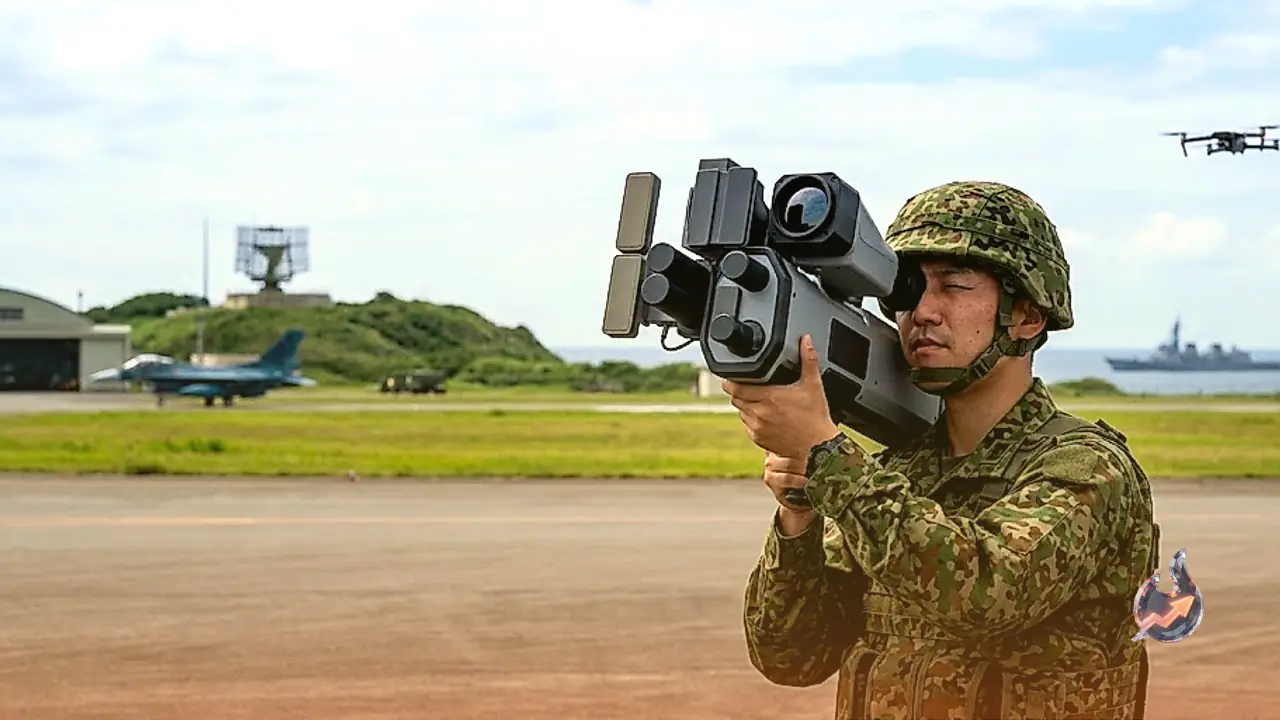
Technically designated as Counter-Unmanned Aerial Systems (C-UAS), anti-drone technologies form a specialized layer of modern air defense designed to detect, track, identify, and eliminate unauthorized Unmanned Aerial Vehicles (UAVs). Because small commercial and military drones possess minimal radar signatures and low flight altitudes, conventional air defense radars often fail to detect them, and costly traditional surface-to-air missiles prove economically impractical against low-cost aerial targets. C-UAS platforms solve this dilemma by deploying multi-layered sensor arrays and specialized effectors engineered specifically for low-altitude aerial threats.
The Three Operational Phases of Anti-Drone Technology
To successfully neutralize incoming aerial drones, counter-drone systems execute a precise three-phase operational workflow.
- Detection and Tracking: High-resolution radars, radio frequency (RF) sensors, acoustic sound detectors, and dual-spectrum electro-optical/infrared thermal cameras scan designated airspaces. Upon identifying suspicious aerial movement near sensitive boundaries, the system automatically alerts defense operators.
- Analysis: Advanced analytical software evaluates the target's telemetry, determining the drone's specific model, flight trajectory, velocity, and the origin coordinates of its control signals.
- Neutralization: Once confirmed as hostile, the system initiates counter-measures using either soft kill or hard kill protocols to render the threat harmless.
Soft Kill vs Hard Kill Neutralization Methods
Counter-drone systems employ two distinct methods to neutralize hostile targets depending on the operational environment. Soft kill mechanisms rely on powerful electronic warfare jammers to sever the radio command links or satellite GPS positioning signals between the drone and its remote operator. Deprived of guidance signals, the drone typically crashes to the ground or defaults to its automated return-to-origin protocol. Conversely, hard kill mechanisms are kinetic solutions deployed when immediate physical destruction is required. These utilize kinetic interceptors, directed-energy laser beams, anti-drone projectile weapons, or specialized missile interceptors to detonate the target mid-air.
Why Anti-Drone Systems Are Vital in Contemporary Warfare
The imperative for robust counter-drone technology stems from several critical tactical vulnerabilities exposed in recent global conflicts. Drones offer an asymmetric warfare advantage: while inexpensive to build and deploy, they can inflict millions of dollars in damages on high-value military infrastructure and strategic installations. Furthermore, nations like India face escalating cross-border security challenges, where illicit drones are routinely deployed to traffic narcotics, automatic weapons, and munitions across international borders. Additionally, the proliferation of 'loitering munitions'—or suicide drones capable of hovering undetected over battlefields for hours before striking—necessitates continuous, automated round-the-clock counter-drone defense shields.