














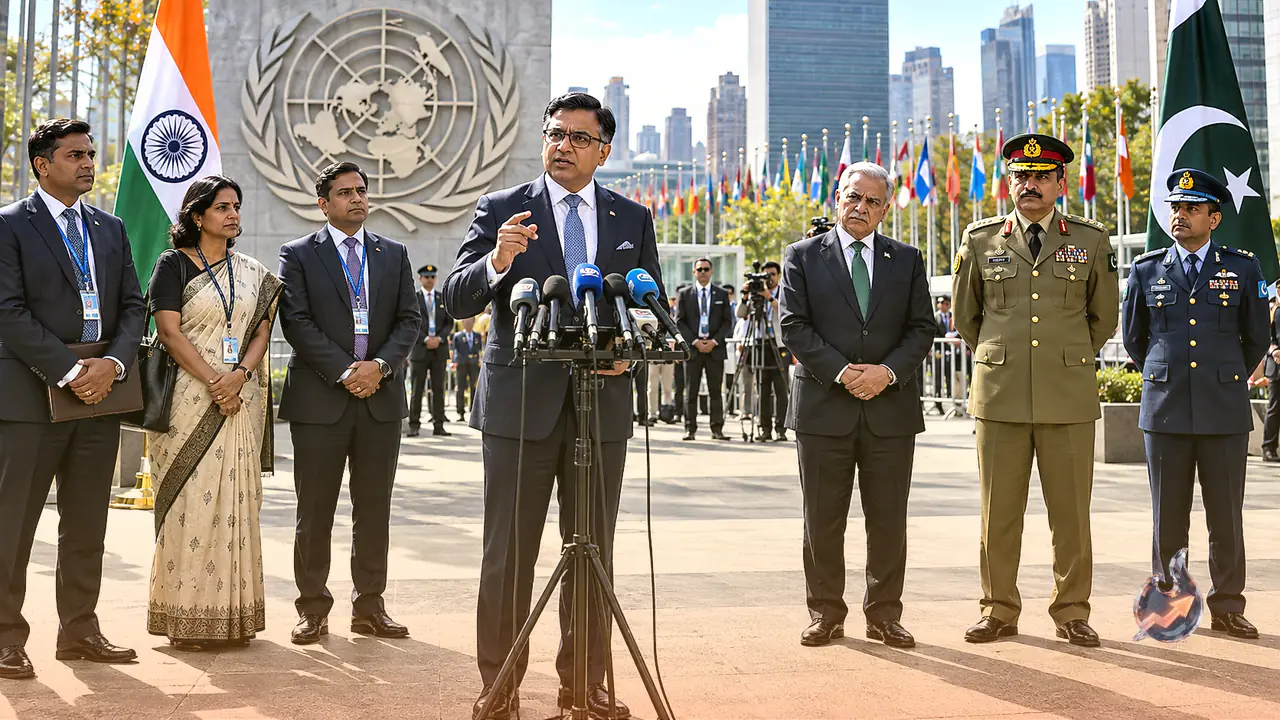

India launched a blistering counter-offensive against Pakistan at the United Nations, asserting that the Pakistani military operates as the country's true ruler and that the prevailing 'Form 47 government' lacks the courage to disregard military directives. These remarks were delivered during an interactive dialogue with the Special Rapporteur on minority issues at the Third Committee of the United Nations General Assembly. Raghu Puri, First Secretary at India's Permanent Mission to the UN, took direct aim at Islamabad, highlighting that its economy is in shambles, the nation is engulfed in chaos, and systematic human rights violations are rampant from Khyber Pakhtunkhwa to Balochistan.
Deflecting Attention From Internal Crises
Puri elaborated that in order to deflect mounting domestic pressure away from these pressing internal failures, Pakistan continuously resorts to distorting India's image on international platforms. He emphasized that within Pakistan's skewed political framework, the narrow interests of the armed forces remain paramount, with the military exercising decisive control over all governance matters. The persistent economic turmoil and widespread civil unrest have pushed the civilian setup to a subservient position where independent policy formulation is virtually nonexistent.
Decoding the 'Form 47 Government' Reference
Explaining the background of the term, 'Form 47' is officially designated in Pakistan as an electoral document that records provisional and consolidated voting results for specific constituencies. Following the general elections held in February 2024, widespread allegations of blatant rigging and massive irregularities surfaced, leading critics and political opponents to routinely invoke the term to question the legitimacy of the official outcome. Referencing this context, Puri underscored that an administration birthed through such disputed mechanisms remains entirely subservient to military command.
Calling Out Minority Rights Abuses
Addressing Pakistan's attempts to lecture others on minority rights, Puri pointed out that historical records starkly demonstrate a massive, continuous decline in the minority population of Pakistan since its independence. He urged the Pakistani delegation to heed the advice of their own citizens, thoroughly evaluate their internal state of affairs, and prioritize the basic welfare of their own populace. Referring to the report on minority issues, Puri reiterated that safeguarding minority rights remains fundamentally a sovereign responsibility, noting that domestic challenges must be addressed through established regulatory frameworks via open dialogue at multilateral forums.
Reiterating Stance on Jammu and Kashmir
Dismissing Islamabad's persistent fixation on raising the Jammu and Kashmir issue at global forums, Puri firmly reiterated that the region is an integral and inseparable part of India, with the only remaining pending issue being the vacation of territories under illegal Pakistani occupation. Highlighting India's rich civilizational ethos, he noted that the nation stands proudly as the world's most multi-religious, multi-ethnic, and multi-lingual society, where constitutional guarantees empower minorities across top government positions, defense, judiciary, and corporate spheres. Previously, Bhavika Mangalanandan, First Secretary at India's Permanent Mission, had similarly exposed Pakistan's persistent patronage of terrorism at the UN while invoking the Kargil War.