



















Pope Leo XIV chose the Fourth of July to make a pointed statement about migrant deaths at sea, travelling on Saturday to the small Italian island of Lampedusa to pray for those who never completed the crossing to Europe. The American-born pontiff stopped at a migrant cemetery, laid flowers on the graves and celebrated Mass for both longtime residents and people who had only recently landed. His journey unfolded on the very day the United States was marking the anniversary of its Declaration of Independence with rallies and fireworks.
An island at the heart of Europe's migration story
Lampedusa sits squarely in the middle of Europe's long argument over migration and continues to be one of the first places boats reach after crossing the sea. The island stretches just 9 kilometres end to end, has very few trees, and lies nearer to Africa than to the Italian mainland. Many of those who arrive set out from Libya or Tunisia, frequently after paying human traffickers to smuggle them across.
Leo greeted a group of migrants at the port before walking by himself out onto the sharp rocks of the jetty. A stiff wind tugged at his cassock and knocked the zucchetto skullcap off his head. He then blessed a plaque that dedicates the dock to Pope Francis, who had come to the island in 2013, and afterwards celebrated Mass ashore.
"This is a place where gestures speak louder than words. But for gestures to be human, they need a heart," Leo said.
A message aimed at Europe and America
The visit was widely read as a signal to both Europe and the United States about their obligations to vulnerable people. Leo has been at odds with the Trump administration over its immigration policies, and his words also nodded to America's own origins as a country built by immigrants. He insisted that the dignity of migrants belongs on the same list as other issues of life.
In a letter addressed to Americans for the July 4 anniversary, Leo tied the defence of life directly to standing up for migrants. "To receive them with compassion and generosity is not only an act of charity, but also a recognition of the dignity that belongs to every human person," he wrote. He argued that the hopes and sacrifices of migrants had helped shape the story of the United States from its earliest days.
"A miracle of compassion"
Over the past several years Lampedusa has turned into what many call the Ground Zero of Europe's migration debate. Governments across the continent have tried to police their borders while still honouring their legal duty to take in refugees, even as people keep fleeing war, a changing climate and poverty. Wearing vestments patterned with images of waves, Leo used his homily to thank the islanders for what he called a "miracle of compassion" and pressed Europe to live up to its responsibilities.
"Indeed, before any intellectual consideration or ideological conviction, the encounter with those who lie before us, stripped of everything, calls us to be close to them," Leo said.
He urged European leaders to treat migration as something to be handled broadly and with careful planning. That meant both immediate help and longer-term measures to receive, protect, support and integrate those who arrive. He also called for real development in the countries people are leaving, so that no one feels forced to go. His appeal blended hands-on humanitarian action with hard policy thinking.
"Here you have seen not just one, but thousands of human beings fallen into the hands of robbers who have taken everything from them, beaten them brutally and walked away, leaving them half-dead," he said. "Others have died making the voyage, yet we feel their presence, which challenges us no less than that of those who have landed in need of attention and aid."
Fewer arrivals, but no less danger
Italy has logged fewer arrivals so far this year than in recent stretches. The Interior Ministry counted 14,464 arrivals as of Friday, against 30,598 over the same span a year earlier and 26,202 back in 2024, a clear dip in landings.
Yet the toll of deaths and disappearances across the Mediterranean remains grim. The International Organisation of Migration has logged more than 35,000 missing migrants since 2014, and the real number is thought to be higher still because so many shipwrecks are never even reported, leaving countless losses uncounted. Salvatore Sortino, the IOM's head of mission for Italy and Malta, said the danger has not lessened. Deaths, he noted, have actually risen in proportion even as arrivals fall. "That speaks about the vulnerability that remains," he said, adding that the visit mattered because Lampedusa is where these events actually play out.
Crosses carved from shipwrecked boats
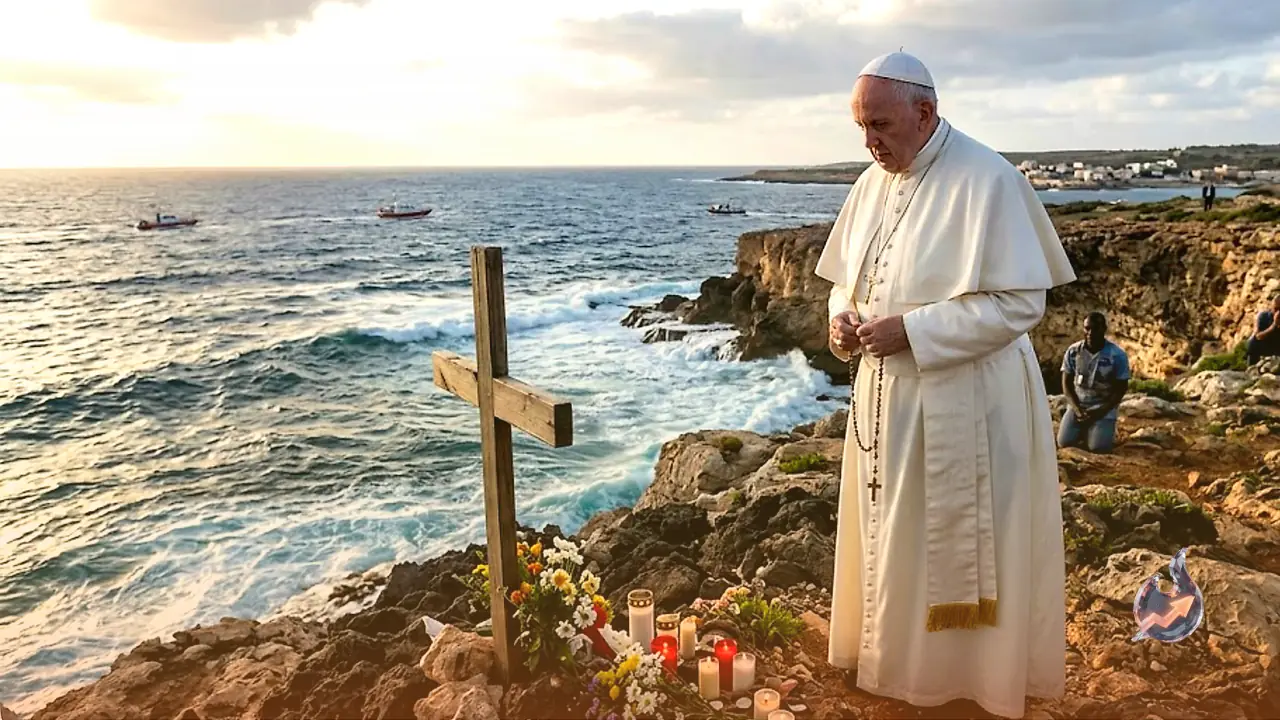
After landing by plane, Leo made his way to the island's migrant cemetery, where he set down a wreath of yellow and white flowers on graves marked only by plain crosses, each one fashioned from splintered wood salvaged from boats that had gone down. The gestures were meant to honour the dead.
Tareke Brhane, a migrant from Eritrea, said such acts carry real weight for grieving families. Brhane heads the October 3rd Committee, a nonprofit set up by relatives of victims after a 2013 shipwreck near Lampedusa that killed 368 people, and he said families are still fighting to have their lost loved ones officially recorded. "The gestures send a strong message of solidarity," he said. "It is a strong sign for our battle with Italy and with Europe in order to register the deaths, because as of today we still do not have a registry of those deceased." He added that "Leo's visit both honours the dead and gives a message to the relatives, so many of them still waiting and suffering."
Following in Francis' footsteps
Leo's trip retraced the path laid down by Pope Francis, who made migrants one of his central causes. Francis came to Lampedusa in July 2013, his first journey outside Rome after being elected, threw a wreath into the sea for the dead and denounced what he called the "globalisation of indifference" toward migrants.
Leo has also been speaking directly to Europe's Christian leaders in this period. Last month he travelled to Spain's Canary Islands, another migration hot spot, where he criticised leaders who send migrants away without a second thought and warned people smugglers that God's wrath awaits those who exploit the desperate. The Vatican has kept its attention fixed on dignity and protection.
By choosing Lampedusa on one of America's biggest civic holidays, Leo knotted together faith, memory and hard questions of policy. The timing set the deaths of migrants right alongside the celebrations of American independence. Islanders, new arrivals and bereaved families stood at the centre of the day, and the trip sharpened his calls for dignity, for a proper record of the dead, and for safer responses to those who keep coming.