























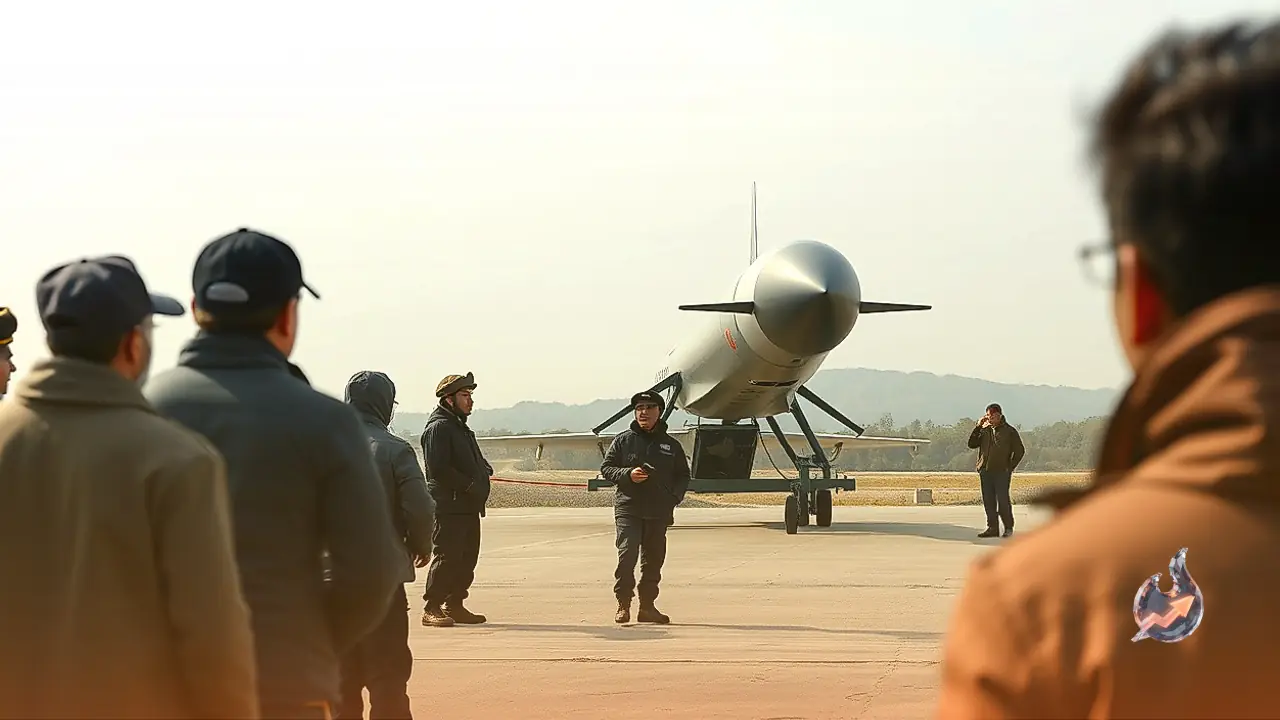

South Korea has marked a major milestone in its strategic weapons development by carrying out the maiden test of its domestically produced hypersonic missile. The firing took place on Thursday, October 8, with South Korean President Lee Jae-myung personally attending the site to observe the trial. Engineered to fly at least five times faster than the speed of sound, the new platform is specifically designed to evade and bypass sophisticated missile defense arrays. While defense observers widely view the move as a direct signal following North Korea's recent ballistic activities, South Korea has stopped short of framing the test as an explicit retaliatory measure.
Mid-Flight Maneuverability and Anti-Defense Capabilities
The defining operational capability of this newly unveiled weapon lies in its extreme velocity combined with an ability to alter its trajectory mid-flight. Standard hypersonic weapons operate at velocities exceeding Mach 5, creating an engagement window so narrow that conventional air and missile defense systems struggle to intercept them. Furthermore, unlike ballistic projectiles that follow predictable parabolic arcs, this weapon can adjust its flight path during descent, making real-time tracking and targeting exceptionally complex for ground-based radars.
During the operational test, a dedicated booster rocket propelled the payload to a designated altitude before separation. Once detached from the carrier rocket, the glide unit initiated its downward trajectory toward the target zone. Throughout this high-speed glide phase, the weapon performed horizontal and vertical maneuvers, shifting left, right, up, and down before striking its intended coordinates. Authorities noted that upon full operational readiness, the weapon will provide South Korea with the capability to deliver rapid, precise strikes against critical strategic locations across the Korean Peninsula. Nevertheless, technical experts emphasize that the program remains in its evaluation phase and cautioned that designating the system as combat-ready would be premature.
Strategic Firing Follows North Korean Launch
The test occurred roughly a week after North Korea staged its own high-profile launch, having claimed the test of an intermediate-range hypersonic missile on October 3. That previous event triggered sharply conflicting tracking assessments among regional military observers. While North Korean authorities insisted their missile travelled a distance exceeding 1,000 kilometers, South Korean defense officials estimated the flight path to be slightly over 700 kilometers. Japan's defense ministry offered an even lower figure, noting the projectile traveled approximately 680 kilometers before splashing down into the sea outside Japan's exclusive economic zone.
The discrepancy in tracking data prompted sharp rhetoric from Kim Yo Jong, the sister of North Korean leader Kim Jong Un. She publicly criticized the variance between the American and South Korean intelligence assessments, asserting that neither Washington nor Seoul possessed the technological capability to reliably track or counter hypersonic weapons. South Korea's latest domestic trial underscores how rapidly the technological arms race across the Korean Peninsula is accelerating, with both sides prioritizing high-speed strike platforms that neutralize conventional interception networks.