























The military conflict between Ukraine and Russia has escalated into one of its most intensive aerial phases of 2026, following a massive Ukrainian drone assault involving 822 unmanned aerial vehicles aimed at targets inside Russian territory. Russian regional authorities confirmed that nearly 600 of these drones targeted the Moscow region alone, marking one of the heaviest concentrated strikes on the Russian capital since the full-scale conflict began. In response, Russian forces unleashed heavy missile and aerial bomb counter-strikes hitting 13 Ukrainian regions. The combined casualties across both countries have reached at least 14 fatalities, along with dozens of civilians wounded and extensive damage to industrial and civilian infrastructure.
Massive Drone Offensive Targets Moscow Region and Border Provinces
According to Russian official accounts, the overnight wave represented the largest-scale coordinated drone attack launched by Ukrainian forces this year. The regional governor of Moscow highlighted that the capital region had endured one of the most massive aerial bombardments in recent memory. A major impact occurred in Koledino, located roughly 25 kilometers (15.5 miles) from the center of Moscow, where a drone struck a warehouse complex owned by Wildberries, Russia's prominent online retail enterprise. Moscow Mayor Sergei Sobyanin confirmed that three workers sustained injuries in the strike, which triggered a massive blaze and sent dense columns of dark smoke into the sky.
Wildberries, frequently described as Russia's direct commercial equivalent to Amazon, has faced repeated long-range strikes since July. Strategic defense officials in Kyiv have previously stated that these logistics centers are primary targets because they serve as key supply hubs used by Russian military procurement channels to purchase and distribute equipment to frontline units. Beyond the Moscow region, violence flared across south-western border zones. The governor of the Rostov region reported that overnight strikes claimed five lives, while additional civilian casualties were registered in the Belgorod region bordering Ukraine as well as around Moscow, bringing the total Russian death toll from the attack to seven.
Russian Retaliatory Missile Strikes Devastate Kyiv and Defense Plants
Following the drone wave against Russian targets, Russian forces initiated severe retaliatory missile strikes directed at multiple Ukrainian cities and industrial hubs. These strikes killed at least seven people and injured more than 39 others across Ukraine. In the capital city of Kyiv, air-raid sirens echoed four times overnight, forcing residents into emergency shelters. Kyiv Mayor Vitali Klitschko reported that at least six individuals, including a young child, suffered injuries during the overnight barrage.
The Russian Defense Ministry stated that its weekend bombardments targeting Kyiv were focused on destroying key facilities within Ukraine's military-industrial complex. Specifically, Russian military command stated that their missiles hit a FirePoint industrial facility responsible for manufacturing vital components for Ukrainian Flamingo missiles, alongside another plant engaged in producing specialized drone components. However, the impact of these strikes extended far beyond military sites, causing substantial destruction across civilian neighborhoods and commercial districts.
Destruction of Civilian Infrastructure and Cultural Shock in Kyiv
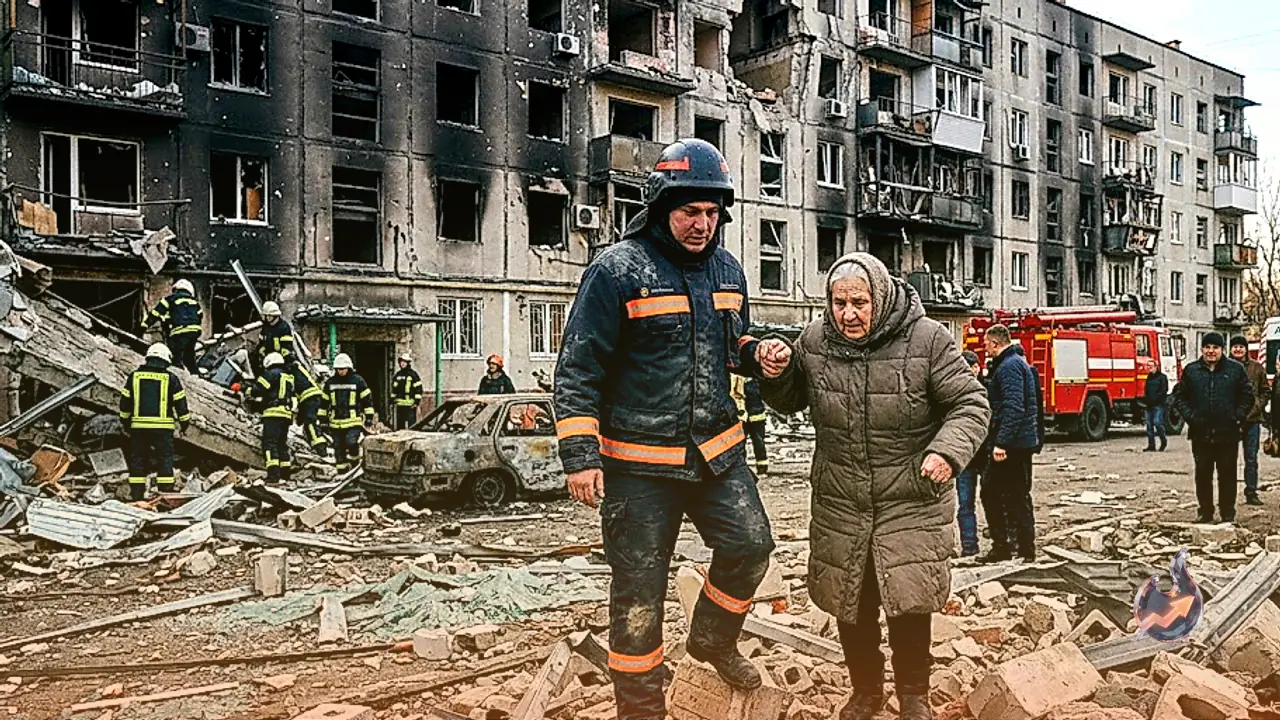
Among the non-military sites severely damaged in Kyiv was a well-known book market situated in the Pochayna district. Emergency firefighting crews spent hours pouring water over burning structures and clearing debris, while charred literature lay strewn across the pavement. Sixty-nine-year-old Valentina surveyed the ruin of the market where her husband operated a book stall, picking through the ashes. She recounted seeing her husband's books scattered across the street and reflected on how surreal such sudden devastation feels when it directly shatters one's personal life.
In the same commercial area, 42-year-old Luba, who owned a specialized vinyl record shop, reported devastating financial losses amounting to 500,000 hryvnias (approximately £8,262) in destroyed inventory. Describing her business as a personal passion project built over years, she explained that many of the destroyed vinyl records were rare and irreplaceable pressings. She expressed intense bitterness over the destruction of her store and the ongoing destruction wrought upon civilian livelihoods by the war.
Weekly Bombardment Figures and Statement from President Zelensky
Ukrainian President Volodymyr Zelensky outlined the immense scale of recent aerial attacks, stating that 13 different administrative regions across Ukraine had come under fire over the past week alone. According to data provided by the Ukrainian leadership, Russian forces launched over 1,550 attack drones, nearly 1,560 guided aerial bombs, and 62 missiles within a seven-day window. President Zelensky emphasized that wherever Russian ballistic missiles are capable of reaching, civilian infrastructure inevitably becomes a target for destruction.
Both warring nations continue to accuse each other of striking non-combatant civilian populations and vital energy infrastructure. As long-range weaponry grows more sophisticated, the risk to civilians on both sides of the border has intensified, with long-range weapons frequently striking urban centers, commercial warehouses, and residential neighborhoods far removed from active frontline trenches.
Strategic Landscape of the Ongoing Conflict
More than four years after Russia initiated its full-scale invasion of Ukraine in February 2022, Russian forces maintain control over approximately one-fifth of Ukrainian territory. Ground operations along the extensive front line have largely devolved into an attritional stalemate, where neither side has managed to secure rapid or decisive territorial breakthroughs despite significant personnel and material commitments.
As a direct consequence of the static ground front, the conflict has predominantly evolved into a high-intensity aerial war. Both military commands rely heavily on long-range missile salvos and massed drone swarms to systematically weaken the opponent's logistical capacity, military production capability, and economic infrastructure. The deployment of 822 drones by Ukraine and Russia's immediate counter-strikes underscore how aerial warfare has become the primary operational domain driving the conflict forward.