























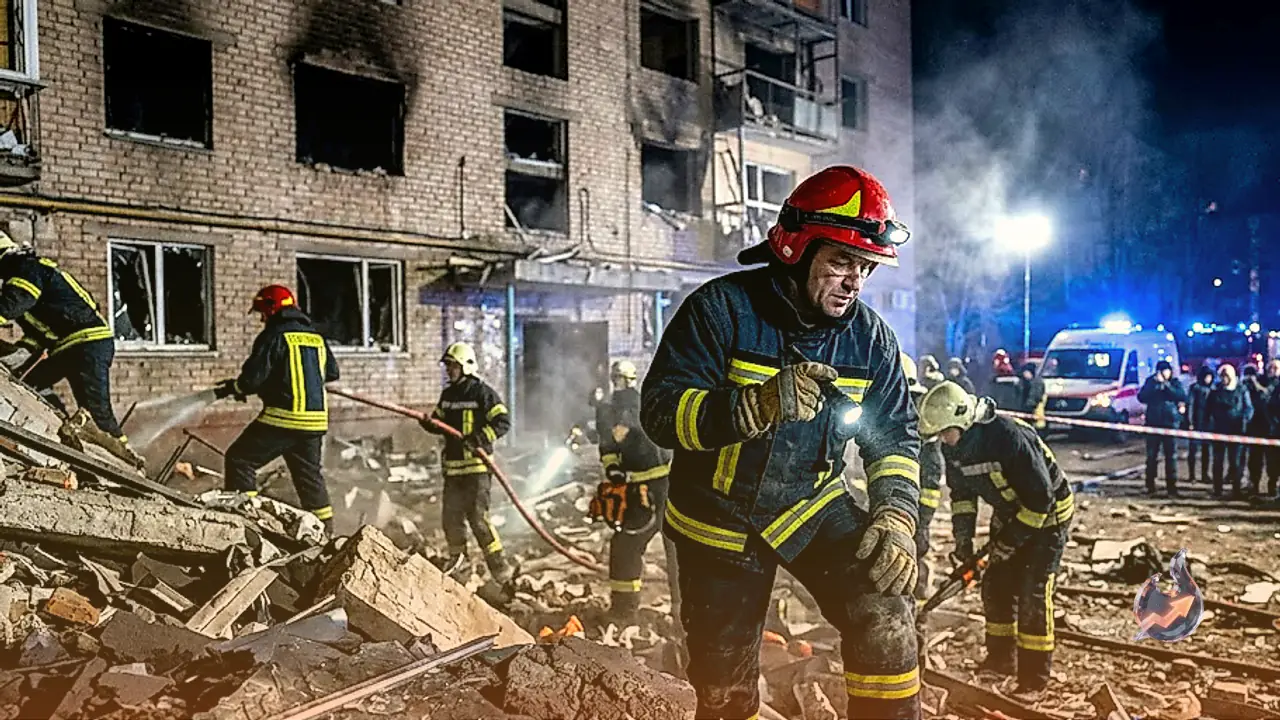

A nighttime barrage of ballistic missiles and kamikaze drones devastated Ukraine's capital city, resulting in the loss of at least 15 lives and injuring more than 50 residents. The surprise assault hit multiple neighborhoods while citizens slept, marking one of the most violent air strikes launched against Kyiv during the current year.
Devastation Across Seven Districts as Sirens Echo
Military officials supervising the defense of Kyiv confirmed that the incoming air raid involved a coordinated combination of high-speed ballistic missiles and suicide drones. The bombardment targeted at least seven separate districts across the capital, creating chaos as explosions echoed through the midnight hours. For over an hour, air defense sirens sounded continuously across the metropolis, forcing frightened residents out of their homes and into underground metro stations and reinforced bomb shelters.
This fatal strike comes amid a sharp escalation in cross-border violence. Over the preceding days, reciprocal attacks between Russian and Ukrainian forces had already claimed more than 27 lives. Rather than moving toward a pause or ceasefire, the conflict—now stretching into its fifth year—is growing increasingly destructive, with civilian infrastructure taking a severe toll in major urban centers.
Search Operations Underway at Damaged Warehouses
Emergency responders from Ukraine's State Emergency Service rushed to multiple destruction sites shortly after the impacts. Emergency workers cautioned that rescue operations were being conducted under high-risk conditions due to the constant threat of secondary strikes targeting the same areas. First responders continue to sift through burning rubble and shattered concrete to locate survivors.
In the central area of Kyiv, a massive commercial warehouse building was completely demolished by a direct impact. Kyiv Mayor Vitali Klitschko stated that emergency personnel successfully pulled two survivors from the heavy debris of the ruined warehouse. He noted on Telegram that additional victims might still be trapped under the collapsed structure, emphasizing, "Search and rescue operations are ongoing." Klitschko previously confirmed that air defense units were heavily engaged in intercepting incoming aerial targets across the sky, while Kyiv Military Administration Head Tymur Tkachenko reported that enemy forces had unleashed another large-scale offensive targeting the capital region.
Air Defense Shortages and High-Stakes Diplomacy
The tragedy highlights Ukraine's growing vulnerability to air attacks as defensive stockpiles run low. Earlier in the week, Ukrainian President Volodymyr Zelenskyy pointed out that an acute shortage of ballistic missile interceptors leaves Ukrainian skies exposed, directly encouraging enemy forces to carry out lethal missile strikes against populated cities.
To address this critical gap, President Zelenskyy traveled to Washington on July 28 to hold direct talks with US President Donald Trump. During their meeting, the Ukrainian leader lobbied Washington for approval and technical licenses to manufacture Patriot missile defense systems domestically. Ukrainian defense strategists believe that local production of advanced interceptors is essential for maintaining long-term protection over major population hubs.
Escalating Conflict and Mounting Civilian Toll
Despite diplomatic efforts, peace initiatives proposed by US President Donald Trump have failed to achieve any concrete breakthrough or halt hostilities. Over recent weeks, Moscow has steadily intensified its aerial campaigns against Kyiv and other key Ukrainian centers. In response, Ukrainian military forces have carried out retaliatory strikes against Russian power plants, electrical grids, and critical civilian infrastructure across the border.
This aggressive cycle of action and reaction signals that neither side is ready to back down. Human rights monitors from the United Nations have voiced grave concern over the sharp rise in civilian casualties. According to UN observations, non-combatant death rates have climbed to their highest levels since the full-scale invasion commenced in February 2022, underscoring the severe humanitarian crisis unfolding across the region.