






















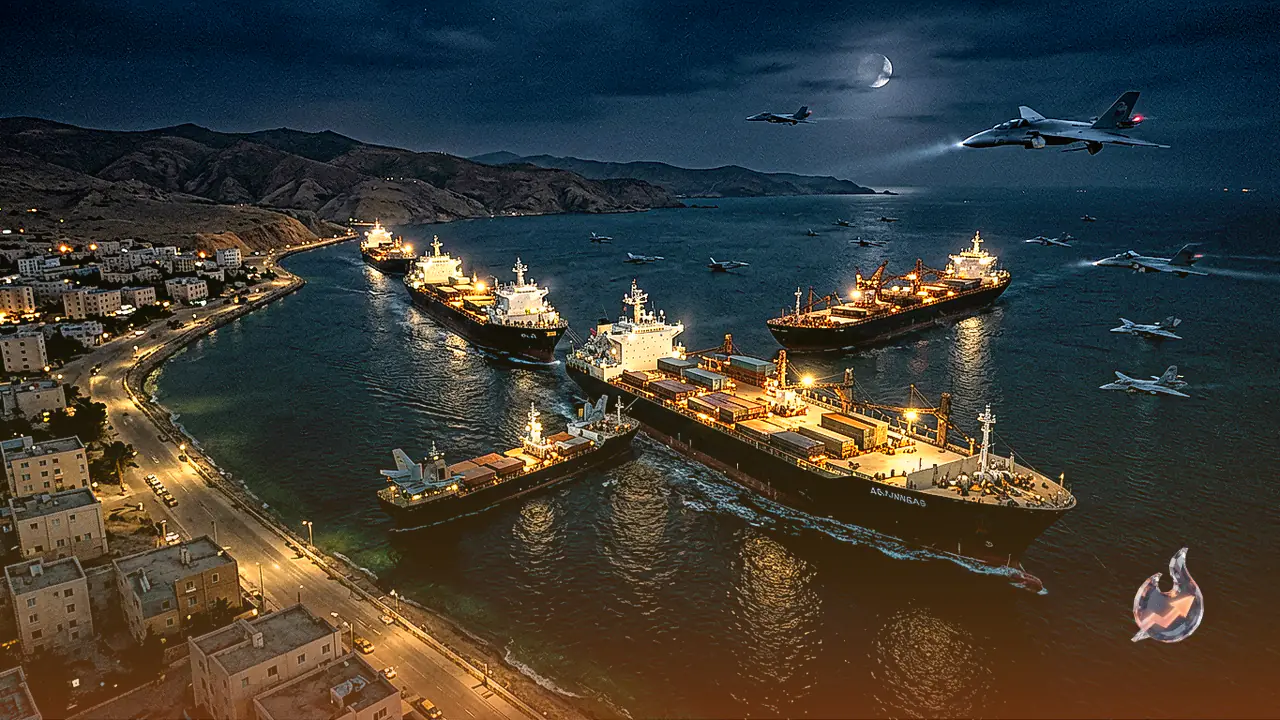

The Strait of Hormuz, a vital maritime chokepoint connecting the Persian Gulf to the Gulf of Oman and the Arabian Sea, has become the center of a covert high-stakes US military operation. Following US President Donald Trump's refusal to extend a delicate 60-day truce with Tehran, the United States military has quietly engineered a secret shipping corridor through the strategic waterway. Under the protection of heavy naval and air escorts, millions of barrels of crude oil are being extracted daily to prevent a catastrophic collapse in global energy markets. Washington has asserted full operational command over the passage, executing a meticulously scheduled convoy mission that has been running undetected for several weeks.
Structure and Logistics of the Secret Convoy System
The intricate operation is directed by a specialized military task force operating directly from the US Army headquarters at Fort Bragg in North Carolina, working in close synchronization with regional Gulf allies. Every day, military planners generate precise manifests of loaded tankers preparing to exit the Gulf into the Arabian Sea, as well as empty chartered vessels waiting to enter regional ports to collect fresh cargo. To minimize vulnerability, the transit is strictly executed at night through a designated southern channel along the coast of Oman. Under strict time windows, structured convoys of 15 to 20 tankers travel in organized formations under direct US military routing.
Impact on Global Oil Supply and Export Volumes
The Strait of Hormuz remains the single most important transit route for global energy, conveying approximately 20 percent of the world's crude oil and nearly one-third of global liquefied natural gas (LNG). Key Middle Eastern producers including Saudi Arabia, Iran, Iraq, Kuwait, and the United Arab Emirates rely heavily on this narrow passage to deliver energy to world markets. Since conflict escalated on February 28, supply disruptions had caused crude oil prices to surge worldwide. However, the newly established US shipping lane has stabilized daily exports at an average of 10 million barrels per day, roughly half of pre-conflict volumes. On peak nights, exit volumes have spiked to between 15 million and 20 million barrels per day, including one recent night where over 20 tankers safely navigated the channel carrying roughly 15 million barrels.
Degradation of Iranian Radar and Surveillance Infrastructure
The feasibility of this secretive operation hinged on a intense two-week military offensive recently executed by US Central Command. The campaign targeted and systematically degraded Iran's coastal radar installations and maritime surveillance apparatus. According to US officials, Tehran's monitoring capability along the southern shipping channel has been reduced to a handful of partially restored radar sites and spotters stationed aboard small Islamic Revolutionary Guard Corps (IRGC) fast boats. Deprived of precise targeting data, Iranian forces have resorted to launching unguided strikes toward suspected shipping lanes, most of which have been successfully neutralized.
Air Defense Shield and Counter-Drone Operations
To guard against aerial threats, the US Air Force maintains continuous air patrols over the convoy route using advanced fighter jets capable of intercepting incoming cruise missiles and kamikaze drones. While the IRGC retains the ability to create localized disruptions, US officials confirm that Iran no longer exercises operational control over the strait. Earlier this week, US forces intercepted and destroyed eight Iranian drones and two cruise missiles targeted near the transit zone. This multi-layered defense mechanism ensures that empty tankers can safely cross from the Arabian Sea into Gulf ports, load crude oil, and make their exit without suffering severe disruption.