
























A devastating tragedy struck the coastal Iranian town of Kuhestak on Tuesday night when an American missile slammed into a residence hosting a wedding celebration for a local fisherman's daughter. The strike killed four civilians, including two women and two children, while leaving more than 60 others injured. The bombardment occurred along the strategic Strait of Hormuz, where US forces have conducted repeated air raids targeting Iranian radar networks, air defense systems, and coastal maritime assets.
Destruction at the Wedding Celebration in Kuhestak
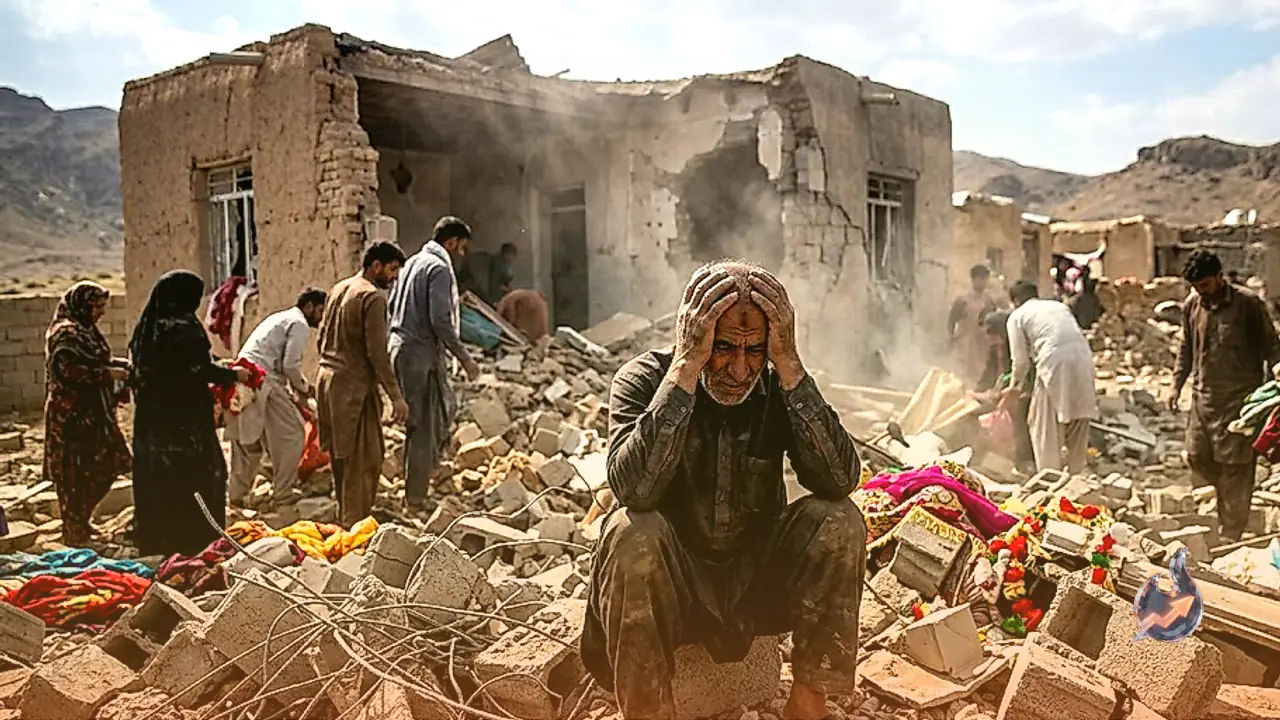
The missile struck the home of Ali Mallahi, a fisherman belonging to Iran's Baluch ethnic minority, where dozens of relatives and guests had gathered for his daughter's marriage ceremony. The impact completely obliterated the roof of the main house, leaving a deep crater inside the living quarters. A second missile impacted an adjacent house sharing the same courtyard, spreading destruction across the compound. Ground images showed severe structural collapse, flattened perimeter walls, a crushed automobile, and personal belongings including wedding footwear scattered among concrete fragments.
Emergency responders transported victims to the regional medical facility in Minab. Although provincial deputy governor Ahmad Nafisi initially stated five people had perished, refined casualty reports issued by health officials confirmed four deaths, specifically identifying the young victims as aged 4 and 16. Hospital wards housed several injured women and young children wrapped in heavy bandages, with medical staff noting severe trauma among survivors. One injured eyewitness recounted arriving at the venue just as jet aircraft roared overhead, followed immediately by heavy explosions that brought down masonry onto gathered guests.
Strikes on Port Infrastructure and Divergent Accounts
Approximately 100 meters (yards) from Mallahi's dwelling, a vital communications tower at Kuhestak's port facility was targeted in the same operational wave. According to testimony collected by Moein Arjomand, director of the Balochistan Human Rights Documentation Network, at least two missiles hit the communications tower structure, while an additional strike struck a nearby loading pier.
The human rights documentation network clarified that the 16-year-old victim was actually riding a motorcycle near the targeted communications tower when hit by lethal shrapnel, rather than perishing inside the home as initially stated by state broadcasts. Concurrently, broader military strikes across the sector resulted in the deaths of four Revolutionary Guard personnel and ten volunteer Basij militia members, with military casualty figures reaching 108 wounded individuals overall.
Ordnance Analysis Pinpoints US SLAM-ER Cruise Missile
Independent armament experts examining photographic evidence of retrieved missile debris identified key components of the weapon used against the residential target. Analysts Trevor Ball and N.R. Jenzen-Jones from Armament Research Services confirmed that distinctive fin fragments belong to an upgraded SLAM-ER (Stand-off Land Attack Missile Expanded Response) precision cruise missile manufactured by Boeing.
The SLAM-ER is an air-launched weapon possessing an operational range exceeding 270 kilometers (168 miles). Weapons experts emphasize that it is engineered for extreme precision, featuring real-time video control via an infrared camera that allows a human operator to adjust target coordinates during flight. While regional militaries in Saudi Arabia and the United Arab Emirates deploy the SLAM-ER, neither nation reported flight operations over Iranian airspace. US Central Command spokesman Capt. Tim Hawkins confirmed that military officials are examining reports concerning the wedding strike, though he refrained from verifying whether a formal command investigation has been initiated.
Escalating Conflict Along the Strait of Hormuz
Kuhestak lies along a narrow coastal corridor controlling access to the Strait of Hormuz, a critical maritime chokepoint that has served as a primary battleground throughout the six-month war. The town is situated roughly 30 kilometers (18 miles) from Minab, the site of a Feb. 28 missile strike on an elementary school during the conflict's opening hours that claimed the lives of over 100 children. The continuation of heavy bombardment along populated coastal sectors continues to heighten civilian vulnerability across the region.