





















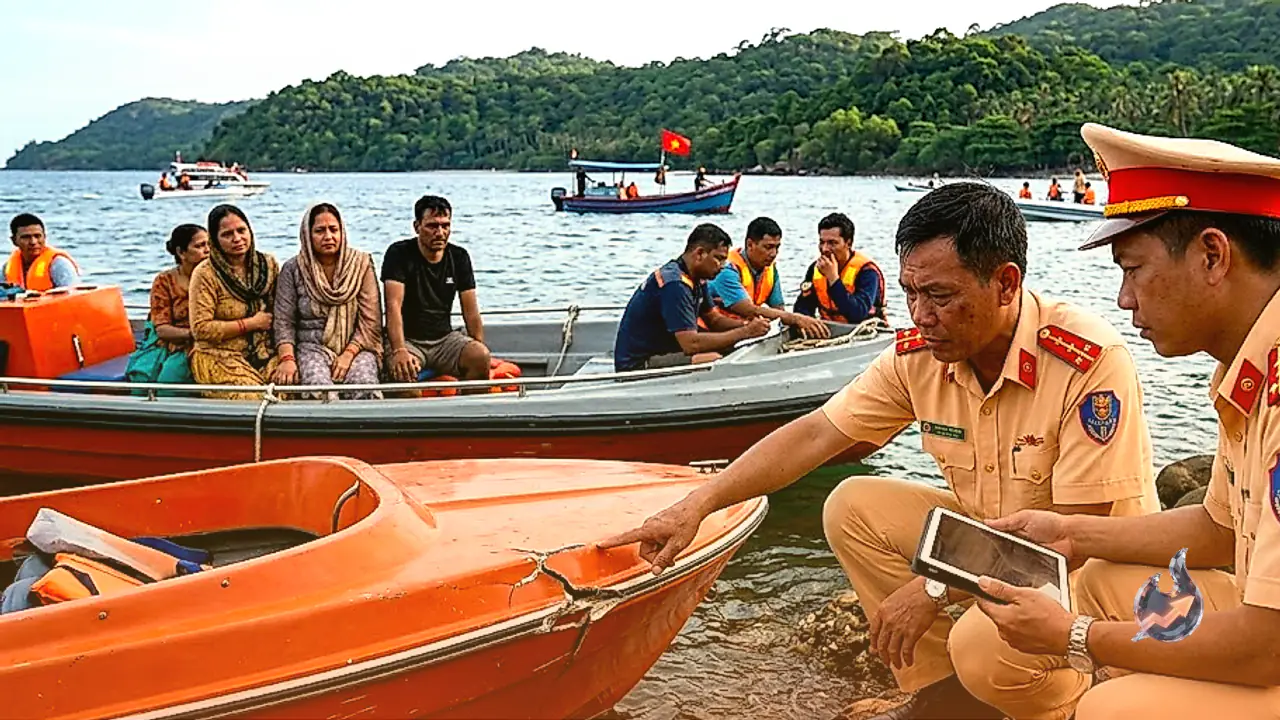

A devastating speedboat accident off the coast of Phu Quoc Island this Saturday has sent shockwaves through the community, resulting in the tragic deaths of 15 Indian citizens. The victims were part of a corporate-sponsored trip. At the time of the accident, the vessel was carrying 36 people in total, consisting of 32 Indian tourists and four crew members. While search and rescue efforts managed to save 21 individuals, 15 others—13 men and two women—could not be rescued. Most of the victims hailed from Tamil Nadu, Kerala, and Andhra Pradesh. The accident occurred approximately 400 meters from Hon Me Rut Ngoai Island, where the speedboat suddenly capsized. Investigators are now working to determine whether this was an unavoidable maritime disaster or the direct result of human error and systemic safety lapses.
Was the vessel operating beyond its capacity?
A primary focus of the investigation is the weight-bearing capacity of the vessel. The speedboat, registered as AG 26751, is being scrutinized to see if it was overloaded. Maritime experts argue that when a boat is burdened beyond its authorized capacity, maintaining stability amidst high waves becomes nearly impossible. Officials are currently analyzing the official passenger limit, the number of people on board, and the distribution of weight at the time of the accident to understand if overloading was the catalyst for the disaster.
Why did passengers get trapped inside the capsized vessel?
Local boatmen involved in the rescue operation reported extreme difficulties in extracting survivors, noting that many were trapped inside the enclosed cabin of the capsized boat. The probe is now examining whether the vessel's architectural design made exiting after a capsize virtually impossible. Investigators are looking into whether emergency exits were clearly marked and if passengers were provided with mandatory safety briefings before departure. The use of life jackets is also under review; experts suggest that in certain enclosed cabin scenarios, wearing a life jacket can actually hinder evacuation, as the device pushes the wearer upward, potentially pinning them against the ceiling.
Did the captain disregard weather warnings?
Local authorities have confirmed that the sea conditions during the incident were characterized by strong winds and high waves. However, eyewitness accounts indicate that other tourist boats were operating in the same area without incident. This raises a critical question: Did the captain continue the voyage despite warnings from meteorological or coast guard authorities? The investigation will conduct a thorough review of weather records from that day, sea conditions, and the specific decisions made by the captain to see if the accident could have been avoided.
Was the speedboat technically sound and maintained?
The technical integrity of the boat is another vital component of the inquiry. Authorities are examining maintenance logs, inspection certificates, and technical reports regarding the engine. The investigation seeks to determine whether the vessel underwent regular maintenance and if any mechanical failure occurred just before the incident, such as a total engine shutdown or a failure in the steering system. Furthermore, officials are checking for any structural damage or existing fissures in the hull that might have allowed water to flood the vessel rapidly.
Has safety been compromised by the tourism boom?
Phu Quoc Island has emerged as a major global tourism hub, receiving over 1.3 million foreign visitors in the first six months of 2026 alone. This rapid increase in tourism has sparked concerns about whether local maritime authorities are effectively enforcing safety standards. Investigators are also scrutinizing the operating company, Ocean Pearl Island Company, to verify if all required licenses were in place and if regular safety inspections were being conducted with rigor rather than as mere bureaucratic formalities.