














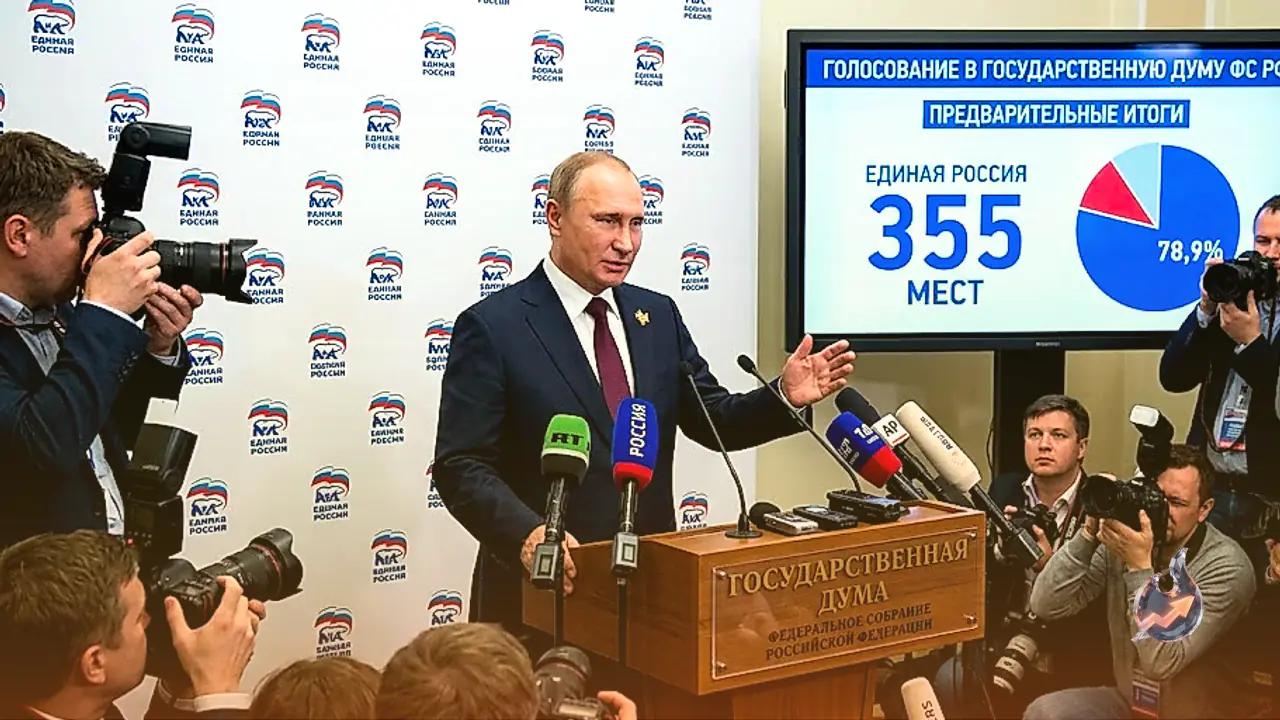

In a decisive political outcome, President Vladimir Putin's governing United Russia party has achieved an unprecedented victory in Russia's nationwide parliamentary elections. Preliminary official results released after three days of tightly managed voting show that the party secured a historic 355 seats in the 450-member State Duma, cementing Kremlin authority across the federal legislature.
Record Seat Share and Constitutional Power
Official figures presented by Russia's election chief Ella Pamfilova revealed that United Russia captured 57.83 percent of the popular vote. This total marks the highest seat share the party has ever controlled in the State Duma, comfortably surpassing its previous record of 343 seats. By securing 355 seats, the ruling party retains an overwhelming supermajority, providing it with complete authority to enact constitutional amendments independently without requiring legislative support from rival political factions.
First Duma Vote Since Ukraine Military Campaign
This election marked the first national parliamentary vote conducted since Moscow launched its full-scale military offensive against Ukraine in February 2022. Voter turnout across the nation exceeded 59 percent. Although the final day of voting saw a major Ukrainian drone strike targeting Moscow, election chief Ella Pamfilova characterized the overall balloting process as secure. The Kremlin immediately cited the results as definitive proof of widespread national solidarity behind Putin and his governance trajectory.
Parliamentary Distribution and War Veterans
Among the remaining parties, the Communist Party finished second by capturing 40 seats. The nationalist LDPR party secured 25 seats, while the New People party took 20 seats, with the remaining mandates going to Just Russia. All four parliamentary factions have consistently aligned with Kremlin policy on fundamental strategic questions, including the ongoing war in Ukraine. Furthermore, United Russia announced that 49 military veterans who served in the Ukraine campaign are poised to enter the State Duma as newly elected lawmakers. Concurrently, regional elections saw close Putin ally Ramzan Kadyrov re-elected as leader of Chechnya, with election officials crediting him with 99.85 percent of the vote.
Anti-War Yabloko Party's Regional Footprint
The anti-war political movement Yabloko failed to secure any federal legislative representation, having been barred from participating in the national parliamentary race and seeing numerous candidates excluded from regional contests. Nevertheless, Yabloko achieved a modest breakthrough in the Novgorod regional assembly by gathering slightly over 6 percent of the vote, clearing the mandatory five percent threshold. The party confirmed that more than 12,000 citizens voted for its ticket in that jurisdiction. Meanwhile, domestic opposition figures and multiple Western governments raised sharp criticisms regarding the transparency and integrity of the election process.