


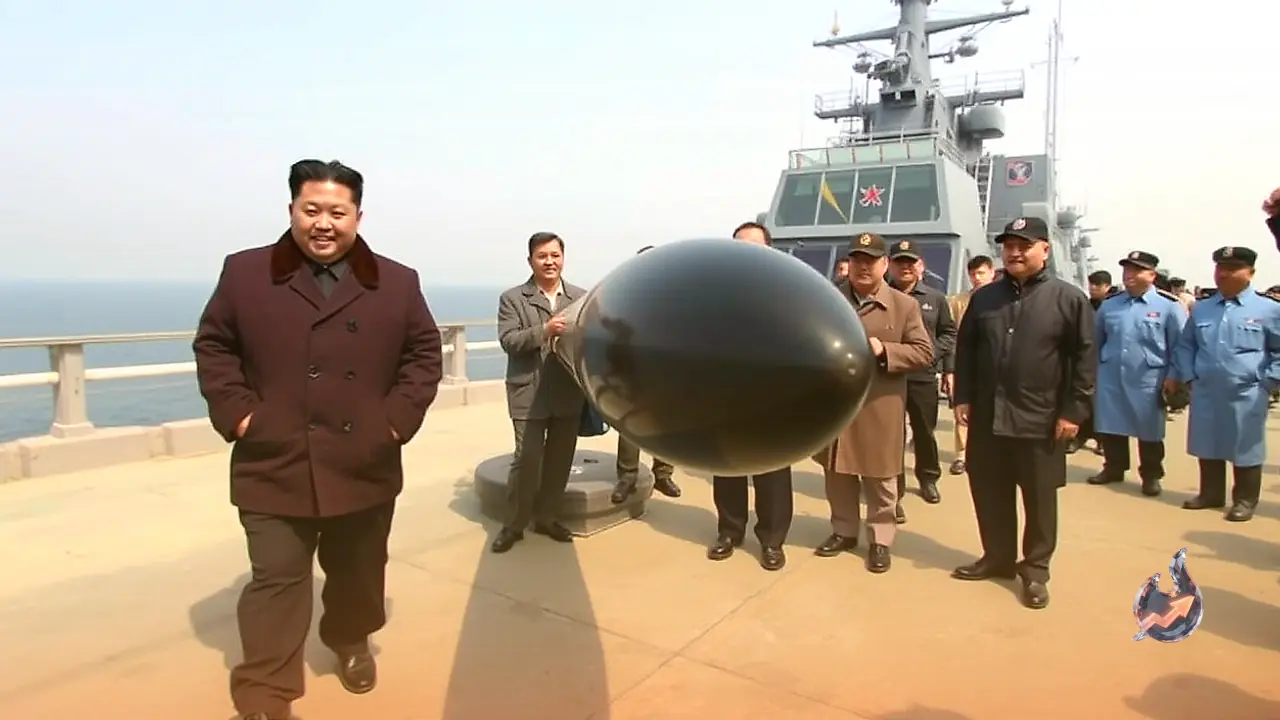



















North Korea has announced the successful trial of an advanced torpedo system equipped with artificial intelligence designed to independently detect and pursue targets underwater. Pyongyang presented the newly developed weapon as an agile, high-speed maritime platform capable of delivering precision strikes against hostile surface and undersea threats. Under the direction of Kim Jong Un, the country has steadily expanded its conventional and strategic military programs, placing renewed priority on upgrading naval strike components and sub-surface warfare capabilities.
Propulsion Trials and Over 180 Tests Conducted Over Five Years
Official state media, the Korean Central News Agency, reported that the torpedo operation took place on Thursday. State outlets indicated that the weapon relies on AI algorithms to identify objectives and adjust its trajectory to strike assigned targets. However, the official announcement refrained from disclosing technical details regarding how the software functions, its sensor packages, or the autonomous parameters governing its guidance. Beyond navigation assessments, the exercise evaluated the operational efficiency and endurance of the weapon's propulsion system. North Korean military developers reportedly conducted more than 180 separate tests over the past five years to bring the propulsion and guidance mechanisms to their current operational state.
South Korea's military, which monitors northern weapons developments closely and has frequently accused Pyongyang of exaggerating technological breakthroughs in state broadcasts, did not immediately issue a public assessment or comment regarding the KCNA announcement.
Subsurface Military Expansion and Escalating Testing Pace
North Korea has conducted a steady series of arms tests that have heightened regional military vigilance and complicated security calculations for neighboring states. The push highlights Kim Jong Un's concerted shift toward reinforcing his navy's deterring presence in surrounding waters. Just one day before the torpedo trial, on Wednesday, North Korea carried out its first underwater missile launch in nearly three years. Defense analysts suspect the firing involved an uncommissioned submarine currently under development. Pyongyang previously asserted that this vessel is being engineered specifically to launch ballistic missiles armed with nuclear warheads, giving its forces a survivable second-strike capability from beneath the sea.
Diplomatic Standoff and Peninsula Confrontation
The weapons showcase unfolds against a backdrop of hardened ideological divisions across the Korean Peninsula. In recent years, Kim Jong Un suspended all diplomatic engagements, contact channels, and cross-border cooperation programs with South Korea, explicitly designating Seoul as an unalterable principal adversary. Concurrently, broader denuclearization talks and negotiations with the United States remain frozen without any signs of resumption. In this climate of prolonged standoff, frequent tests of tactical and strategic platforms serve as Pyongyang's primary means to validate and display its defense growth.
The torpedo trial follows another recent live-fire drill in which North Korea launched multiple ballistic missiles toward its eastern maritime sector. South Korea's Joint Chiefs of Staff detected that those missiles were launched from territories situated around Pyongyang, prompting heightened surveillance alongside international partner forces.