



















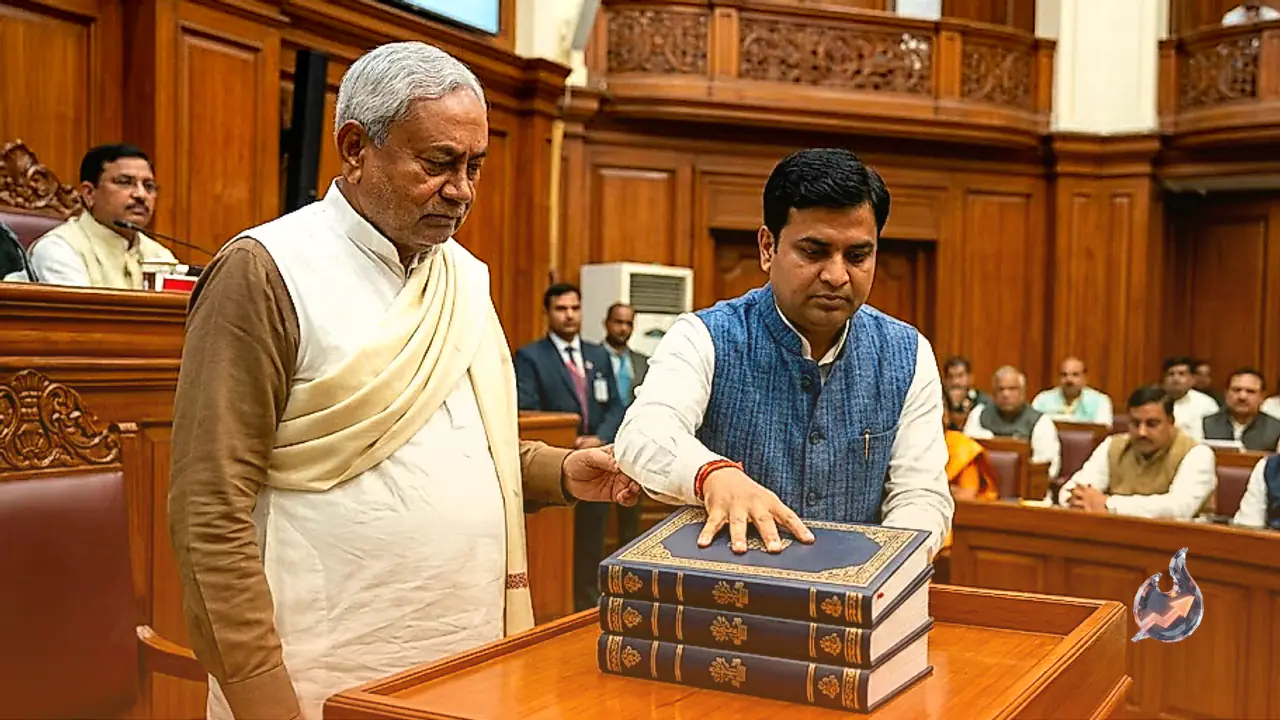

Kicking off the monsoon session of the state legislature, the Bihar government has unveiled a massive financial roadmap to accelerate ongoing development and welfare programs. Finance Minister Vijendra Prasad Yadav formally introduced the first supplementary budget for the financial year 2026-27 on the floor of the assembly. Totalling an impressive ₹87,383.43 crore, the newly proposed fiscal plan demonstrates a clear prioritization of crucial areas such as civic infrastructure, educational expansion, public health, power distribution, and comprehensive social security nets. With major allocations flowing toward high-profile initiatives like the Patna Metro, employment schemes, and extensive road networks, the administration aims to maintain a rapid pace of development. Furthermore, a substantial chunk of the treasury has been earmarked for various pension plans and electricity subsidies to provide direct financial relief to citizens.
Structuring the Multi-Billion Rupee Allocation
Tabled under Article 205 of the Indian Constitution, the supplementary fiscal blueprint strategically divides the state's resources across multiple spending categories. A major portion, exactly ₹57,077.96 crore, is dedicated entirely to funding annual development projects and welfare schemes. Meanwhile, to keep the wheels of the government turning, ₹30,265.99 crore has been reserved for establishment costs and other committed expenditures. Additionally, a smaller fraction of ₹39.48 crore is specifically designated to support various central sector initiatives operating within the state.
Big Winners in Flagship Schemes
The financial document reveals a heavy tilt toward employment generation and grassroots welfare. The Viksit Bharat Rozgar Evam Aajeevika Guarantee Mission secured the largest single slice, receiving a massive ₹9,335.35 crore to boost job creation. Senior citizens and child welfare were also front and center; the Indira Gandhi Rashtriya Vridhavastha Pension was allotted ₹3,308.69 crore, while the Saksham Anganwadi & Poshan 2.0 initiative garnered ₹2,780.94 crore to combat malnutrition. Furthermore, the education sector saw significant capital infusion, with the Sarva Shiksha Abhiyan obtaining ₹2,732 crore. Nutritional support in schools through the PM Poshan (Mid-day Meal) scheme was granted ₹1,359.72 crore, and rural connectivity via the Pradhan Mantri Gram Sadak Yojana received a dedicated ₹680 crore fund.
State-Level Infrastructure and Social Security Investments
Beyond national programs, Bihar's own state-run initiatives received robust financial backing. The Mukhyamantri Vridhjan Pension Yojana emerged as a top priority with a ₹6,710.93 crore allocation, ensuring elderly residents receive consistent financial support. Heavy infrastructure is also a major focus, as ₹3,665 crore has been poured into major road and bridge construction projects across the region. Other vulnerable demographics were not ignored, with ₹1,147.84 crore allocated for the Divyang Samajik Suraksha Pension and ₹1,056.44 crore set aside for the Lakshmibai Samajik Suraksha Pension.
Educational empowerment and rural mobility are similarly prioritized in the state's spending. The Backward and Extremely Backward Class Scholarship program was funded with ₹940 crore, ensuring marginalized students can pursue higher learning. Healthcare infrastructure got a ₹927 crore boost specifically for constructing new medical colleges and hospitals. Rural connectivity continues to be upgraded through the Mukhyamantri Gram Sadak Unnayan Yojana (₹850.15 crore) and the Mukhyamantri Gram Sampark Yojana (₹649.85 crore). Energy generation received attention as well, with the Bihar State Power Generation Company securing ₹700 crore, and student loans remain supported with ₹500 crore allocated to the Student Credit Card Yojana.
Managing Fixed Costs and Subsidies
A significant segment of the budget is strictly allocated to the government's fixed financial obligations. Under the establishment and committed expenditure banner, a massive ₹13,550 crore has been authorized for transfer into the state's Contingency Fund to handle unforeseen emergencies. To keep electricity bills manageable for ordinary citizens, the Mukhyamantri Vidyut Upbhokta Sahayata Yojana (power subsidy) was heavily funded with ₹9,994.34 crore. The government has also directed ₹2,658.16 crore to Panchayati Raj Institutions to settle pending 16th Finance Commission dues, while ₹2,423.47 crore has been set aside strictly to ensure timely salary payments across various administrative departments.
Funding Central Projects and Cybersecurity
Though a smaller portion of the overall pie, the budget fully accounts for mandatory central sector programs. Preparations for the delayed Census 2021 have been granted ₹36.55 crore. Additionally, ₹2.30 crore has been directed toward strengthening consumer forums to better protect buyer rights. In a move reflecting the growing digital threat landscape, the state has also carved out a specific ₹44 lakh provision dedicated to the prevention of cyber crimes targeting women and children. The broader financial strategy paints a clear picture of the administration's long-term vision, showing a balanced focus on both physical development and robust welfare schemes.