
























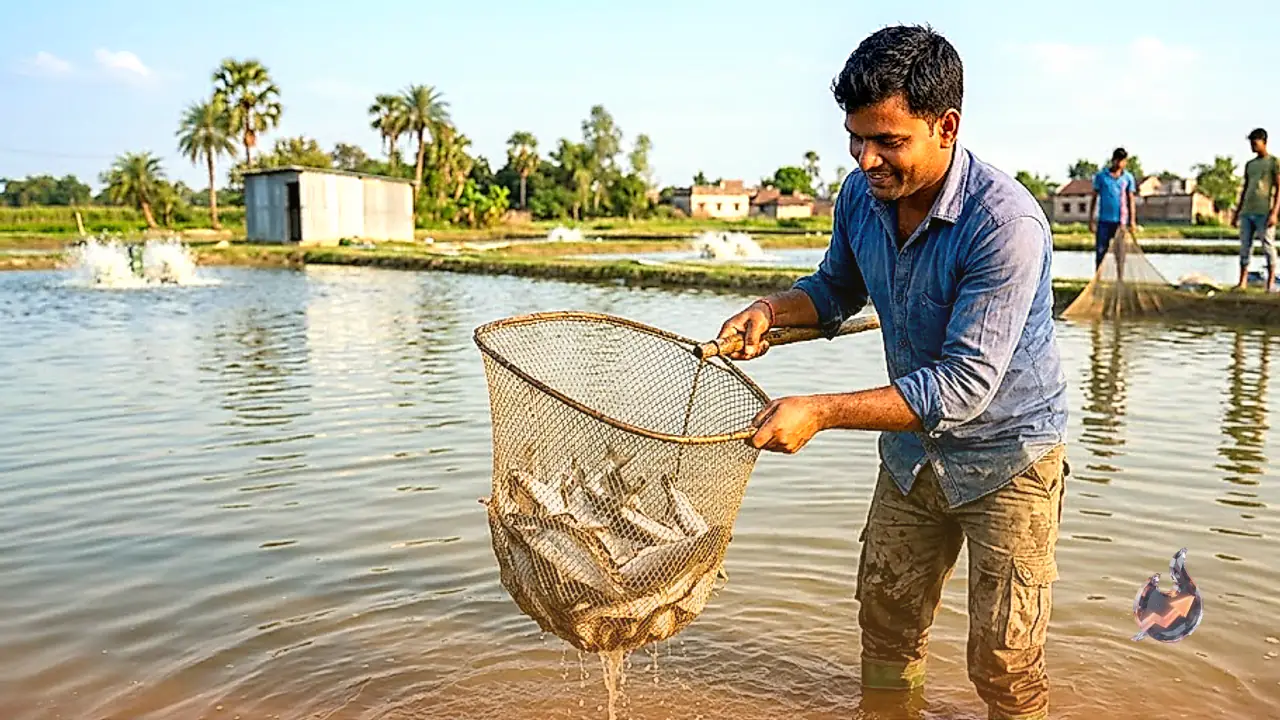

In Bihar's Bhagalpur district, young individuals are increasingly shifting their focus toward modern agribusiness as a profitable avenue for self-employment. Moving away from traditional jobs, many local youths are venturing into poultry farming, dairy operations, and aquaculture. Among these options, fish farming has emerged as a top choice due to the perception that it offers substantial financial returns within a short period. However, fisheries experts emphasize that achieving long-term profitability requires thorough knowledge, appropriate species selection, and meticulous management to avoid initial financial setbacks.
Shifting from Traditional IMC to High-Yield Pangasius
Providing insights into local aquaculture trends, Bhagalpur's Fisheries Specialist cum District Fisheries Officer Krishna Kanhaiya explained the evolution of fish farming in the region. Traditionally, farmers practiced Indian Major Carp (IMC) culture, which utilized a three-layer stocking system in ponds. Under this approach, Rehu occupied the surface layer, Katla inhabited the column or middle layer, while Naini or Mrigal fed at the bottom layer. While this multi-layer approach was long considered standard, market preferences and production techniques have significantly transformed.
Why Pangasius Offers Superior Commercial Potential
Today, Pangasius fish farming has become the preferred choice for commercial growers in and around Bhagalpur. District Fisheries Officer Krishna Kanhaiya highlighted that Pangasius exhibits remarkably fast growth rates even in small ponds and high-density setups. Unlike conventional carp species, Pangasius reaches marketable weight in a significantly shorter operational cycle. Because it matures quickly while requiring lower resource overheads, the profit margin relative to operational costs remains noticeably higher, making it an ideal option for young entrepreneurs seeking quick capital rotation.
Importance of Professional Training Before Investment
While the government provides various subsidy schemes and financial assistance programs to promote aquaculture, experts warn against entering the sector without adequate preparation. Krishna Kanhaiya cautioned aspiring fish farmers against starting operations without formal training. Aquaculture demands considerable initial capital expenditure for pond construction, seed procurement, and equipment. Entering the field without hands-on knowledge increases the vulnerability to disease outbreaks and operational failures, leading to heavy losses. Proper training equips farmers to identify potential risks early and implement effective corrective measures.
Essential Practices: Soil Testing, Water Treatment, and Nutrition
Sustained yields in fish farming depend almost entirely on rigorous scientific pond maintenance. Soil treatment represents the foundational step, requiring comprehensive soil health checks both before digging a pond and periodically during active farming. Equal emphasis must be placed on water quality management. Parameters such as dissolved oxygen levels and pH balance need regular monitoring to ensure an optimal environment for fish survival and growth. Combining timely water treatment, systematic pond cleaning, and balanced nutritional feed forms the core strategy for maximizing yield and profitability.


