






















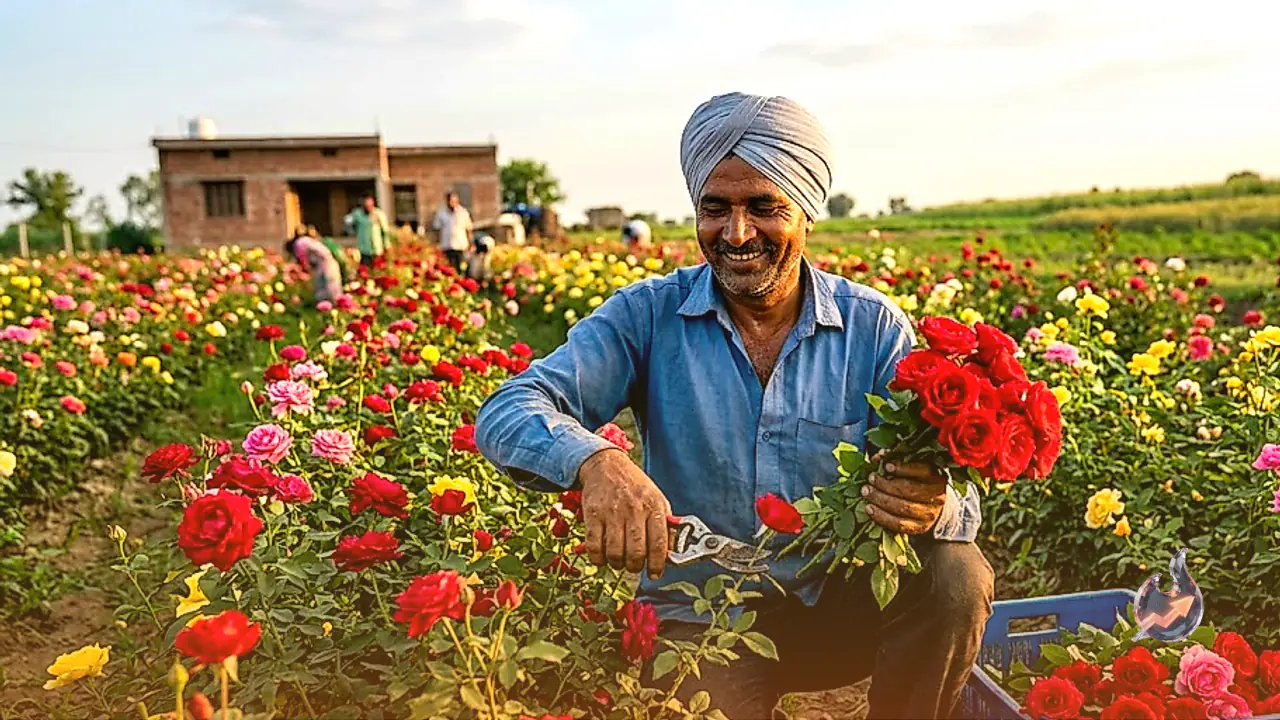

Farmers in the rural belts of Firozabad are increasingly adopting alternative farming methods to boost their financial returns. Moving away from standard grain production, cultivators are shifting toward high-value cash crops and reaping rich rewards. While some are turning to green chilies, others are finding remarkable success through floriculture. A local farmer residing in a nearby village has completely transformed his economic standing by dedicating his land to rose cultivation. Starting on a very small scale, he eventually expanded the practice across multiple bighas, turning the fragrant crop into a steady wealth generator. The demand is so consistent that traders from the city travel directly to his fields to purchase the freshly harvested blooms.
A Decade of Growing Roses
Ram Gopal, a resident of Daupeli village in Firozabad, has been cultivating roses for the past ten years. In the early days, he relied strictly on traditional farming, growing wheat and mustard on his land, but the resulting yields and financial returns were limited. The turning point came when he visited a relative and learned about the commercial prospects of rose farming. Inspired by this knowledge, he prepared and planted rose saplings across two bighas of his land. According to the cultivator, setting up the plants on roughly one bigha incurs an initial cost between 10,000 and 15,000 rupees. It takes about a full year for these saplings to mature into fully developed plants.
Maintenance and Pest Management
Once established, the crop requires consistent upkeep to ensure healthy growth. The process involves regular weeding and soil loosening, known locally as narwai and gudai, which stimulates flower production. Once blooming begins, the flowers are harvested daily and handed over to buyers, providing a reliable cash flow. However, rose plants remain vulnerable to pest infestations, requiring timely spraying of insecticides to protect the yield. Annual maintenance, including soil upkeep and weeding, must be carried out consistently every year to keep the plants productive and healthy.
Fetching 70 Rupees Per Kilogram
One of the major advantages of rose cultivation is that it eliminates the need for repeated tilling of the fields after the initial plantation. Once planted, the bushes continue to produce flowers for up to fifteen years. Having expanded his cultivation to three bighas, Gopal harvests and sells between ten to twenty kilograms of roses every single day. Floral traders from Firozabad arrive directly at his farm to collect the produce. Selling the flowers at 70 rupees per kilo, he easily generates a daily income ranging from two to three thousand rupees. This venture has provided enough stability that he no longer needs to seek manual labor elsewhere. Furthermore, he has received financial assistance in the form of a government subsidy amounting to up to 5,000 rupees to support his agricultural efforts.