























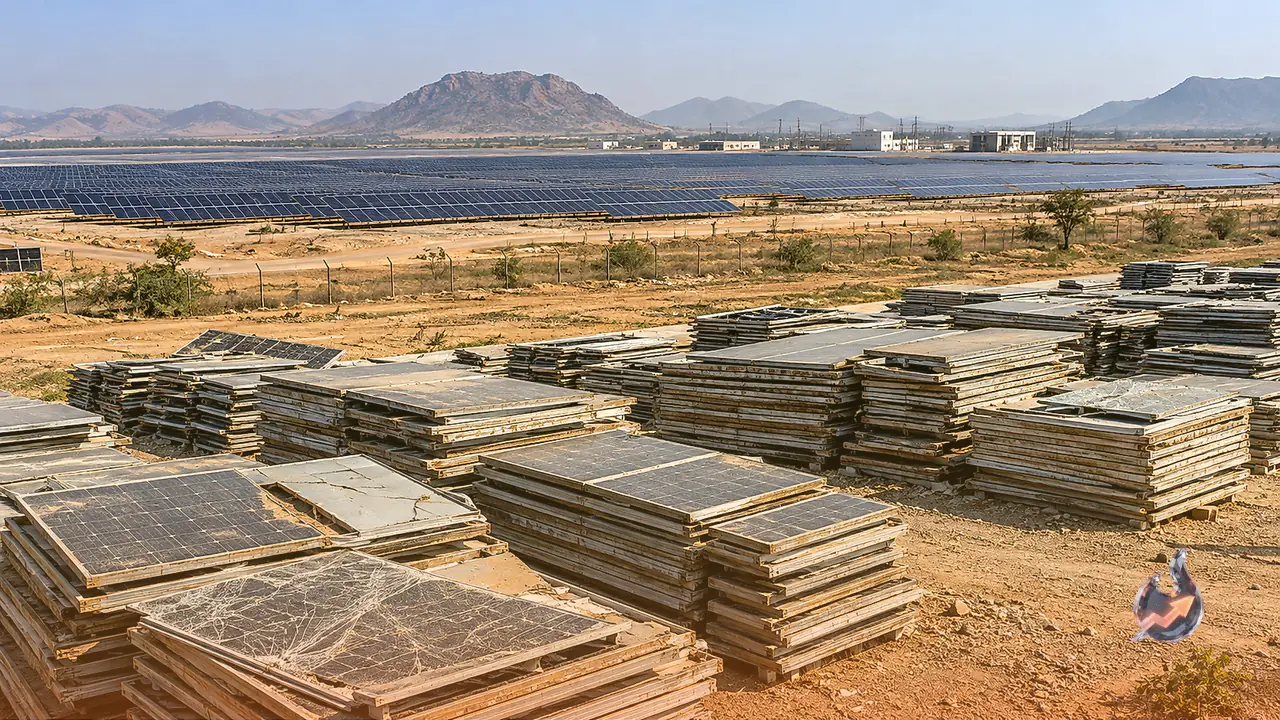

Propelling its transition toward green energy and a net-zero future, India is aggressively scaling up its renewable power footprint. Under the umbrella of central initiatives like the Pradhan Mantri Sarvodaya Yojana, the country is working to equip one crore households with rooftop solar installations. Designed to slash domestic electricity expenses for low-income and middle-class citizens, this large-scale deployment also introduces a massive industrial consideration: managing decommissioned and damaged photovoltaic modules across their lifecycles.
According to findings published in the Council on Energy, Environment and Water study titled ‘Enabling a Circular Economy in India’s Solar Industry: Assessing the Solar Waste Quantum’, the country faces a substantial wave of decommissioned equipment. Projections show that India’s existing operational solar plants alongside new capacity added between financial years 2023-24 and 2029-30 will produce up to 600 kilotonnes of solar waste by 2030. In volumetric terms, this accumulated hardware is equivalent to filling approximately 720 Olympic-sized swimming pools.
Five Key States Bearing the Largest Volume
Geographic patterns mapped in the assessment indicate that the overwhelming majority of this electronic refuse will emerge from five regional hubs: Rajasthan, Gujarat, Karnataka, Andhra Pradesh, and Tamil Nadu. Cumulative decommissioned hardware from projects operating today will account for 340 kilotonnes by 2030. Locked inside this volume are vital elements, including roughly 10 kilotonnes of silicon, between 12 and 18 tonnes of silver, and nearly 16 tonnes of cadmium and tellurium. These minerals serve as essential components for the broader technology and energy manufacturing sectors.
The remaining 260 kilotonnes will originate from installations scheduled to come online through the rest of the current decade. While this surge presents an operational challenge, it simultaneously hands India an opportunity to transform its renewable sector into a leader in circular manufacturing. By reclaiming critical minerals from retired modules, domestic producers can insulate local supply chains against volatile international trade and reduce reliance on overseas raw materials.
Targeting 292 GW Alongside Extended Producer Mandates
With an official target of securing approximately 292 gigawatts of solar power by 2030, systemic module recovery is becoming indispensable across environmental, economic, and social parameters. National solar generation has seen rapid expansion, climbing from just 4 gigawatts in March 2015 to 73 gigawatts by December 2023. The CEEW study marks the first time that solar waste generation across all non-manufacturing operational phases has been rigorously quantified, supplying foundational baseline data for administrative policies.
Regulatory frameworks have already begun moving into place. The Ministry of Environment, Forest and Climate Change introduced the E-Waste (Management) Rules, 2022, bringing solar photovoltaic cells and modules under formal oversight. These statutes place Extended Producer Responsibility on equipment makers, legally obligating them to organize the collection, safe handling, and recycling of spent photovoltaic components.
Leadership Perspectives on Circular Resilience
Emphasizing the urgency of structural readiness, CEEW Chief Executive Officer Dr. Arunabha Ghosh noted that addressing solar waste should be treated as both an environmental imperative and a strategic pillar for national energy security. Pointing to the expansion from 4 gigawatts in 2015 to 73 gigawatts by late 2023, he emphasized that mature recovery chains are essential to safeguard the renewable ecosystem, spur green jobs, secure mineral supplies, and cultivate industrial resilience.
Echoing these considerations, CEEW Senior Programme Lead Neeraj Kuldeep stressed that India’s G20 presidency had positioned circular economic models at the core of sustainable growth. Maximizing resource efficiency through comprehensive solar waste handling can fortify domestic manufacturing. However, Kuldeep cautioned that India’s photovoltaic recycling ecosystem and technical processes remain in nascent stages, requiring targeted policy incentives and structured financial support to scale.
Premature Module Failures and Strategic Logistics
Although modern photovoltaic modules are typically engineered with a 25-year operational design life, real-world conditions often cause premature breakdown. Rough handling during transit, subpar installation, poor field maintenance, and project wear-and-tear mean that a measurable portion of panels exit service long before their intended expiration. As a consequence, waiting for a quarter-century decommissioning cycle is an inadequate strategy.
To tackle these near-term volumes, the study urges the domestic solar industry to establish comprehensive reverse logistics networks, secure regional storage warehouses, dismantling centers, and specialized processing plants. Stakeholders must also experiment with novel business and financing models to make recycling commercially self-sustaining. Crucially, the analysis calls for an authoritative, periodically updated national registry documenting operational installations, complete with module technology variants, manufacturer identities, and commissioning dates. This tracking mechanism will allow authorities and recycling operators to accurately forecast waste streams and position infrastructure where it is needed most.