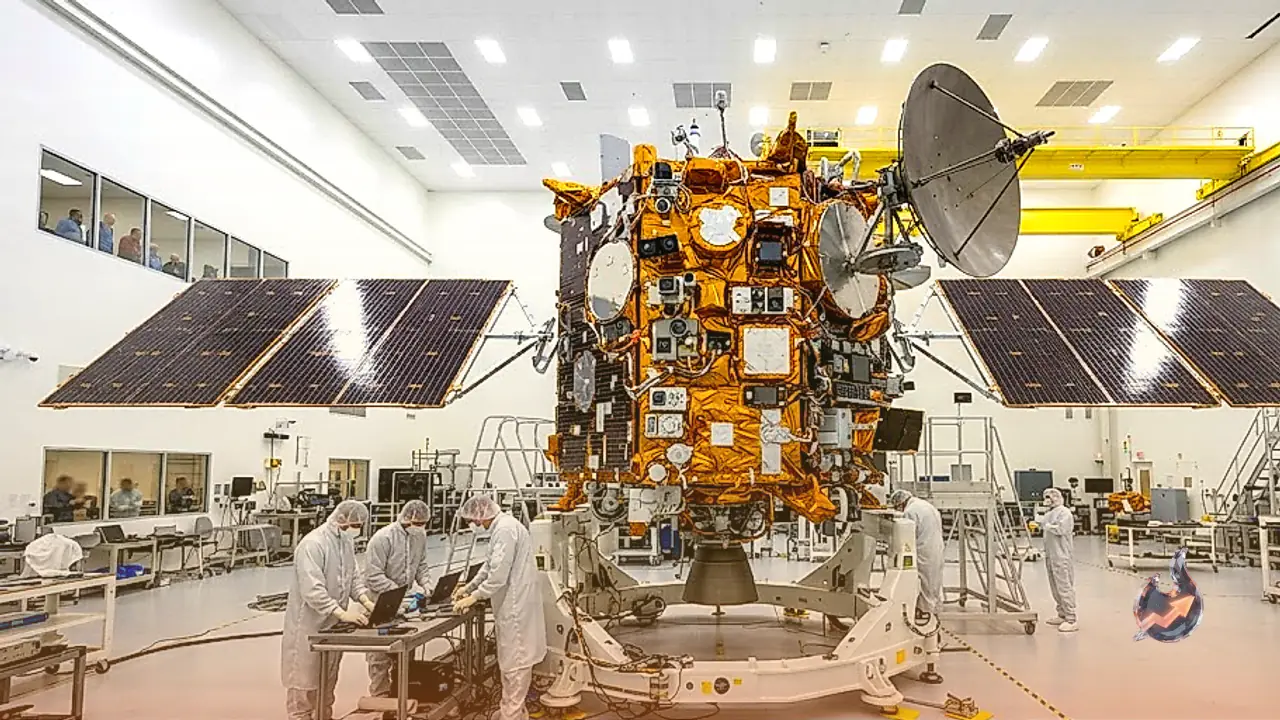























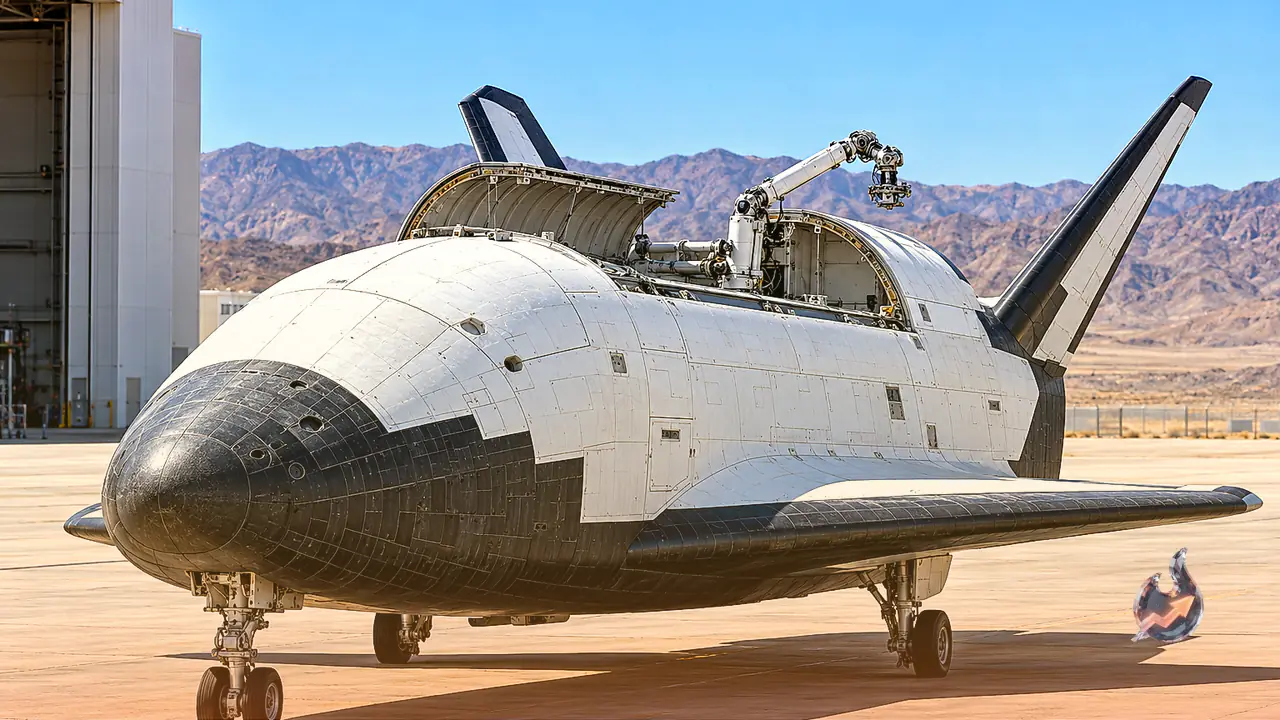

A detailed view of China’s secretive robotic spaceplane has come to light through newly declassified intelligence assessments, offering rare clarity on a platform whose missions have unfolded under strict operational security. The vehicle features swept delta wings, protective cargo bay doors, a dark thermal protection heat shield along its belly, and a rear service module fitted with power-generating solar arrays. Structurally and aerodynamically, the uncrewed craft mirrors the fundamental design architecture of the X-37B orbital test vehicle operated by the US Space Force, reflecting parallel engineering choices by both global powers in the pursuit of reusable orbital flight.
The imagery capturing the spaceplane in orbit was gathered by a commercial satellite belonging to Vantor, the Earth-observation enterprise previously known as Maxar in 2024. Vantor serves as one of several major commercial contractors supplying high-resolution overhead reconnaissance to US defense and intelligence organizations. Because Earth-observation platforms carry agile, high-magnification optical telescopes, operators can pivot those sensors upward or sideways to image other artificial objects travelling across orbital space.
Declassification of High-Resolution Imagery
While low-resolution glimpses showing the overall silhouette of the Chinese vehicle had previously circulated in public aerospace circles, a US Space Force official initially acknowledged the existence of the Maxar orbital photograph during an aerospace symposium in South Korea in 2024. However, the Department of Defense withheld the full-resolution visual until Monday, releasing it within an unclassified space threat assessment compiled by the Defense Intelligence Agency (DIA).
The contents of the DIA document provide limited confirmation regarding the specific mission objectives the spaceplane carries out during long stays in orbit. Since 2020, Chinese defense entities have executed four distinct spaceplane launches, with individual flight durations extending up to nine months. The program’s fourth mission remains aloft following an injection into orbit in February. Official records do not clarify whether Beijing maintains multiple operational airframes or cycles a single reusable vehicle through successive refurbishment routines.
Operational Comparisons Between X-37B and the Chinese Craft
By comparison, the US Space Force alternates flights across a fleet of two X-37B orbital vehicles. Over the course of eight missions carried out to date, the most enduring American flight spanned two-and-a-half years between its launch and eventual touchdown. While the US military has openly shared photographs, dimensional baselines, and selected experimental payloads flown aboard the X-37B, the overriding majority of its operational activities remain strictly classified.
Flight operations for both nations follow identical launch and recovery concepts. The Chinese craft launches tucked inside the protective payload fairing of a standard multi-stage rocket, deploying into space to maneuver as an autonomous satellite. Functioning like a compact, crewless variant of NASA’s retired Space Shuttle, the spaceplane conducts atmospheric reentry at mission completion, touching down autonomously on a conventional terrestrial runway before ground crews inspect and service the airframe for subsequent deployment.
Maneuvering Capacity and On-Orbit Capture Milestones
In its evaluation, the DIA emphasized that the enhanced maneuverability inherent to spaceplanes makes them far more adaptable for specialized orbital tasks than standard, single-trajectory satellites. Up to this point, China’s vehicle has conducted operations strictly within low-Earth orbit (LEO), navigating at altitudes spanning a few hundred miles. Conversely, the US Space Force pushed an X-37B flight to an apogee exceeding 24,000 miles before relying on atmospheric aerobraking maneuvers to shed energy for its return flight.
Both vehicle families feature internal cargo bays capable of dispensing secondary payloads into orbit. China recently demonstrated the mechanical ability to rendezvous with and capture objects in space, an action believed to rely on an onboard robotic articulation arm. Tracking data cataloged by astrophysicist Jonathan McDowell indicates that the craft currently in orbit ejected a miniature sub-satellite in June, recaptured it during orbital maneuvers in July, and repeated the identical deployment and recovery routine across August and September.
Nomenclature Ambiguity and Non-Earth Imaging Dynamics
The verified military designation of the Chinese vehicle remains shielded from public disclosures. Western defense analyses frequently refer to the project as Shenlong, tracing back to robotic spaceplane research concepts reported in China during the early 2000s. According to reference documentation compiled by the Secure World Foundation, Chinese official media exclusively denote the platform as Chongfu Shiyong Shiyan Hangtian Qi, abbreviated as CSSHQ, which translates directly to reusable experimental spacecraft.
The DIA report excluded operational parameters surrounding the Maxar observation, withholding specifics regarding the precise orbital intersection, range, and lighting conditions. Such collections fall within the emerging domain of non-Earth imaging (NEI), where terrestrial imaging satellites leverage orbital crossing geometry to photograph nearby spacecraft. NEI technology provides defense planners and private analysts with a potent tool for inspecting proprietary and classified satellites, opening an unprecedented avenue for orbital intelligence collection.
Russian Space Capabilities and Tactical Differences
The nature of commercial NEI passes differs sharply from deliberate intercept maneuvers executed by foreign military craft. Earlier this month, a Russian military satellite designated Kosmos 2612 actively adjusted its orbital trajectory to close in on an American-registered commercial radar satellite. Whereas commercial NEI relies on fleeting, high-speed flybys at crossing angles, dedicated inspector satellites actively track and shadow targets.
Russia has advanced other hostile orbital architectures, including the Nivelir system, designed to launch kinetic projectiles to disable opposing spacecraft. The Russian armed forces simulated an orbital strike utilizing the Nivelir platform in 2020. Furthermore, in April, Russia positioned several small satellites in proximity to a commercial radar imaging spacecraft operated by ICEYE, a provider of reconnaissance data to Ukraine. US defense officials reported that one Russian satellite closed within tens of meters of the ICEYE platform before pulling away. American intelligence assessments also indicate Moscow is pursuing orbital combat programs that include ambitions to position a nuclear device in space.
Direct-Energy Counterspace Weapons and Strategic Parity
The DIA threat report highlights China’s comprehensive investments in anti-satellite and counterspace capabilities. The agency notes that Chinese military strategists view directed-energy weapons (DEWs) as prime counterspace tools because they offer flexible options to degrade, blind, or permanently disable satellite electronics. A primary application involves employing focused ground lasers to dazzle optical and infrared sensors aboard adversarial surveillance satellites.
According to the intelligence assessment, China operates several ground-based laser installations with differing output thresholds capable of disrupting or damaging low-altitude spacecraft. The DIA projects that by the late 2020s, China could field operational space-based directed energy weapons alongside higher-powered ground systems engineered to reach satellites situated in higher orbital regimes.
These developments complement China’s proven direct-ascent anti-satellite missiles and an unprecedented satellite refueling demonstration completed last year in geosynchronous orbit at an altitude of approximately 22,000 miles (36,000 kilometers) above the equator. In addition to testing grappling arms capable of seizing foreign spacecraft, Beijing operates a fleet of TJS satellites that routinely rendezvous with foreign orbital hardware. In response, the US Space Force maintains its own geosynchronous inspection network and recently procured refuelable platforms. Underscoring the militarization of the domain, Air Force Secretary Troy Meink confirmed last month that the Pentagon has stationed operational weapons in space, marking the first formal acknowledgment of deployed orbital armaments by the United States.