



















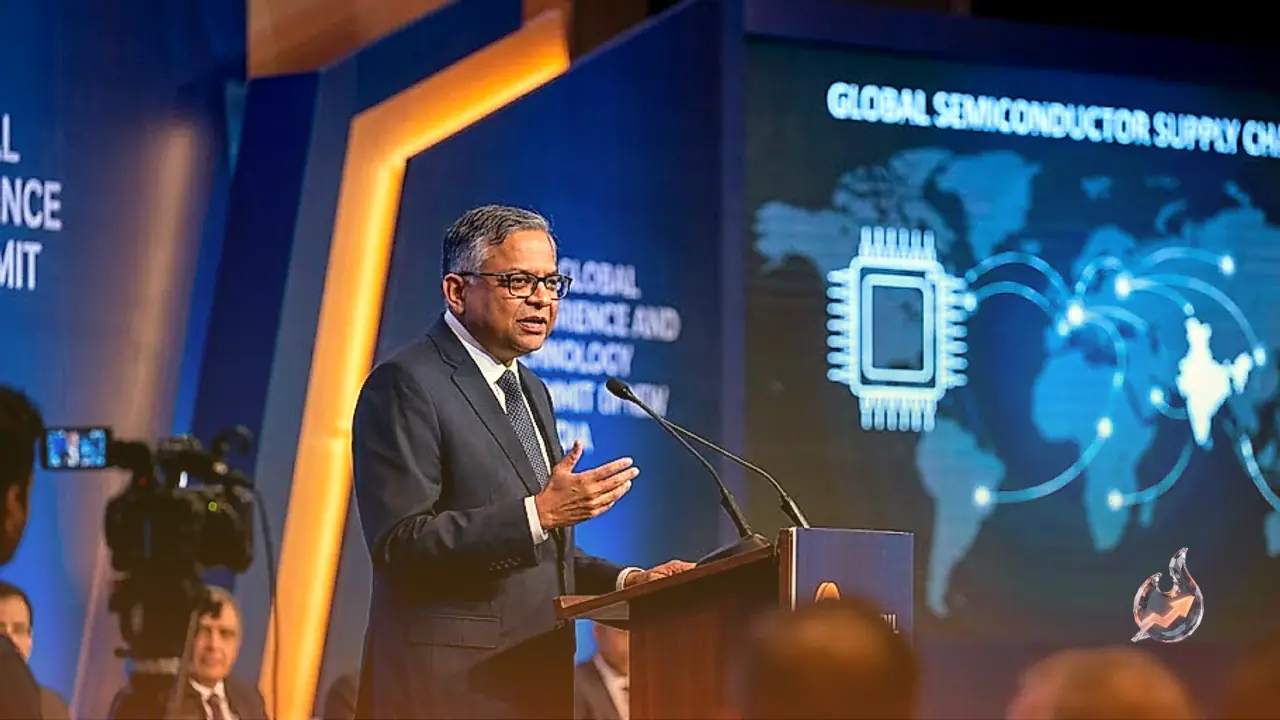

Semiconductor microchips have emerged as the foundational building blocks powering contemporary smartphones, automobiles, computers, and artificial intelligence systems. As global industries accelerate their digital transitions, the worldwide requirement for these critical components is projected to expand significantly. Addressing this evolving landscape on Tuesday at the 2026 Bloomberg New Economy Forum, Tata Sons Chairman N Chandrasekaran highlighted that India holds a prime opportunity to cement its position in the international semiconductor landscape by leveraging its skilled technical workforce, expansive domestic market, and cross-border partnerships.
Long-Term Strategic Value Over Short-Term Gains
Highlighting the critical importance of microchips for national economic development, Chandrasekaran stressed that high-tech manufacturing initiatives must be viewed through a patient, forward-looking lens. He cautioned against evaluating the Tata Group's substantial capital commitments in the semiconductor sector through the narrow lens of financial returns generated within a brief two to three-year timeframe. Instead, these strategic capital deployments are architected to address India's extensive long-term technological requirements and supply chain resilience.
Leveraging Talent, Domestic Scale, and International Alliances
In analyzing India's core advantages, Chandrasekaran noted that the country possesses a vast reservoir of engineering talent alongside a burgeoning internal consumer base. However, capturing a notable footprint in the global supply chain necessitates active cooperation with established international players. Achieving sustained progress in the sector will also demand focused efforts to secure access to advanced fabrication technologies while simultaneously addressing the significant, round-the-clock power and energy demands essential for semiconductor manufacturing units.
Major Manufacturing Footprint in Gujarat and Assam
Tata Group is already actively executing multi-billion-dollar investments to build India's semiconductor capacity from the ground up. Through Tata Electronics, the conglomerate has partnered with Taiwan's Powerchip Semiconductor Manufacturing Corporation, known as PSMC, to build a commercial chip fabrication plant at Dholera in Gujarat. Backed by a proposed investment of approximately 91,000 crore rupees, this facility is designed to manufacture semiconductor chips destined for automotive applications, mobile devices, consumer electronics, AI hardware, and diverse industrial machinery. Concurrently, the group is setting up an assembly and testing facility in Assam backed by an investment of around 27,000 crore rupees.
Prioritizing Commercial Viability Over Raw Technological Prestige
Offering a pragmatic perspective on industrial expansion, Chandrasekaran cautioned against rushing directly into fabricating the most advanced microscopic chip nodes without first conducting a rigorous assessment of immediate market demand and commercial practicality. He maintained that investment decisions must remain commercially viable, economically sound, and structured to generate steady, sustainable employment opportunities across the manufacturing ecosystem over the long run.