






















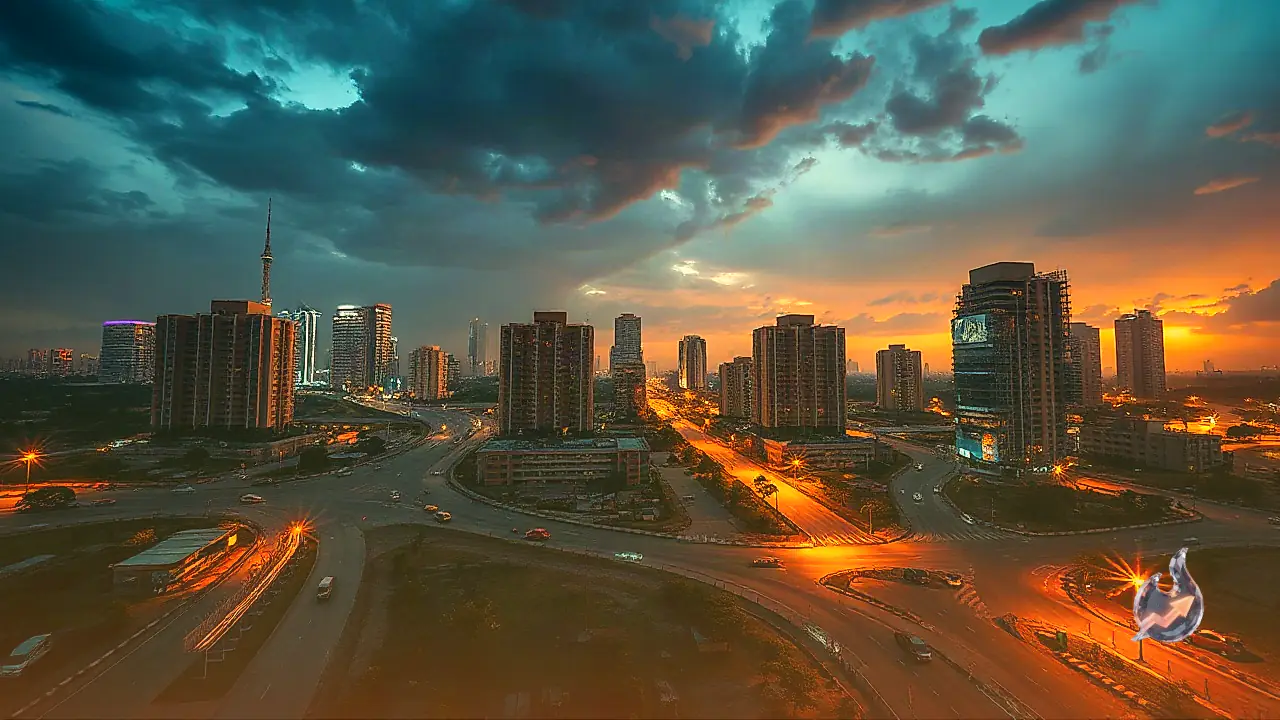

The real estate landscape across the National Capital Region is experiencing a dramatic shift as land valuations in Noida reach unprecedented heights, challenging Gurugram's long-standing dominance as the premium property market. A recent commercial residential land auction in Noida's Sector 108 has shattered previous valuation benchmarks, signaling a major transition in investor sentiment and property dynamics across Northern India. For decades, home buyers and corporate developers viewed Gurugram as the ultimate luxury destination with the highest per-acre land costs. However, infrastructural transformations, massive aviation projects, and strategic urban planning have rapidly elevated Noida's profile, making residential plots in key sectors significantly more expensive to acquire than ever before.
The Rs 1,839 Crore Record Land Deal in Noida
The primary catalyst behind this real estate debate stems from a landmark land transaction in Noida Sector 108, where a 12.5-acre residential plot was placed under public auction by the Noida Development Authority. Originally, the authority had established a base reserve price of Rs 835 crore for the prime land parcel. However, intense competitive bidding among major industry players escalated the final sale price to an astonishing Rs 1,839 crore, won by real estate developer M3M. On a unit basis, this transaction translates to roughly Rs 147 crore per acre, marking it as the most expensive per-acre land acquisition in the documented history of Delhi-NCR. Furthermore, this bidding process generated total revenue of approximately Rs 3,300 crore for the Noida Authority. Notably, DLF, recognized as the largest real estate enterprise in the country, also participated aggressively in the auction but was outbid, underscoring the intense appetite among top developers to secure strategic land banks in Noida.
Gurugram’s Benchmark 2018 Land Auction
To contextualize the magnitude of the Sector 108 transaction, market analysts look back to Gurugram's previous record-holding land auction completed in 2018. During that transaction, DLF acquired an 11.76-acre land parcel located in Udyog Vihar, Gurugram, for a total sum of Rs 1,496 crore. That specific property was brought to auction by the Haryana State Industrial and Infrastructure Development Corporation (HSIIDC), which had fixed a base price of Rs 686 crore. The final competitive bid resulted in a land cost of Rs 127 crore per acre, establishing an NCR record that stood unchallenged for several years. Comparing the two benchmark deals highlights the changing trajectory: while Gurugram achieved Rs 127 crore per acre in 2018, Noida has now surged past that milestone with a rate of Rs 147 crore per acre, officially resetting the ceiling for land valuations in the capital region.
Infrastructure and Connectivity: Noida vs Gurugram
Historically, Gurugram built its commercial supremacy around robust corporate job creation, establishing itself as the primary Information Technology and multinational hub of NCR. The presence of global corporate headquarters, superior road connectivity, and immediate proximity to Delhi’s Indira Gandhi International Airport (IGI Airport) provided Gurugram with an unbeatable commercial advantage. Conversely, Noida previously struggled with slower IT adoption, remaining largely secondary in corporate office space absorption. However, Noida is now undergoing an unprecedented infrastructure overhaul that is rapidly narrowing the economic gap between the two regional centers.
Jewar Airport, New Expressways, and Pod Taxi Transit
The pivotal engine driving Noida's economic surge is the development of the Noida International Airport in Jewar, Greater Noida. Commercial flight operations commenced at Jewar Airport on 15 June, providing the eastern corridor of NCR with direct international air connectivity and reducing reliance on IGI Airport. Road infrastructure has similarly expanded beyond the established Yamuna Expressway. The completion of the Ganga Expressway, alongside a dedicated expressway linking Jewar Airport to Faridabad, has vastly improved regional mobility. Additionally, the Uttar Pradesh government has initiated a 30-minute connectivity scheme designed to enable travel between any two key points within the city within half an hour. Public transportation is also set for futuristic upgrades, as Noida and Greater Noida prepare to launch NCR's first Pod Taxi system, while Rapid Rail corridors will offer direct transit connections straight into Jewar Airport.
New Noida, Film City, and Industrial Job Expansion
Beyond aviation and transit, large-scale urban expansion projects are redefining the region's long-term economic prospects. State authorities have commenced land acquisition across 84 surrounding villages to construct "New Noida," a master-planned urban extension designed to accommodate industrial and commercial growth. Parallelly, work is progressing on a state-of-the-art Film City near the Yamuna Expressway, conceptualized on the scale of Mumbai’s entertainment industry hub. These mega-projects, combined with expanding manufacturing units establishing operations in Noida, are creating thousands of new employment opportunities, providing sustained momentum to the local housing and commercial real estate sectors.
Sector-by-Sector Real Estate Price Trends and Forecasts
The real estate price surge is clearly visible across multiple key micro-markets in Noida. In the vicinity of Jewar Airport, land values that stood at Rs 3,200 per square foot in 2020 have tripled to reach Rs 9,600 per square foot. Residential apartment prices in the same zone have climbed from Rs 1,100 per square foot to Rs 2,500 per square foot. Meanwhile, Sector 168 has emerged as one of Noida’s fastest-growing residential zones, with land prices reaching Rs 11,600 per square foot in 2026; forecasts indicate an additional growth of over 25 percent, pushing values to between Rs 16,000 and Rs 22,000 per square foot by 2030. Land prices in the New Noida region are projected to rise by approximately 52 percent over the next 4 years. Furthermore, established residential sectors including Sector 128, Sector 137, Sector 150, Sector 143, Sector 142, Sector 107, Sector 76, and Sector 78 are anticipated to register steady price appreciation of 10 to 20 percent over the coming 4-year period.