





















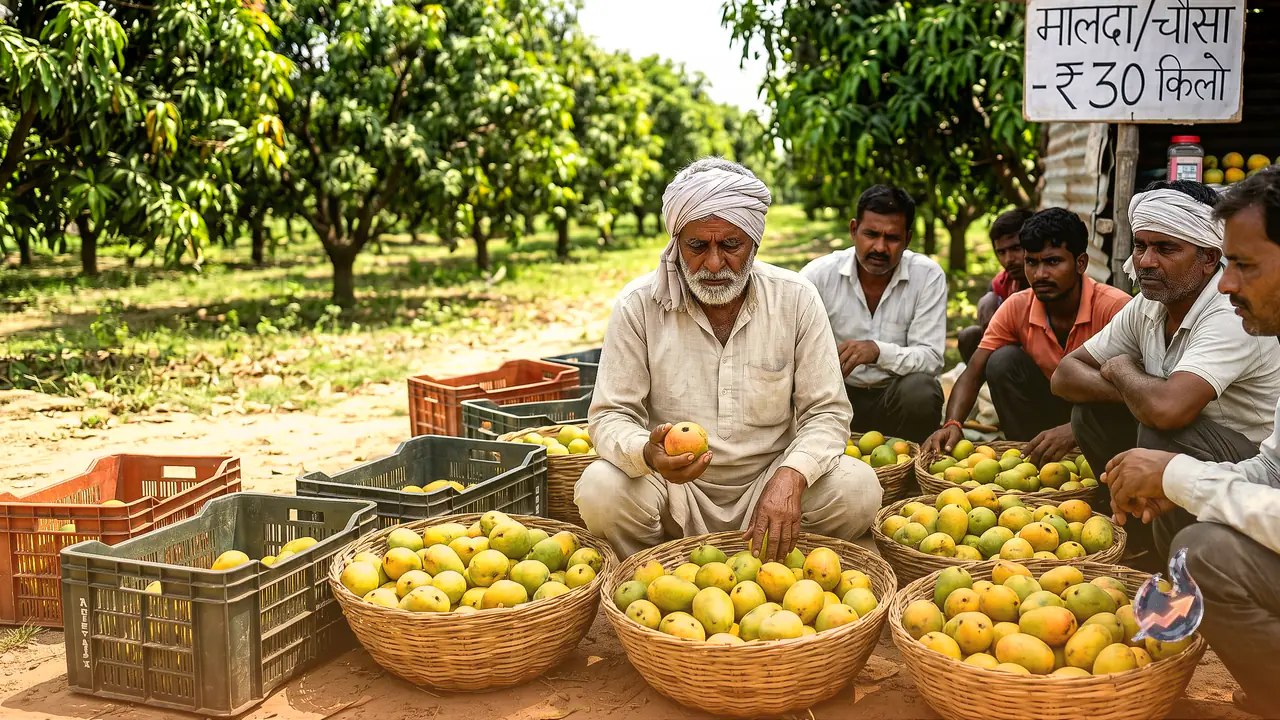

For the mango growers and traders of Malihabad, just outside Lucknow, this season has turned hope into worry. The very crop they have leaned on for decades has become a headache this year, and the chief reason is the excessive use of pesticides. Citing exactly that, Japan has halted imports of mangoes from here. It is not Japan alone. The United States has also stopped lifting these farmers' fruit.
One Export Route After Another Shuts
Sending mangoes to the Gulf and to European countries has grown difficult too. The war between the US and Iran has hit exports directly, as freight charges have climbed so high that traders simply cannot ship their consignments. On top of that came the weather. Swings in the March weather, along with rain and hail, ruined both the size and the appearance of the fruit, making export-grade mangoes hard to come by. Farmers explain that after the unseasonal rain they had to spray even more pesticide to protect the fruit from insects, and it is precisely this that has cost them their exports.
Two Decades of Trade, Undone in One Stroke
In Malihabad's Maal area, Bishan Pal Singh owns a mango orchard spread over 15 bigha. For the past twenty years he has been exporting to the US and Japan. Bishan has sent mangoes worth as much as 8 to 8 lakh rupees to Japan, while last year shipments worth around three lakh rupees went there. This time too he had made firm arrangements to supply Japan and the US through the year.
The scale of that preparation is striking. When the mangoes were still tiny on the branch, a special packet was slipped over each individual fruit so that the sprayed pesticide could not reach it. Separate labour was hired just to tie those packets. He had expected good returns, but both Japan and the US refused the consignment outright. As a result, the fruit that once went to Japan at 150 rupees now has to be sold in the local market for 28 to 35 rupees.
The Toxic and Counterfeit Pesticide Problem
Kalimullah Khan, 80, of Malihabad was awarded the Padma Shri for his work on mangoes. He says plainly that toxic pesticides are being sprayed on the fruit and cause serious harm. Counterfeit pesticides are even being sold in the market, and farmers are unknowingly spraying them. According to him, Japan is extremely strict about food items, which is why it is refusing this mango, whereas in our country dangerous pesticides are present in nearly every mango.
The Same Fruit Sells Briskly at Home
What stands out is that the very mango Japan rejected is selling briskly in Malihabad's own market. The commission agents argue that mangoes cannot be grown without pesticide spraying at all, and that when every fruit and vegetable carries pesticide, the mango is no exception. This is not the first time. Back in the 1980s, Japan had banned Indian mangoes because of fruit fly. The treatment methods were later changed, and in 2006 India resumed shipping to Japan. Now, roughly twenty years on, Japan has shut that door once again.
The Treatment Done Before Shipping Abroad
Malihabad has a pack house built for exports. Its manager, Sachin, explains that before mangoes are sent to Japan they undergo a special process called Vapour Heat Treatment, or VHT. In it, the mangoes are kept for some time in a chamber of hot air so that the insects and larvae inside the fruit are destroyed and the effect of pesticide is wiped out. Recently a Japanese team visited India and inspected plants in Malihabad, Maharashtra and other parts of the country. The team found shortcomings in this very process, and only after that did Japan refuse to take the mangoes.
World's Biggest Producer, Yet in Crisis
India is the largest producer of mangoes. Of the world's total output, 40 to 45 percent is grown in India alone. In Uttar Pradesh by itself, mango orchards cover about 2.8 lakh hectares, yielding roughly seventy lakh metric tonnes every year, with the Maal, Malihabad and Kakori belt around Lucknow making up a large share. According to the figures, around 30 thousand tonnes of mangoes were exported in 2024-25, going not just to Japan but also to the UAE, the US, Britain, Kuwait and Qatar. Japan alone has been receiving up to two thousand metric tonnes a year. Now the real fear among growers is that other countries too might stop buying mangoes from India.