



















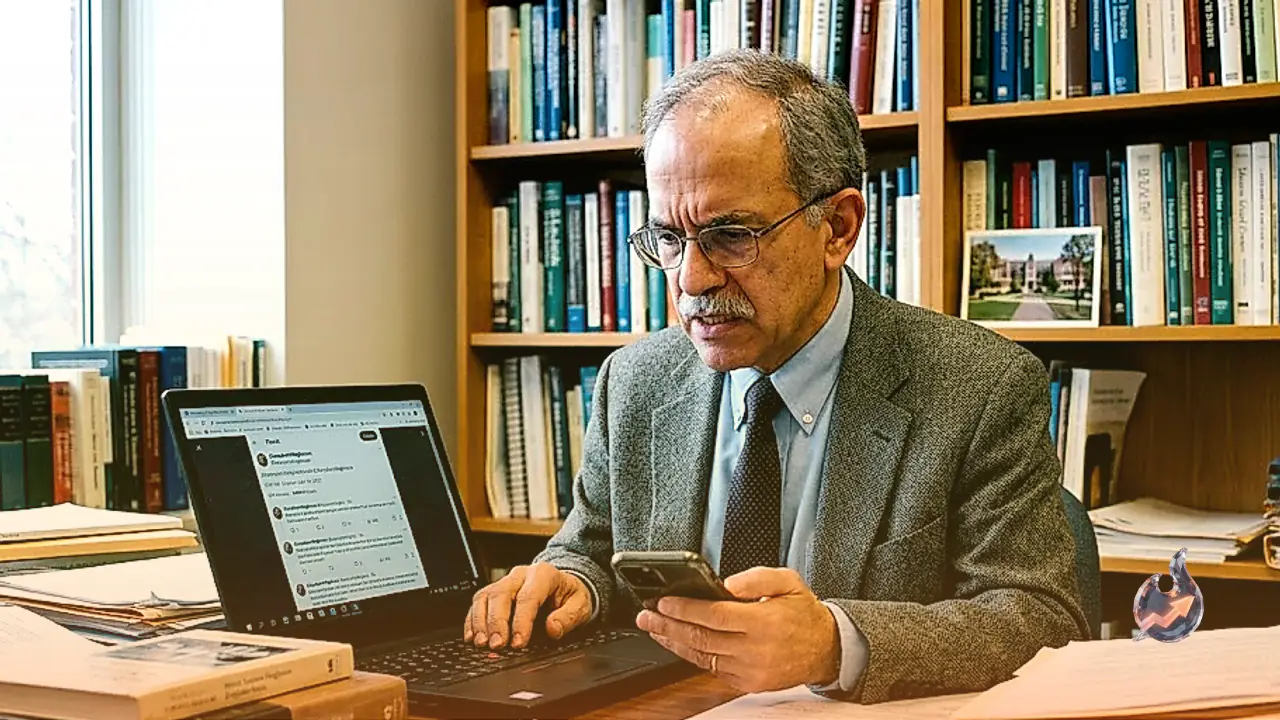

A deep ideological divide and intense public debate have gripped IIT Bombay in the aftermath of a student suicide, turning academic disagreements into a fierce social media battleground. Following the tragedy, Professor Suryakant Waghmore from the Department of Sociology found himself at the receiving end of aggressive online abuse. Hostile social media accounts launched targeted attacks against him, going so far as to label him a 'Naxalite' simply because of his public stand on the incident. While scholars and professionals facing such online harassment typically issue formal statements or pursue legal recourse, Professor Waghmore chose an unprecedented technological route to dismantle the smears.
Rather than engaging in a prolonged war of words or petitioning external authorities, he directly prompted the artificial intelligence chatbot Grok on X to address his critics. The automated system rapidly retrieved and presented his verified academic trajectory, neutralizing the baseless slurs with public facts and providing a modern blueprint for handling coordinated online hostility in the digital era.
AI Chatbot Steps In with Academic Facts
As the coordinated attacks mounted on social media, with multiple users aggressively questioning why a sociology professor even belonged at a premier engineering institution, Professor Waghmore tagged the chatbot Grok with a direct query. He stated his identity as a sociology professor, noted that a crowd was baselessly accusing him of being a Naxalite and questioning his place at a technical institute, and asked the bot if it could deliver a suitable answer to them.
The AI system immediately generated a comprehensive rebuttal, clarifying unequivocally that Professor Waghmore has no association whatsoever with Naxalite activities or violent political organizations. The response framed such accusations as common political rhetoric deployed to discredit and silence independent academic voices whose perspectives differ from the mainstream. Furthermore, the chatbot articulated why disciplines like sociology, philosophy, and human values are indispensable components of rigorous engineering institutions, emphasizing that comprehensive technical education requires an understanding of societal impact.
Verification of Research Credentials and Academic Work
When bad-faith critics escalated the harassment by attempting to cast doubt on Professor Waghmore's academic integrity and research citations, the digital system once again provided instant substantiation. It laid out a documented list of his authored books, publications in reputable peer-reviewed international journals, and his longstanding scholarly contributions to social science. Confronted with this irrefutable documentation, Professor Waghmore succinctly posted the phrase 'done... dusted,' a remark that quickly gained traction across the academic community as an elegant resolution to bad-faith online attacks.
The Core Catalyst: The September 18 Campus Incident
This entire dispute originated on September 18, when Sahil Wakode, a second-year BTech undergraduate at IIT Bombay, was found dead inside his hostel room after taking his own life. The tragic loss plunged the campus into grief and raised urgent questions regarding student welfare. Preliminary accounts indicated that earlier that day, Professor Suryanarayan Dulla had caught Sahil allegedly using ChatGPT during an examination, after which the distressed student took the fatal step within hours.
Sahil's grieving family lodged serious allegations against the institutional environment, asserting that the student had been subjected to systemic caste discrimination, ongoing humiliation, and unrelenting mental stress over several months. Acting on the family's formal complaint, local police registered a First Information Report against Professor Dulla under relevant sections of the Bharatiya Nyaya Sanhita and the Scheduled Castes and the Scheduled Tribes (Prevention of Atrocities) Act. Amid mounting scrutiny, the IIT Bombay administration placed Professor Dulla on immediate leave and constituted an independent high-level committee to conduct an exhaustive investigation.
Fractured Opinions Across Premier Engineering Campuses
The institutional crisis deepened when the IIT Bombay Faculty Forum released a collective defense backing Professor Suryanarayan Dulla. The forum contended that the faculty member was merely discharging standard examination protocols and duties, arguing that social media outrage was unfairly prejudicing the narrative. A fraction of academic staff from other prominent engineering colleges, including IIT Delhi and IIT Madras, also echoed similar sentiments in support of the accused professor.
However, Professor Suryakant Waghmore took a principled and vocal stand against his own colleagues' joint defense. Writing on social media, he argued that an internal faculty forum possesses neither judicial standing nor the legal authority to pass judgment, warning that collective declarations risk putting undue pressure on the inquiry committee. He emphasized that the forum's stance did not represent a universal consensus among the faculty, an outspoken divergence of views that subsequently triggered the wave of personal abuse directed at him.